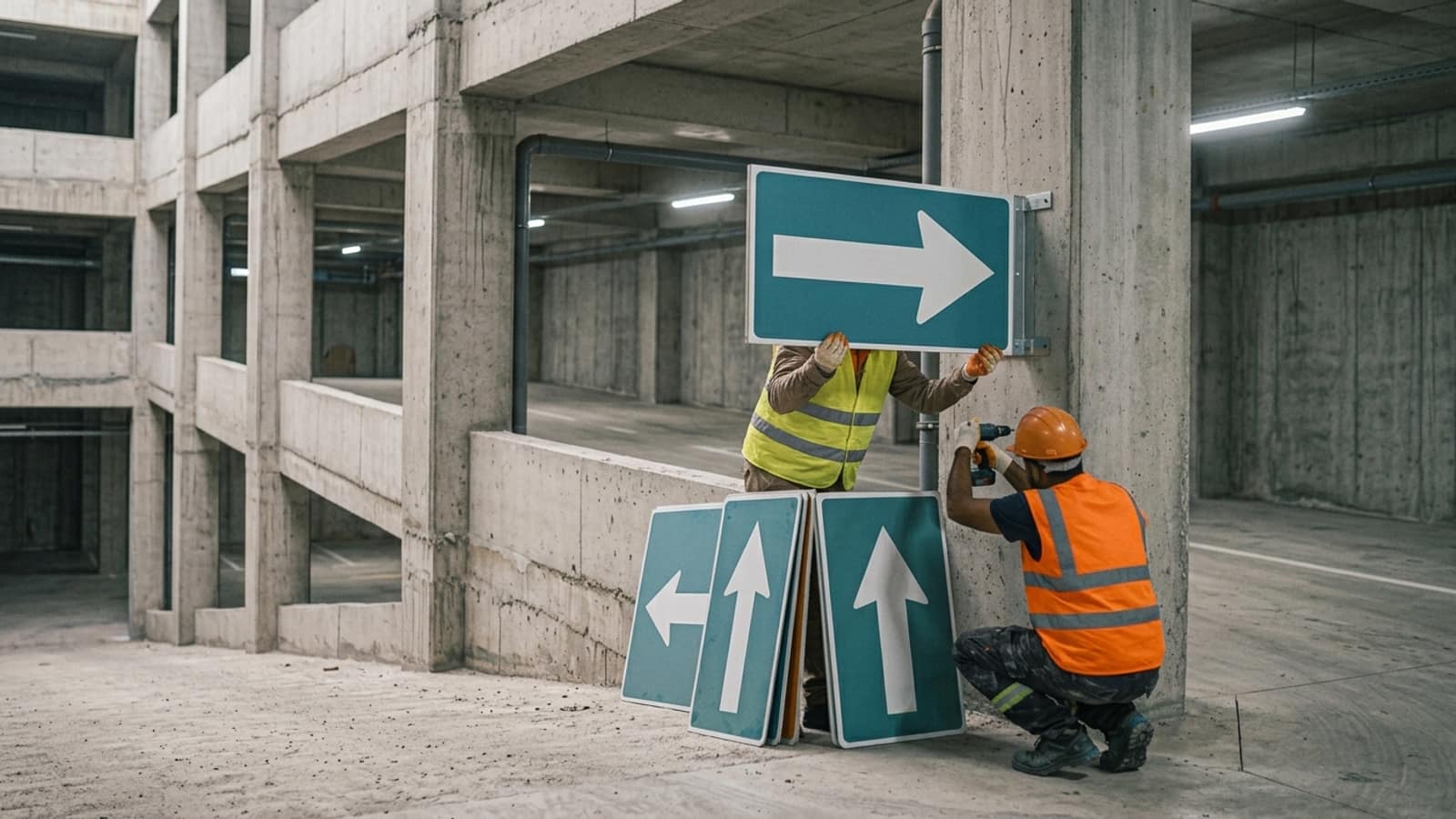
Wayfinding and signage are functional tools used in car parks, business centres, industrial facilities and public areas to establish order, direct traffic and provide information. By giving correct direction, these signs reduce the risk of accidents, improve efficiency and make the space easier to use.
Produced from durable materials, the signs offer long-lasting use. Suitable for both indoor and outdoor use, wayfinding signs are resistant to UV, moisture and other environmental effects. They are an indispensable solution particularly for directing traffic and marking pedestrian routes and emergency escape points.
 Order and Safety: Regulates traffic and improves the safety of both pedestrians and vehicles. Information: Provides users with clear information so that they can use the space more easily. Durability: Shows high resistance to environmental effects. Attractive and Professional Appearance: Adds an orderly, professional look to spaces. Easy Installation: Can be installed quickly and easily. Traffic Signs: Vehicle direction and speed limit signs in car parks. Pedestrian Route Signs: Signs marking pedestrian crossings and routes. Information Signs: Informative signs such as emergency exits, parking areas and office directions. Warning Signs: Signs bearing caution, hazard or prohibition symbols. Planning and Design: Signs are designed according to the requirements of the space. Production: The signs are produced using high-quality, durable materials. Installation: The signs are installed in the designated locations by expert teams. Inspection and Handover: The durability and accuracy of the signs are checked after installation.
With the use of quality materials and professional installation in wayfinding and signage services, Likit İzolasyon makes your spaces more orderly and functional. You can contact us for durable and attractive wayfinding solutions.
Section, aisle and rack wayfinding in factories and warehouses Visitor wayfinding systems in hospitals, shopping centres and campuses Car park level, block and exit wayfinding Emergency exit, assembly point and fire equipment signs Façade and on-site sign applicationsArrows and coloured lines applied to the floor direct visitors without their having to look up. In crowded environments and complex buildings such as hospitals, this can be more effective than signs. Two-component paints are preferred for durability.
These are produced by digital printing or cut vinyl on aluminium composite, acrylic or sheet metal. Placing them at decision points (junctions, in front of lifts, at the head of stairs) determines how well the system works.
On emergency escape routes and in low-light areas, materials that reflect light or glow in the dark are used. This keeps the escape route legible even during a power failure.
1. Wayfinding plan: Visitor and employee flows are mapped and decision points are identified. It is planned which information will be given where. 2. Information hierarchy: Primary wayfinding, secondary wayfinding and identification signs are distinguished. Giving too much information is as confusing as giving too little. 3. Design and legibility: The text size is determined by the reading distance; the contrast ratio and the typeface directly affect legibility. 4. Production: Materials are selected according to the environment; UV-resistant vinyl and a corrosion-resistant carrier are used outdoors. 5. Installation: The signs are installed taking eye level and viewing angle into account; floor applications are sealed with a protective top coat. Emergency exit and fire safety signs must comply with the shape, colour and size requirements in the relevant legislation. There is a direct relationship between letter height and reading distance; this calculation must be made for signs that need to be read from a distance. Designs with low colour contrast create an accessibility problem for users with impaired vision. If UV-resistant vinyl is not used in outdoor applications, the colours fade markedly within a few years.The two complement each other. In crowded, complex environments floor wayfinding is perceived faster because people are already looking ahead of them. Information that needs to be seen from a distance, on the other hand, should be given with suspended or wall-mounted signs.
A sign is needed at every decision point; junctions, areas in front of lifts, the heads of stairs and corridor intersections are the critical points. In straight corridors requiring no decision, an unnecessary accumulation of signs weakens the information.
The reading distance is the determining factor. While a small point size is sufficient on door signs read from close up, the letter height must increase markedly on wayfinding signs that need to be read from the end of a corridor. The decision is made by measuring the distance at the design stage.
A coding system compatible with the warehouse management system in use should be chosen. A consistent, expandable system that follows an aisle-rack-bay logic directly improves both the speed of operations and the error rate.

Likit İzolasyon exceeded our expectations with their waterproofing and floor coating services. Thanks to their meticulous workmanship and on-time delivery, our building is now far safer and more durable.
During our building strengthening works we saw the difference of working with a professional team. With carbon fibre and concrete repair applications they gave our structure a new life. I would definitely recommend them!
We used their epoxy floor coating service and the result is incredible! We gained both an attractive appearance and a long-lasting, durable solution. I appreciate their professional approach.
We received terrace and foundation waterproofing services. With their polyurethane-based solutions in particular, they provided a permanent answer to water leaks. The team's professionalism and on-time delivery are truly commendable.
Concrete cracks and deterioration in our old building were causing serious problems. The Likit İzolasyon team made the structure safe again with concrete repair and protection. They kept us informed in detail at every stage of the process.
They did outstanding work on car park line marking and industrial painting projects. With thermoplastic paint they delivered a solution that is both attractive and long-lasting. The importance they place on occupational safety is a further plus!
We had epoxy and polyurethane floor coating applied in our factory. Our spaces gained both a durable and an attractive appearance. They are also very easy to clean. Thank you to the professional team!
We worked with Likit İzolasyon on building strengthening. Thanks to the carbon fibre application our structure became earthquake resistant. Their transparent and meticulous work from start to finish gave us confidence.
The concrete crack repair service completely solved the problems in our old building. Even the finest details were attended to during the work. We now have a structure we can use safely for many years.