
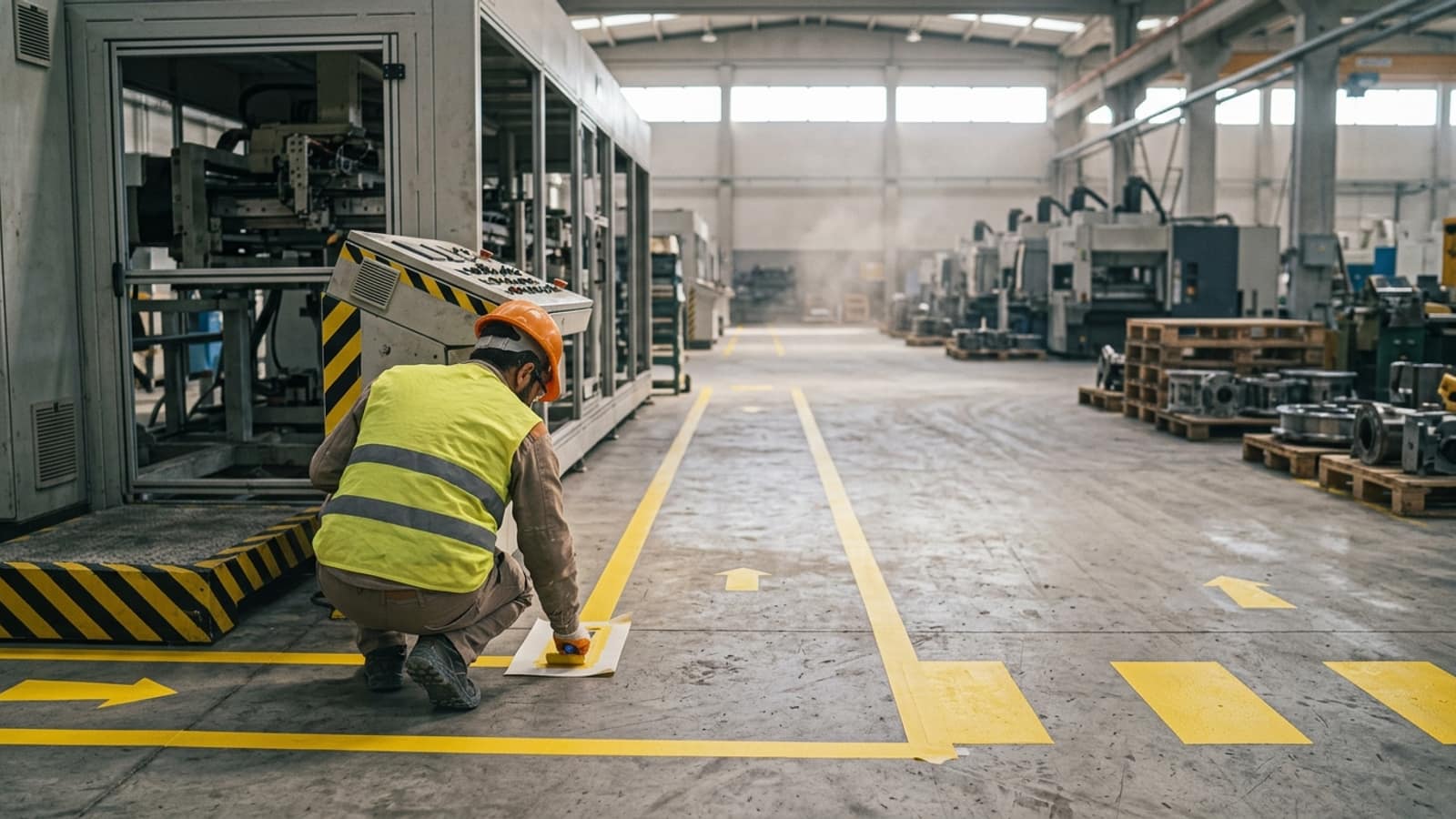
Occupational safety signs and markings are important measures used to meet occupational health and safety standards in working areas, to improve the safety of employees and to prevent accidents. These signs provide warning, direction and information through easily understood symbols and wording.
Occupational safety signs and markings are used in production facilities, warehouses, construction sites, offices and public areas. They offer a wide range of solutions, such as warning boards indicating hazards, symbols marking prohibitions, and directional signs showing emergency exits and safe areas.
 Provides Safety: Warns employees and visitors about potential hazards. Legal Compliance: Prepared in accordance with occupational health and safety legislation. Easily Understood: Provides effective communication through clear symbols and wording. Durability: Produced from materials resistant to UV, moisture and wear. Fast Installation: Can be installed quickly in working areas and used immediately. Warning Signs: Indicate hazardous zones and areas of risk. Prohibition Signs: Show areas where entry or certain activities are prohibited. Emergency Signs: Mark escape routes, firefighting equipment and safe zones. Information Signs: Remind people of the rules and the equipment required in the working area. Area Analysis: Determining the appropriate signs according to occupational safety requirements. Design and Production: Preparing the signs in accordance with legal standards. Installation: Fitting the signs correctly in the designated locations. Inspection and Audit: Checking whether the signs are working as intended.
Likit İzolasyon offers professional services in the field of occupational safety signs and markings. Produced from high-quality materials, our solutions make your working areas safer and more orderly.
Separating pedestrian routes and forklift routes in production facilities Safety zones around machinery and hatching of hazard areas Markings for emergency escape routes, assembly points and in front of fire equipment Pallet layout boundaries and stock zones in warehouse areas Warning bands at ramps, stairs and changes of levelPedestrian routes, vehicle routes, hazard zones and storage areas are distinguished by different colours. A consistent colour code allows an employee to read the area correctly even on their first day at the facility. The colours must carry the same meaning throughout the facility.
Yellow-and-black or red-and-white hatched patterns indicate areas that must not be crossed or that require caution. They are used in front of fire cabinets, electrical panels and emergency exits so that access is not blocked.
Warnings such as the requirement for personal protective equipment, forklift crossings and high voltage are applied to the floor or wall by stencil. The use of pictograms makes them understandable regardless of language.
1. Risk assessment and plan: The facility's flow diagram, crossing points and hazard zones are identified. The marking plan is drawn up together with the occupational safety specialist. 2. Establishing the colour code: The meanings of the colours to apply throughout the facility are agreed and documented. 3. Surface preparation: The floor is cleaned; oily and dusty surfaces are prepared mechanically. 4. Application: Band widths and hatching angles are applied in accordance with the plan. Anti-slip aggregate is added in areas where it is required. 5. Training and communication: The meaning of the new markings is communicated to employees; markings only protect once they are understood. The markings must comply with the safety and health signage requirements in occupational health and safety legislation. Colour codes must be consistent throughout the facility; the same colour carrying a different meaning in different sections increases risk. The points where pedestrian routes cross vehicle routes are the highest-risk zones; additional warning markings must be provided here. In areas requiring slip resistance, a check can be made with the TS EN 13036-4 pendulum test.It is strongly recommended in terms of occupational health and safety and is frequently looked for during inspections. Separating pedestrian routes physically or visually markedly reduces vehicle-pedestrian collisions, which are the most common type of accident within a facility.
In general practice, yellow is used for warning and boundaries, red for prohibition and fire equipment, green for safe areas and emergency exits, and blue for mandatory requirements. What matters is consistency throughout the facility; the code chosen should be set down in writing and communicated to employees.
On routes with heavy forklift traffic, wear is rapid. Two-component systems last far longer than single-component ones. Because a marking that has worn away or become illegible loses its protective function, periodic inspection is important.
Yes. By dividing the work into zones it can be carried out between shifts, at weekends or during planned shutdowns. By choosing a fast-drying system, the time the area is out of service can be reduced to a few hours.

Likit İzolasyon exceeded our expectations with their waterproofing and floor coating services. Thanks to their meticulous workmanship and on-time delivery, our building is now far safer and more durable.
During our building strengthening works we saw the difference of working with a professional team. With carbon fibre and concrete repair applications they gave our structure a new life. I would definitely recommend them!
We used their epoxy floor coating service and the result is incredible! We gained both an attractive appearance and a long-lasting, durable solution. I appreciate their professional approach.
We received terrace and foundation waterproofing services. With their polyurethane-based solutions in particular, they provided a permanent answer to water leaks. The team's professionalism and on-time delivery are truly commendable.
Concrete cracks and deterioration in our old building were causing serious problems. The Likit İzolasyon team made the structure safe again with concrete repair and protection. They kept us informed in detail at every stage of the process.
They did outstanding work on car park line marking and industrial painting projects. With thermoplastic paint they delivered a solution that is both attractive and long-lasting. The importance they place on occupational safety is a further plus!
We had epoxy and polyurethane floor coating applied in our factory. Our spaces gained both a durable and an attractive appearance. They are also very easy to clean. Thank you to the professional team!
We worked with Likit İzolasyon on building strengthening. Thanks to the carbon fibre application our structure became earthquake resistant. Their transparent and meticulous work from start to finish gave us confidence.
The concrete crack repair service completely solved the problems in our old building. Even the finest details were attended to during the work. We now have a structure we can use safely for many years.