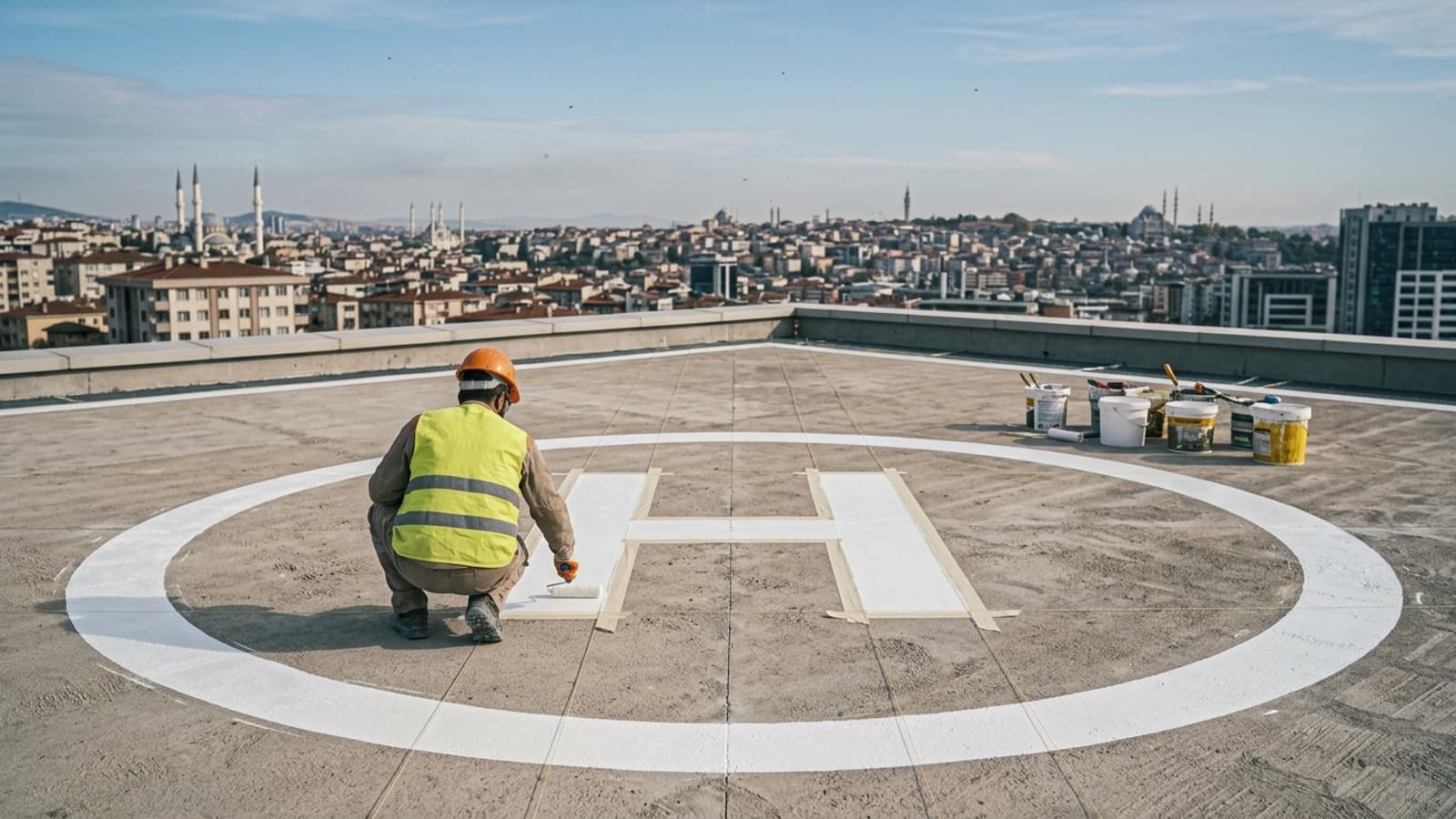
Helipad (heliport) markings and paint are applied to ensure that landing and take-off operations are carried out safely and in an orderly way. These markings guide helicopter pilots correctly during landing and take-off and are prepared in accordance with international aviation standards.
Heliport paints are produced from special materials that are resistant to demanding environmental conditions, long-lasting and highly visible. Offering brightness and clarity suited to night vision systems as well as daytime use, these paints provide an ideal solution in terms of both safety and appearance.
 Safety: Makes helicopter landing and take-off operations safe. International Standards: Applied in accordance with the standards laid down by the aviation authorities. Durability: Provides superior resistance to UV, wear and demanding weather conditions. High Visibility: Offers maximum visibility in both daytime and night-time conditions. Appearance and Order: Gives helipads an orderly and professional appearance. Hospital Helipads: Landing and take-off areas used for emergencies. Commercial and Industrial Pads: Companies' private heliport areas. Airports: Marking of helicopter landing and take-off areas. Yachts and Ships: Helipad markings on marine vessels. Planning and Design: The markings are designed according to the dimensions of the heliport area and the requirements of use. Surface Preparation: The surface to be marked is cleaned and levelled. Paint Application: The markings are applied with durable, highly visible heliport paints. Inspection and Testing: The durability of the markings and their compliance with the standards are checked.
Likit İzolasyon offers durable, high-quality solutions in compliance with international standards in helipad marking and painting services. Make use of our professional services for safe and orderly helipads.
Hospital heliports — emergency medical evacuation areas Heliport platforms on the roofs of high-rise buildings Landing areas at hotels, business centres and public buildings Emergency heliports at industrial facilities and power plants Offshore platform and port heliport areasHeliport marking includes the perimeter marking of the landing area, the touchdown and lift-off area marking, the identification marking (a white H on a red background at hospital heliports) and the maximum mass and D-value information. The dimensions and positions of these markings are determined according to the requirements of the aviation authority.
Heliport surfaces are exposed to rotor downwash, exhaust heat, contact with fuel and continuous UV. For this reason, high-performance two-component polyurethane or epoxy-based systems are used.
Slip resistance on a heliport surface is a safety requirement. Aggregate is added to the paint system to provide a safe friction value even in wet conditions. A balance is struck between slip resistance and ease of cleaning.
1. Regulatory and design check: The requirements of the relevant aviation authority and the approved heliport design are examined. The dimensions and positions of the markings are determined accordingly. 2. Surface preparation: The platform surface is prepared by grinding or blasting; oil and residues of old paint are removed. 3. Primer and base coat: A suitable primer is applied and, if required, the base colour (for example the red area for the identification marking) is formed. 4. Marking application: The H marking, perimeter line, D-value and mass information are applied using stencils. The dimensions are checked again. 5. Slip resistance and inspection: Aggregate is applied, the top coat is laid, and the surface is checked before handover. The dimensional, colour and position requirements for heliport markings are subject to international civil aviation rules and the regulations of the national authority; the approved design must be taken as the basis before the work. Rotor downwash puts stress on the paint edges; systems with weak edge adhesion lift within a short time. Slip resistance is critical for safety and can be verified by the TS EN 13036-4 pendulum test. On roof heliports, the weight of the system applied and its compatibility with the waterproofing must also be assessed.The type and meaning of the markings are standardised by international rules, but the dimensions are calculated according to the heliport's D-value and the platform dimensions. For this reason each heliport is worked on from an approved design; arbitrary application is not accepted.
A white H on a red background makes it quickly distinguishable from the air that the heliport is for medical use. This colour code is an internationally accepted identification marking and allows the pilot to select the correct area in an emergency.
Because of rotor downwash, UV and contact with fuel, heliport paints deteriorate faster than ordinary floor paints. Regular visual inspection should be carried out and renewal planned when colour fading or a loss of slip resistance is observed.
To avoid this, the system to be applied must be compatible with the existing waterproofing. If the paint system is to be applied directly over the membrane, a compatibility test must be carried out and an intermediate protective layer devised if necessary.

Likit İzolasyon exceeded our expectations with their waterproofing and floor coating services. Thanks to their meticulous workmanship and on-time delivery, our building is now far safer and more durable.
During our building strengthening works we saw the difference of working with a professional team. With carbon fibre and concrete repair applications they gave our structure a new life. I would definitely recommend them!
We used their epoxy floor coating service and the result is incredible! We gained both an attractive appearance and a long-lasting, durable solution. I appreciate their professional approach.
We received terrace and foundation waterproofing services. With their polyurethane-based solutions in particular, they provided a permanent answer to water leaks. The team's professionalism and on-time delivery are truly commendable.
Concrete cracks and deterioration in our old building were causing serious problems. The Likit İzolasyon team made the structure safe again with concrete repair and protection. They kept us informed in detail at every stage of the process.
They did outstanding work on car park line marking and industrial painting projects. With thermoplastic paint they delivered a solution that is both attractive and long-lasting. The importance they place on occupational safety is a further plus!
We had epoxy and polyurethane floor coating applied in our factory. Our spaces gained both a durable and an attractive appearance. They are also very easy to clean. Thank you to the professional team!
We worked with Likit İzolasyon on building strengthening. Thanks to the carbon fibre application our structure became earthquake resistant. Their transparent and meticulous work from start to finish gave us confidence.
The concrete crack repair service completely solved the problems in our old building. Even the finest details were attended to during the work. We now have a structure we can use safely for many years.