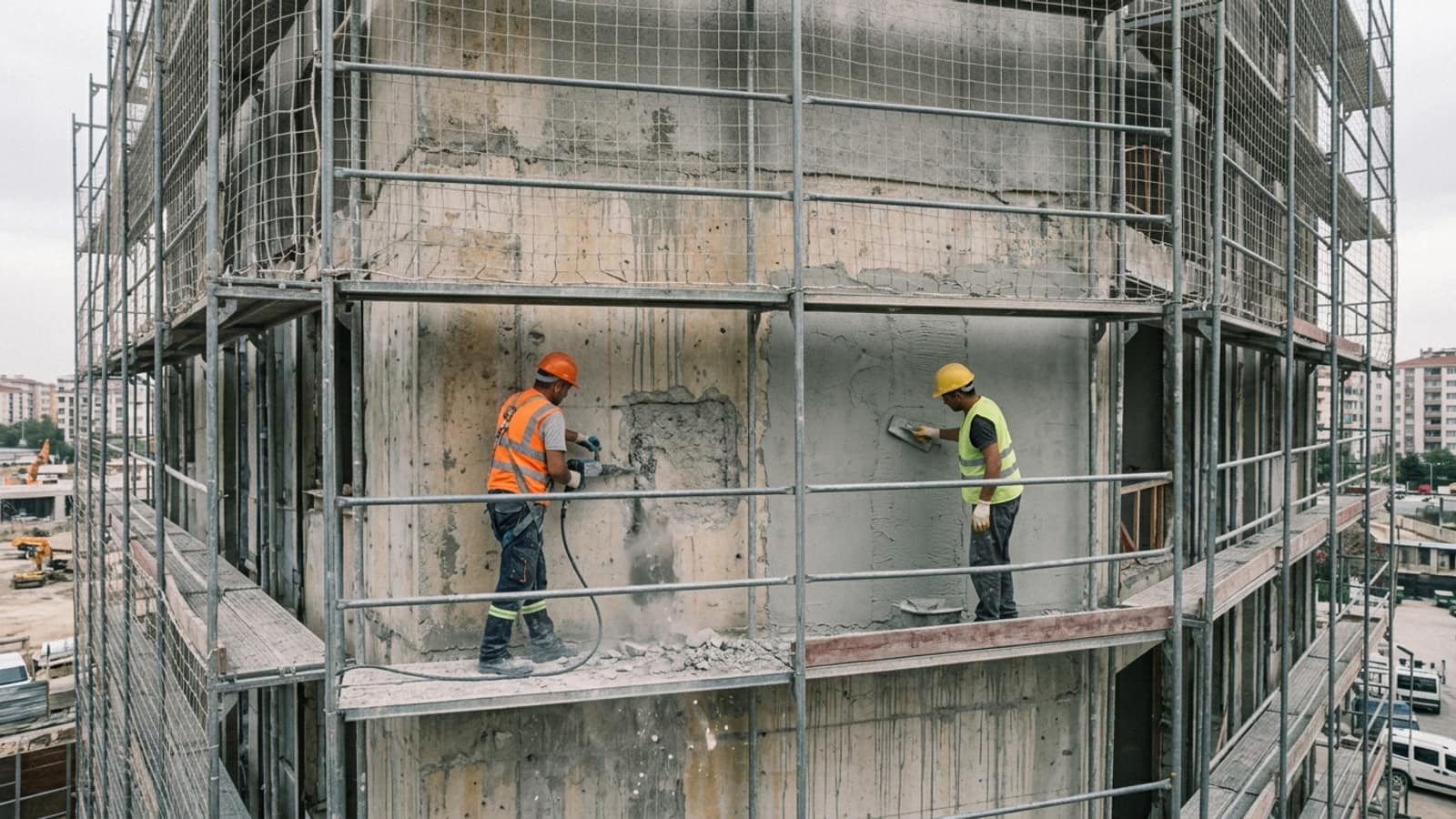
Reinforced concrete structures can suffer damage over time from environmental factors, conditions of use and natural processes. Even in the highest-quality construction, cracks, wear and other deformations can occur on concrete surfaces. Regular maintenance and repair of concrete surfaces is therefore vital to preserving the durability and appearance of structures.
Cracks forming on reinforced concrete surfaces allow air and water to enter and can cause the steel reinforcement within the concrete to corrode. Corroded reinforcement, together with the effects of freezing and thawing, causes serious damage to surfaces and an unsightly appearance. Concrete maintenance and repair works eliminate such problems, extending the life of structures and increasing their durability.
 Damage Assessment: Cracks, wear and other deformations on the concrete surfaces are analysed. Selecting the Right Method: The most suitable repair and protection method is chosen according to the needs of the structure. Repair and Restoration: Concrete surfaces are repaired with professional materials and techniques. Protection: After repair, additional protective materials are used to give the structure a long service life. Structural Safety: Eliminates the risks caused by damage and preserves the load capacity of the structure. Corrosion Prevention: Prevents corrosion that may develop in the steel reinforcement because of cracks. Attractive Appearance: Increases the aesthetic value of the structure by making good deformations on concrete surfaces. Long-Lasting Protection: Makes structures more resistant to environmental and mechanical effects. An Economical Solution: Offers an economical repair option instead of demolishing the structure or carrying out major restoration.
With quality materials and an expert team, Likit İzolasyon gives your structures durability and an attractive finish in concrete maintenance and repair applications. Contact us to give your structures a long service life with our professional solutions.
Areas of reinforced concrete columns, beams and shear walls showing cover spalling and reinforcement corrosion Car park decks and ramps — surfaces where salt, water and traffic loads act together Bridges, viaducts and retaining walls — structures subject to carbonation and freeze-thaw effects Water tanks, treatment plants and channel structures — concrete in permanent contact with water and chemicals Floors and walls in industrial facilities exposed to acids, oils and process chemicals Coastal structures and jetties — concrete at risk of corrosion accelerated by chlorides Breakage and corner damage occurring in precast elements during transport and installationCarbonated and loosened concrete is cleaned away right to the back of the reinforcement. The reinforcement is freed of rust and coated with a corrosion inhibitor. The section is then rebuilt with a shrinkage-compensated, polymer-modified repair mortar. In selecting the mortar, compatibility of the modulus of elasticity with the existing concrete is taken into account.
Static cracks are injected with low-viscosity epoxy resin to restore the integrity of the section. For moving cracks or those with water ingress, elastic polyurethane resin is preferred. Crack width, depth and movement determine the choice of product.
Protective coatings that slow carbonation and chloride ingress are applied. Systems with high carbon dioxide impermeability that retain water vapour permeability are preferred, so the concrete continues to breathe while harmful gases are kept out.
Silane/siloxane-based impregnation products make the capillary pores of the concrete water-repellent. They reduce water and chloride absorption without changing the appearance; they form an effective protective layer on structures exposed to salt, such as bridges and car parks.
In expansion and construction joints, elastic sealants preserve the capacity for movement while preventing the passage of water. Joint width, expected movement and chemical exposure determine the type of sealant.
1. Damage assessment: The type and extent of the damage are determined by visual inspection, hammer tapping to detect hollow areas, measurement of carbonation depth and cover scanning. 2. Identifying the cause: The source of the damage (carbonation, chlorides, freeze-thaw, chemical attack, structural overloading) is established. A repair carried out without removing the cause will not last. 3. Preparation: Deteriorated concrete is removed with a hydraulic breaker, water jet or milling. Sound concrete is reached and a rough, open-pored surface is obtained. 4. Reinforcement works: The reinforcement is cleaned; if section loss exceeds a certain proportion, additional reinforcement is added. A corrosion-inhibiting primer is applied. 5. Application of the repair mortar: The surface is brought to a saturated surface-dry condition, a bonding bridge is applied and the repair mortar is placed in accordance with the specified layer thicknesses. 6. Curing and protection: The mortar is cured so as to prevent early loss of water. The concrete is then given long-term protection with a surface protection coating or hydrophobic impregnation. Products, test methods and conformity criteria for the protection and repair of concrete structures are defined in the TS EN 1504 series. Structural repair mortars are divided into classes R1-R4 within the scope of TS EN 1504-3 ; class R3/R4 is generally required for load-bearing members. Surface protection systems fall within TS EN 1504-2, injection products within TS EN 1504-5, and reinforcement corrosion protection within TS EN 1504-7 . The adhesion of the repair mortar is verified by the TS EN 1542 pull-off test. The modulus of elasticity of the repair mortar must be compatible with the existing concrete; a mortar that is too rigid can separate at the edges because of stress accumulation. Curing is the step most often neglected in concrete repair. Inadequate curing shows itself as shrinkage cracks and low strength.No. Fine surface cracks caused by shrinkage usually pose no structural risk. However, cracks that run along the line of the reinforcement, that appear together with rust staining, or that widen over time can be a sign of corrosion and loss of load capacity. The direction, width and development of the crack must be assessed.
Yes, if the section loss is limited. The rusted reinforcement is cleaned and protected with a corrosion inhibitor, and the section is rebuilt with repair mortar. If section loss is significant, additional reinforcement is added or strengthening is required. The decision is taken by measuring the remaining section area.
This depends on exposure conditions. Coatings exposed outdoors to UV and traffic should be inspected every few years and worn areas renewed. Because the effect of hydrophobic impregnations diminishes over time, periodic reapplication is recommended.
No. Visible spalling is usually the result of corrosion progressing inside. Corroding reinforcement expands in volume and stresses the concrete from within; covering it does not stop this process, only conceals it, and the damage reappears over a larger area.
With the correct class of mortar and proper application, the repaired area reaches a strength that allows it to act together with the surrounding concrete. However, the aim is not strength alone but extending service life by removing the cause of the damage; repair and protection are therefore designed together.

Likit İzolasyon exceeded our expectations with their waterproofing and floor coating services. Thanks to their meticulous workmanship and on-time delivery, our building is now far safer and more durable.
During our building strengthening works we saw the difference of working with a professional team. With carbon fibre and concrete repair applications they gave our structure a new life. I would definitely recommend them!
We used their epoxy floor coating service and the result is incredible! We gained both an attractive appearance and a long-lasting, durable solution. I appreciate their professional approach.
We received terrace and foundation waterproofing services. With their polyurethane-based solutions in particular, they provided a permanent answer to water leaks. The team's professionalism and on-time delivery are truly commendable.
Concrete cracks and deterioration in our old building were causing serious problems. The Likit İzolasyon team made the structure safe again with concrete repair and protection. They kept us informed in detail at every stage of the process.
They did outstanding work on car park line marking and industrial painting projects. With thermoplastic paint they delivered a solution that is both attractive and long-lasting. The importance they place on occupational safety is a further plus!
We had epoxy and polyurethane floor coating applied in our factory. Our spaces gained both a durable and an attractive appearance. They are also very easy to clean. Thank you to the professional team!
We worked with Likit İzolasyon on building strengthening. Thanks to the carbon fibre application our structure became earthquake resistant. Their transparent and meticulous work from start to finish gave us confidence.
The concrete crack repair service completely solved the problems in our old building. Even the finest details were attended to during the work. We now have a structure we can use safely for many years.