Water is one of the most significant environmental factors that damage structures. Water penetrating a building causes concrete to crack and deteriorate over time, and corrodes the reinforcement in load-bearing systems, reducing their load capacity. This seriously jeopardises the durability and service life of the structure.
Structures are constantly exposed to external water (rain, snow, soil moisture, groundwater) and internal water (from wet areas such as bathrooms and washbasins). These effects harm not only structural durability but also the comfort and health of living spaces.
With the right design and application it is possible to eliminate these adverse effects of water. The work carried out on the building envelope to protect structures against water and damp from every direction is called "waterproofing". Our company carries out this work to the highest standards, providing long-lasting protection for your structures.
 Protecting the load-bearing systems of the structure and extending its service life Preventing health problems caused by damp and moisture Creating comfortable and healthy living spaces Reducing financial losses and repair costs
With more than 25 years of experience in waterproofing, an expert team and a commitment to quality materials, our company offers tailored solutions for every structural requirement. You can take advantage of our waterproofing services to protect your structures and carry them safely into the future.
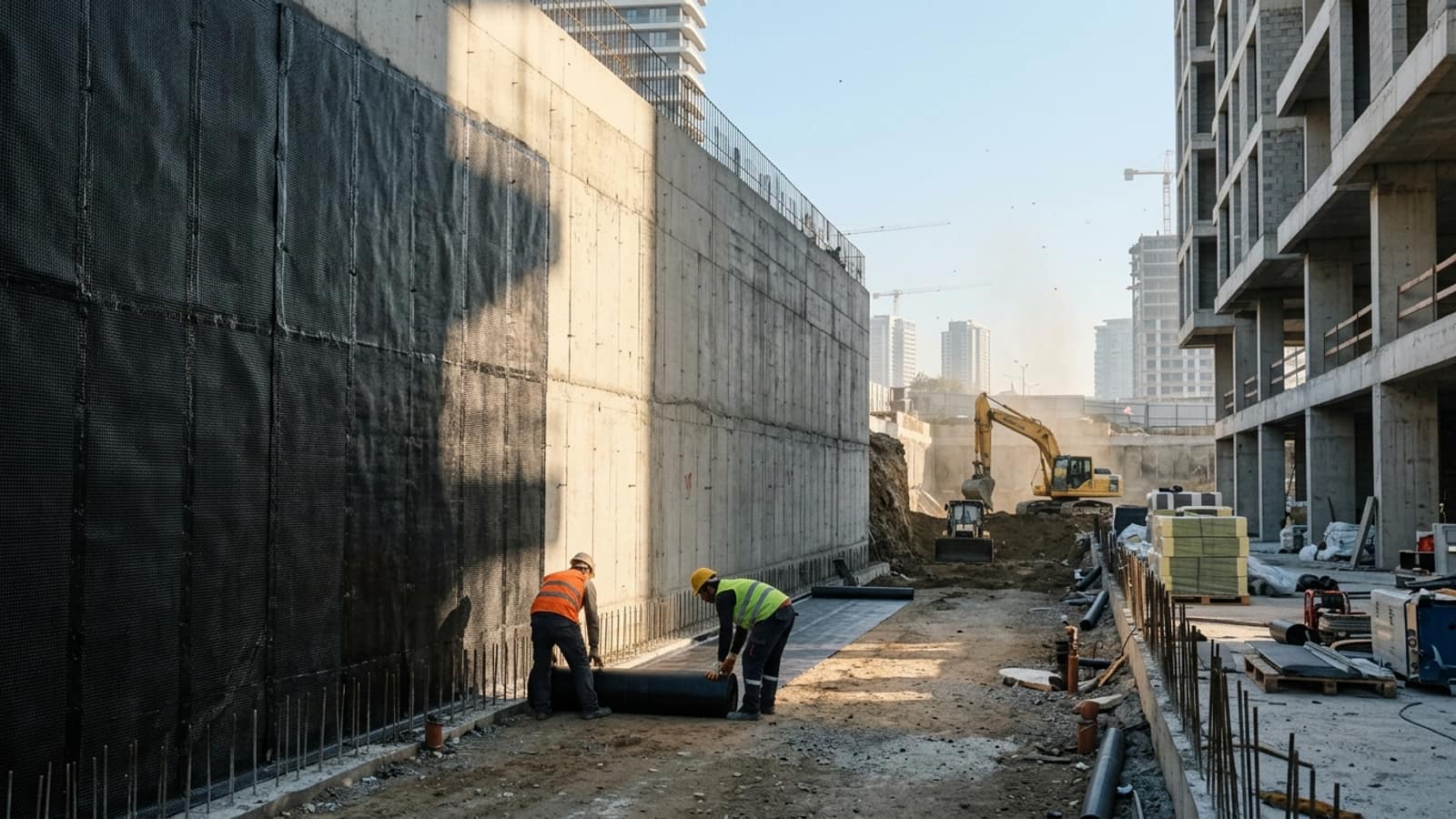
Building foundations, retaining walls and basements — on surfaces in contact with soil, against negative and positive water pressure Terraces, roofs and balconies — upper coverings exposed to rain, snow and freeze-thaw cycles Wet areas — bathroom, shower, kitchen and WC floors together with skirting zones Water tanks, swimming pools and treatment structures — reservoirs in permanent contact with water Car park and garage decks — upper levels subject to vehicle traffic and salt/chemical exposure Retaining walls, tunnels and underpasses — engineering structures exposed to groundwater pressure Industrial facilities and warehouses — against process water, wash water and chemical spillagePolymer-bitumen sheets are applied by torching (flame) or cold bonding. With their high impermeability and mechanical strength they are widely used beneath foundations and on retaining walls and terraces. APP-modified sheets provide high-temperature resistance, while SBS-modified sheets remain flexible at low temperatures. Membrane thickness, carrier reinforcement and overlap width are determined according to the project.
Composed of cement, selected aggregate and active chemicals, these products are applied to the concrete surface by brush, trowel or spray. They penetrate the capillary pores of the concrete, form a crystalline structure and block the passage of water. They are preferred in areas subject to negative-side water pressure such as water tanks, swimming pools and wet areas; products in contact with drinking water are additionally certified.
These systems are applied in liquid form and cure in place to create a seamless (jointless) layer. They offer a major advantage on surfaces with complex geometry and on terraces with numerous details and protrusions. Polyurethane provides high elasticity and crack-bridging capability, while polyurea cures within seconds, allowing rapid return to service.
Factory-produced sheets of uniform thickness are joined by hot-air welding to form a monolithic covering. They can be applied as mechanically fixed, ballasted or fully adhered systems. They stand out in industrial buildings thanks to fast application over large roof areas, UV resistance and long service life.
Bentonite panels swell on contact with water and become self-sealing; they are used in areas that cannot be reached afterwards, such as beneath foundations and at pile heads. The injection method is preferred for tackling active water leaks in existing structures; polyurethane or acrylic resin is fed into the crack under pressure.
1. Survey and diagnosis: The structure is inspected and the water source (rainwater, groundwater, plumbing leak) and the direction of water ingress are identified. Where necessary, moisture readings and thermal imaging are used to locate the leak. 2. System selection and detailing: The material system is determined according to the direction of water pressure, the service load, the temperature range and the type of finishing layer. Solutions are designed for critical details such as corners, joints, drains and pipe penetrations. 3. Surface preparation: The surface is cleared of dust, oil, mortar residue and loose particles. Where necessary, milling, grinding or high-pressure water cleaning is carried out. Cracks and voids are filled with repair mortar and coving is formed at internal corners. 4. Priming: A primer suited to the selected system is applied to balance surface absorbency and increase bond strength. The primer's drying time is observed. 5. Application of the waterproofing layer: The membrane is laid, or the liquid system is applied coat by coat. Overlap widths, coat thicknesses and waiting times between coats are checked against the manufacturer's data. Reinforcement fleece is used in detail areas. 6. Testing and protection: A water-holding test is carried out in suitable sections. The approved surface is protected against mechanical damage with a protection board, drainage sheet or screed, and then handed over. Bituminous waterproofing sheets are classified according to TS EN 13707 (roofing) and TS EN 13969 (foundation/damp barrier) standards. For liquid membranes used in wet areas beneath ceramic tiling, compliance with TS EN 14891 is required. Products and systems for the protection and repair of concrete surfaces are assessed within the scope of the TS EN 1504 series. Bond strength can be verified on site by the TS EN 1542 pull-off test. Keeping the surface temperature at least 3 °C above the dew point during application prevents adhesion problems caused by condensation. Waterproofing alone is not enough; correct falls, adequate drainage and a functioning rainwater outlet are integral parts of the system.Waterproofing aims to prevent water and moisture from entering the structure, whereas thermal insulation reduces heat loss. Although they serve different functions, they are usually designed together. On inverted terrace roofs, for example, the thermal insulation board is placed above the waterproofing layer, so the membrane is protected from both UV and temperature fluctuations.
Yes. On terraces, balconies and in wet areas the existing finish can be removed and a new system applied. In areas that cannot be reached from outside, such as basements and foundations, negative-side cementitious systems or the injection method are used. In this case the direction and flow rate of the incoming water must first be established.
Service life varies with material quality, correctness of application, and UV and mechanical loads. Protected foundation waterproofing can last close to the life of the building, whereas upper coverings directly exposed to the sun require periodic maintenance. An annual visual inspection and cleaning of drains extends service life significantly.
Not always. The source of the damp may be external water ingress, but it may equally be a plumbing leak, inadequate ventilation or condensation. The source must be identified before the correct solution can be chosen; otherwise the waterproofing will not solve the problem, only conceal it.
The vast majority of failures begin not on open surfaces but at details: internal and external corners, drain outlets, pipe penetrations, movement joints and wall-to-floor junctions. In these areas it is critical to form coving, to use reinforcement fleece and to carry the waterproofing sufficiently far above the water level.

Likit İzolasyon exceeded our expectations with their waterproofing and floor coating services. Thanks to their meticulous workmanship and on-time delivery, our building is now far safer and more durable.
During our building strengthening works we saw the difference of working with a professional team. With carbon fibre and concrete repair applications they gave our structure a new life. I would definitely recommend them!
We used their epoxy floor coating service and the result is incredible! We gained both an attractive appearance and a long-lasting, durable solution. I appreciate their professional approach.
We received terrace and foundation waterproofing services. With their polyurethane-based solutions in particular, they provided a permanent answer to water leaks. The team's professionalism and on-time delivery are truly commendable.
Concrete cracks and deterioration in our old building were causing serious problems. The Likit İzolasyon team made the structure safe again with concrete repair and protection. They kept us informed in detail at every stage of the process.
They did outstanding work on car park line marking and industrial painting projects. With thermoplastic paint they delivered a solution that is both attractive and long-lasting. The importance they place on occupational safety is a further plus!
We had epoxy and polyurethane floor coating applied in our factory. Our spaces gained both a durable and an attractive appearance. They are also very easy to clean. Thank you to the professional team!
We worked with Likit İzolasyon on building strengthening. Thanks to the carbon fibre application our structure became earthquake resistant. Their transparent and meticulous work from start to finish gave us confidence.
The concrete crack repair service completely solved the problems in our old building. Even the finest details were attended to during the work. We now have a structure we can use safely for many years.