
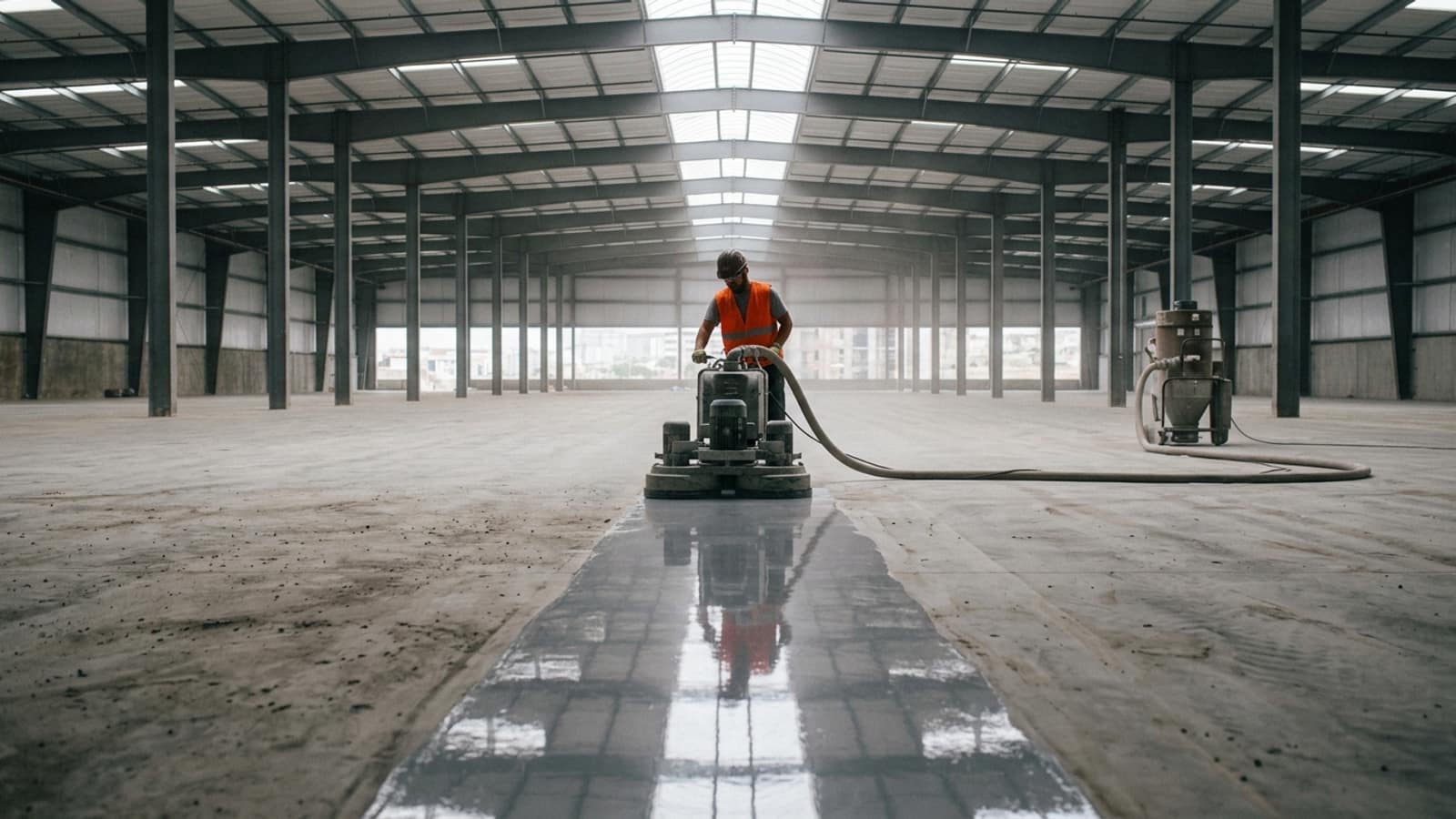
Floor polishing and dust-proofing are modern solutions applied to increase the durability of concrete floors and to give them an attractive appearance. These applications harden the surface of the floor, prevent the formation of dust and provide a glossy, smooth surface. They are preferred particularly in industrial facilities, warehouses, car parks and commercial spaces.
While floor polishing removes small cracks and defects in the surface, dust-proofing makes the floor more resistant to wear and to chemicals. With their low maintenance requirements and long-lasting performance, these methods increase the value of buildings.
 Glossy, Attractive Appearance: Gives the floor a decorative sheen. Prevents the Formation of Dust: Provides a cleaner and more hygienic environment. Durability: Protects the floor surface against wear, impact and chemicals. Low Maintenance Requirement: Offers a long-lasting surface that is easy to clean. Economical Solution: Offers a cost-effective solution with high durability and low maintenance costs. Surface Preparation: Cleaning the floor and making good the defects in the surface. Polishing: Polishing the surface with special machines and diamond discs. Dust-Proofing Application: Achieving dust-proofing by applying a chemical hardener to the floor. Final Inspection and Cleaning: The durability and appearance of the floor are checked after the work.
With its expert staff and the use of quality materials, Likit İzolasyon brings both good looks and durability to your buildings in floor polishing and dust-proofing applications. Contact us to give your floor a long life with our professional solutions.
Large concrete slabs in warehouses and logistics centres Areas in production facilities where dusting must be prevented A glossy decorative concrete appearance in showrooms, shops and commercial spaces Economical surface improvement in car parks and plant rooms Projects where the existing concrete is to be improved without applying a coatingThe concrete surface is abraded with diamond segments moving from coarse to fine grits. Each stage removes the marks left by the previous one. Skipping a stage shows itself in the end as lines that cannot be removed; it is therefore a patient process.
This reacts with the free lime in the concrete to densify the surface and permanently stop dusting. Because it does not form a film like a coating, there is no risk of peeling; the concrete itself is hardened.
After hardening, the desired level of gloss is reached with fine-grit stages. An impregnation is applied to the surface for stain resistance; this layer does not prevent the concrete from breathing.
1. Concrete assessment: The strength of the concrete, the distribution of the aggregate and the condition of the surface are examined. The gloss that can be achieved and the visibility of the aggregate depend on these findings. 2. Coarse grinding: The laitance layer on the surface, remnants of old coatings and irregularities are removed with coarse segments. 3. Repair: Cracks, voids and pinholes are filled with a suitable filler; grinding then continues. 4. Hardener application: Lithium silicate is applied to the surface and allowed to penetrate the concrete. Any excess is removed from the surface. 5. Fine stages and impregnation: The gloss is increased with fine-grit stages, and a protective impregnation is applied at the final stage. This method is not a coating but an improvement of the existing concrete; there is therefore no risk of peeling or blistering. The appearance that can be achieved depends on the quality of the existing concrete; the expected result cannot be obtained on low-strength or segregated concrete. Concrete surface protection products can be assessed under TS EN 1504-2 . Polished concrete is sensitive to substances containing acid; a coating should be preferred in areas where such chemicals are used.If there is no chemical exposure and the existing concrete is sound, polishing is more economical and longer-lasting; it carries no risk of peeling. However, if there is heavy chemical contact, a hygiene requirement, or a coloured or seamless surface is wanted, a resin coating is needed.
Dusting is the crumbling of the weak laitance layer on the concrete surface under vehicle and foot traffic. When this layer is removed by grinding and the surface is densified with silicate, dusting stops permanently; it is a structural improvement, not a surface covering.
Matt, satin and high-gloss options can be achieved according to the number of grinding stages. As the gloss increases, so do the labour and the time required. In functional areas such as warehouses a matt finish is generally sufficient and more economical.
When the work is carried out together with industrial dust extraction units, the dust released into the environment is largely controlled. This makes it possible to work in operating facilities while neighbouring sections continue working.

Likit İzolasyon exceeded our expectations with their waterproofing and floor coating services. Thanks to their meticulous workmanship and on-time delivery, our building is now far safer and more durable.
During our building strengthening works we saw the difference of working with a professional team. With carbon fibre and concrete repair applications they gave our structure a new life. I would definitely recommend them!
We used their epoxy floor coating service and the result is incredible! We gained both an attractive appearance and a long-lasting, durable solution. I appreciate their professional approach.
We received terrace and foundation waterproofing services. With their polyurethane-based solutions in particular, they provided a permanent answer to water leaks. The team's professionalism and on-time delivery are truly commendable.
Concrete cracks and deterioration in our old building were causing serious problems. The Likit İzolasyon team made the structure safe again with concrete repair and protection. They kept us informed in detail at every stage of the process.
They did outstanding work on car park line marking and industrial painting projects. With thermoplastic paint they delivered a solution that is both attractive and long-lasting. The importance they place on occupational safety is a further plus!
We had epoxy and polyurethane floor coating applied in our factory. Our spaces gained both a durable and an attractive appearance. They are also very easy to clean. Thank you to the professional team!
We worked with Likit İzolasyon on building strengthening. Thanks to the carbon fibre application our structure became earthquake resistant. Their transparent and meticulous work from start to finish gave us confidence.
The concrete crack repair service completely solved the problems in our old building. Even the finest details were attended to during the work. We now have a structure we can use safely for many years.