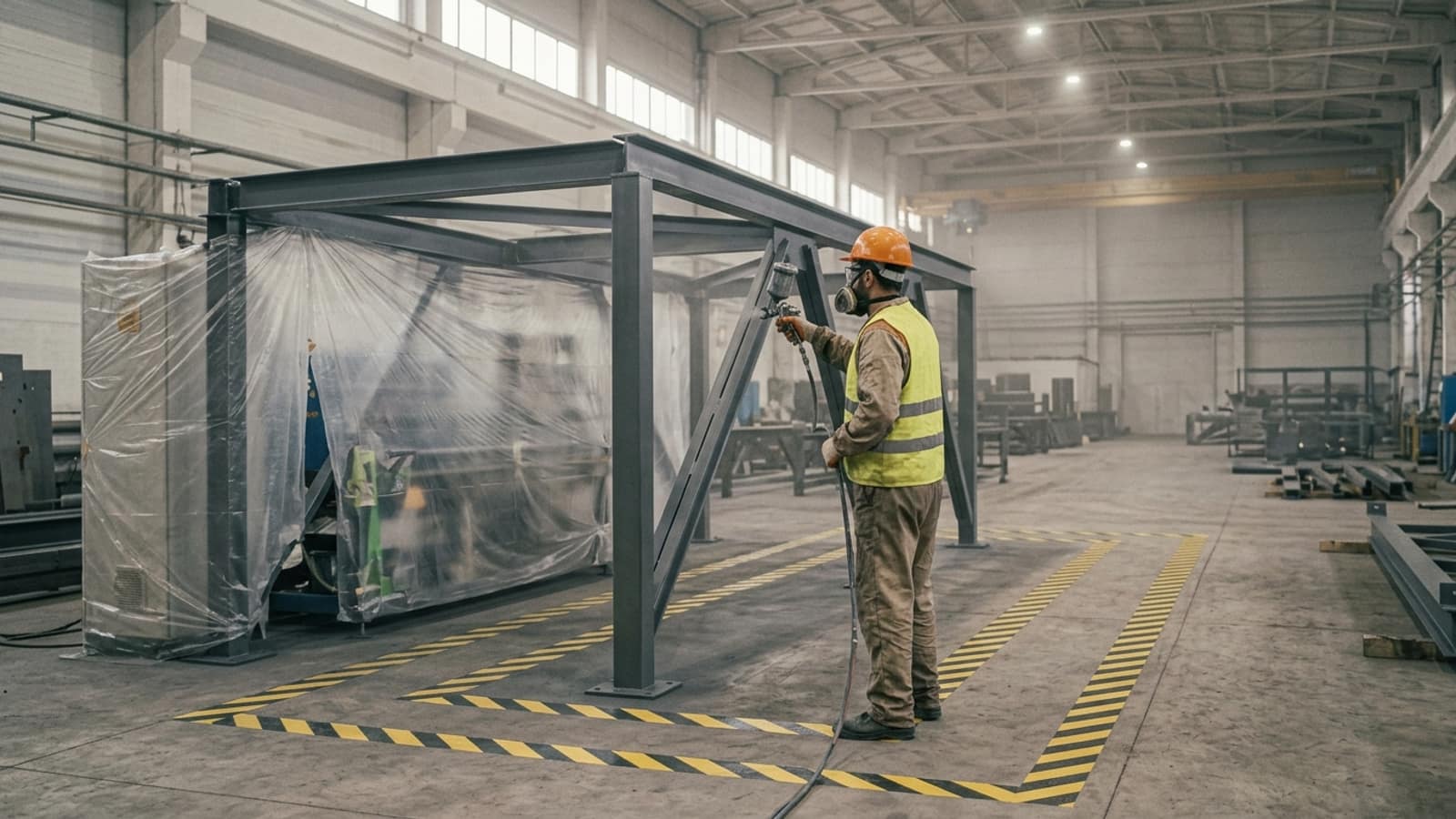
Industrial paints and equipment offer durable, long-lasting solutions designed specifically for industrial facilities, warehouses, factories and commercial spaces. These paints strengthen the surfaces of structures by providing high mechanical durability, chemical resistance and superior protection against environmental effects.
While industrial paints can be supplied in a variety of colours and textures, the professional equipment used to apply them increases both the quality and the speed of the work. These systems have been developed to achieve flawless results on floors, walls, ceilings and metal surfaces.
 Floor and Wall Coatings: Provide durability and an attractive finish in factory and warehouse areas. Metal Surfaces: Prevent corrosion and give surfaces a long service life. Ceiling Coatings: Offer a hygienic and clean appearance. Industrial Facilities: Provide ideal solutions for areas requiring chemical and mechanical resistance. Chemical Resistance: Provides durability against acids, alkalis and solvents. Mechanical Durability: Offers high resistance to heavy traffic and impact. Appearance and Variety: Provides a decorative finish with a wide choice of colours and textures. Easy Application: Offers a fast and effective application process with professional equipment. Environmental Protection: Provides long-lasting protection against harsh external conditions (UV rays, moisture, temperature fluctuations).
With an expert team and modern technology, Likit İzolasyon increases the safety and durability of structures in the field of structural strengthening. We bring your buildings back to life with professional strengthening solutions.
Floor traffic lanes, pedestrian walkways and storage area boundaries in factories, warehouses and logistics facilities Parking bay, arrow, direction and number markings in indoor and outdoor car parks Horizontal markings, pedestrian crossings and lane lines on highways and urban roads Basketball, volleyball, tennis and football court markings in sports facilities Mandatory markings and painting in helipads and runway areas Occupational safety warning strips, safety zones around machinery and emergency exit routes in production areas Numbering, coding and wayfinding applications on walls, columns and racking systemsOne-component acrylic and alkyd paints offer fast drying and low cost; they are suitable for interiors and medium-traffic areas. Two-component epoxy and polyurethane paints react chemically with a hardener to provide far higher abrasion and chemical resistance; they are preferred in facilities with heavy forklift traffic.
This is a thick-film system applied molten after heating to approximately 180-200 °C, which solidifies as it cools. It provides long service life and high visibility on highways. Glass beads are broadcast during application to give night-time visibility (retroreflectivity).
These are two-component systems that require no heating. Being applicable in thick layers, they offer high durability and the option of textured (rumble) markings. They can also be applied at low temperatures and allow rapid reopening to traffic.
Colour-coded strips applied to floors and walls define pedestrian walkways, forklift routes and hazard zones. Colour selection and symbol layout are determined in line with the relevant safety legislation; they can be applied together with anti-slip aggregate.
Column numbers, rack codes and directional arrows produced with stencils or cut vinyl make internal circulation and warehouse management easier. The use of reflective material improves legibility in low light.
1. Area planning: A marking plan is prepared by establishing traffic flow, vehicle turning radii, pedestrian routes and storage areas. Agreement on the plan is reached before application. 2. Surface preparation: The surface is cleared of dust, oil and loose material. Where necessary, grinding or high-pressure water cleaning is carried out. Incompatible residues of old paint are removed by blasting. 3. Setting out and marking: Line routes are measured and set out on the floor with string lines and stencils. On sports courts, federation dimensions are used; in car parks, vehicle size and manoeuvring space are taken as the basis. 4. Primer: A suitable primer is applied on absorbent or critical surfaces to improve adhesion and colour yield. 5. Paint application: Application is carried out by airless spray, roller or a dedicated line-marking machine. Thickness and number of coats are checked according to the system; glass beads or anti-slip aggregate are broadcast where required. 6. Inspection and reopening to traffic: Line widths, alignments and colour boundaries are checked. The area is opened for use at the end of the drying time appropriate to the system. The performance requirements for road marking materials TS EN 1436, and their physical properties in TS EN 1871 . For the protection of steel surfaces against corrosion by paint, TS EN ISO 12944 corrosion categories and paint systems are taken as the basis. In pedestrian areas where slip resistance is required, checks can be made with the TS EN 13036-4 pendulum test. For helipad markings, international civil aviation rules and the requirements of the relevant authority are decisive. Floor temperature and relative humidity are critical during application; applying to a damp or very cold surface results in adhesion problems and early peeling. Before paint is applied to newly poured concrete, the concrete must be sufficiently cured and its moisture content must have fallen.This depends on the system used and traffic intensity. Indoors, one-component acrylic paints last 1-2 years under medium traffic, while two-component epoxy and polyurethane systems serve markedly longer. Outdoors, thermoplastic and cold plastic systems provide high durability.
If the old paint is sound and compatible with the new system, application over the top is possible. However, if a system with a different chemistry is involved, or if the old layer has blistered or flaked, it must first be removed by blasting. Otherwise the new coat will come away together with the old one.
Usually not. Marking works can be planned zone by zone and carried out without interrupting the production flow. Working at weekends and outside shift hours is also a frequently preferred approach. The decisive factor is the drying time of the paint.
The federation dimensions of the relevant sport are used. Court dimensions and line widths are standard for basketball, volleyball, tennis and handball. On multi-purpose courts, the markings of different sports are distinguished by colour codes and applied to the same floor.
It is strongly recommended for occupational health and safety and is an inspection criterion in many facilities. Separating pedestrian routes by colour, providing warning markings at crossing points and indicating hazardous zones with hatched areas significantly reduces the risk of accidents.

Likit İzolasyon exceeded our expectations with their waterproofing and floor coating services. Thanks to their meticulous workmanship and on-time delivery, our building is now far safer and more durable.
During our building strengthening works we saw the difference of working with a professional team. With carbon fibre and concrete repair applications they gave our structure a new life. I would definitely recommend them!
We used their epoxy floor coating service and the result is incredible! We gained both an attractive appearance and a long-lasting, durable solution. I appreciate their professional approach.
We received terrace and foundation waterproofing services. With their polyurethane-based solutions in particular, they provided a permanent answer to water leaks. The team's professionalism and on-time delivery are truly commendable.
Concrete cracks and deterioration in our old building were causing serious problems. The Likit İzolasyon team made the structure safe again with concrete repair and protection. They kept us informed in detail at every stage of the process.
They did outstanding work on car park line marking and industrial painting projects. With thermoplastic paint they delivered a solution that is both attractive and long-lasting. The importance they place on occupational safety is a further plus!
We had epoxy and polyurethane floor coating applied in our factory. Our spaces gained both a durable and an attractive appearance. They are also very easy to clean. Thank you to the professional team!
We worked with Likit İzolasyon on building strengthening. Thanks to the carbon fibre application our structure became earthquake resistant. Their transparent and meticulous work from start to finish gave us confidence.
The concrete crack repair service completely solved the problems in our old building. Even the finest details were attended to during the work. We now have a structure we can use safely for many years.