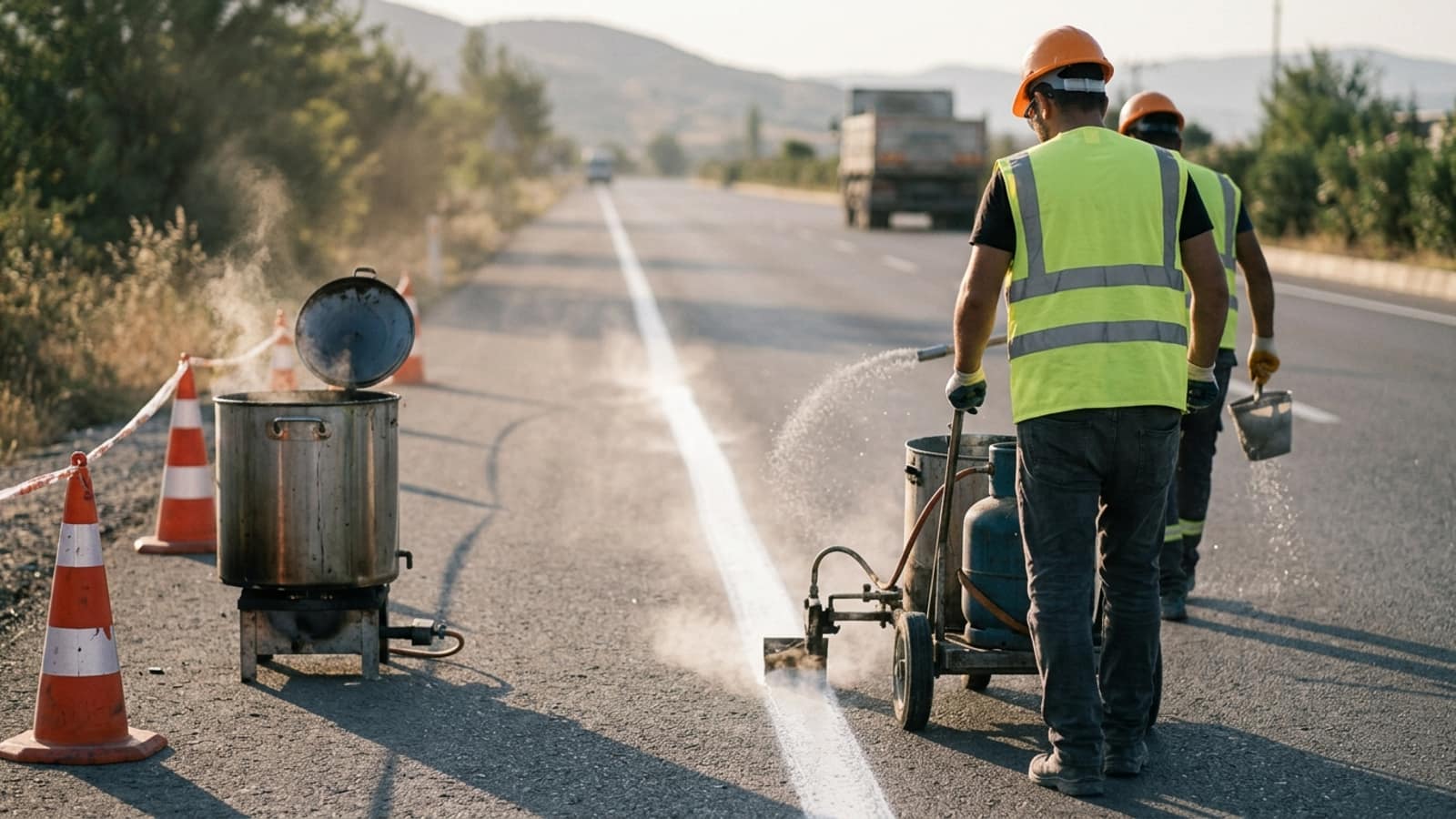
Thermoplastic is a durable, long-lasting marking material used particularly for road lines, car parks and traffic markings. Fast drying and with high resistance to wear, this type of material delivers excellent performance in areas with heavy traffic. Thermoplastic is applied to the surface by a hot-application method and forms a strong bond.
Providing both safety and a good appearance with their high durability and visibility, thermoplastic materials are resistant to UV, chemicals and environmental effects. They can also be tailored to different requirements with a wide range of colours.
 High Durability: Provides superior resistance to traffic density and environmental effects. Fast Drying: Becomes ready for use quickly after application. Long Life: Remains in place for many years thanks to its wear-resistant structure. Visual Impact: Improves traffic safety by providing high visibility. Environmental Resistance: Resistant to UV and chemicals. Road Lines: Ideal for lane divisions and traffic management. Car Parks: Used for parking bays and directional markings. Traffic Markings: Preferred for pedestrian crossings, arrows and warning symbols. Industrial Areas: Applied as directional lines in warehouses and production facilities. Surface Cleaning: The surface to be marked is cleaned and prepared. Heating the Material: The thermoplastic material is melted at a specified temperature for hot application. Application: The material is applied to the surface with special machines and a strong bond is achieved. Inspection: Durability and visibility are tested after application.
With quality materials and its professional teams in thermoplastic marking applications, Likit İzolasyon offers durable, attractive and safe solutions. Benefit from long-lasting marking and coating services for your projects.
Lane and centre line applications on highways and urban main roads Pedestrian crossings, stop lines and junction markings Cycle lanes and dedicated lane markings Airport apron and taxiway markings Industrial and port areas with heavy vehicle trafficThe molten material is laid onto the surface through a special shoe (die). A thick line with sharp edges is obtained; because the material thickness is high, its life is long.
This forms a thinner film and allows rapid progress over large areas. Material consumption is lower, but the service life is shorter than with extrusion.
Raised ribs are formed on the line at regular intervals. When a vehicle reaches this area it generates vibration and noise to alert the driver; it also maintains visibility in wet weather by allowing water to drain away.
1. Heating the material: The material is heated in a stirred kettle to around 180–200 °C. Temperature control is critical; overheating breaks down the binder. 2. Surface preparation: The surface is cleaned and dried. Where necessary a primer is applied to improve adhesion. 3. Application: The molten material is applied by extrusion or spray; glass beads are broadcast at the same time. 4. Cooling: The material cools and solidifies within minutes and can be opened to traffic. 5. Inspection: The thickness, line width and bead distribution are checked; retroreflectivity is measured if required. The performance requirements are given in TS EN 1436, and the material properties in TS EN 1871 . As the thickness increases the life is extended, but so are the cost and material consumption; the optimum thickness is chosen according to the traffic load. Exceeding the application temperature causes the material to yellow and to lose strength. Thermoplastic can suffer adhesion problems at low surface temperatures; the use of a primer becomes important in the winter months.This depends on the applied thickness and the traffic density. Lines applied thickly by extrusion last far longer than sprayed applications. In lanes with heavy vehicle traffic, wear accelerates markedly.
Thermoplastic material is solid at room temperature. When heated it becomes fluid, spreads over the surface and solidifies as it cools to form a thick film. This means it can be opened to traffic within minutes, without waiting for solvent to evaporate.
If the existing line is sound and bonded to the surface, a new coat can be applied over it. However, if the thickness increases excessively there is a risk of the edges breaking away. It is sounder to remove worn and loosened old layers by milling.
It can, but a suitable primer is needed for adhesion on concrete surfaces. In indoor areas and on concrete floors, epoxy and polyurethane systems are generally preferred; thermoplastic is mainly for asphalt and outdoor applications.

Likit İzolasyon exceeded our expectations with their waterproofing and floor coating services. Thanks to their meticulous workmanship and on-time delivery, our building is now far safer and more durable.
During our building strengthening works we saw the difference of working with a professional team. With carbon fibre and concrete repair applications they gave our structure a new life. I would definitely recommend them!
We used their epoxy floor coating service and the result is incredible! We gained both an attractive appearance and a long-lasting, durable solution. I appreciate their professional approach.
We received terrace and foundation waterproofing services. With their polyurethane-based solutions in particular, they provided a permanent answer to water leaks. The team's professionalism and on-time delivery are truly commendable.
Concrete cracks and deterioration in our old building were causing serious problems. The Likit İzolasyon team made the structure safe again with concrete repair and protection. They kept us informed in detail at every stage of the process.
They did outstanding work on car park line marking and industrial painting projects. With thermoplastic paint they delivered a solution that is both attractive and long-lasting. The importance they place on occupational safety is a further plus!
We had epoxy and polyurethane floor coating applied in our factory. Our spaces gained both a durable and an attractive appearance. They are also very easy to clean. Thank you to the professional team!
We worked with Likit İzolasyon on building strengthening. Thanks to the carbon fibre application our structure became earthquake resistant. Their transparent and meticulous work from start to finish gave us confidence.
The concrete crack repair service completely solved the problems in our old building. Even the finest details were attended to during the work. We now have a structure we can use safely for many years.