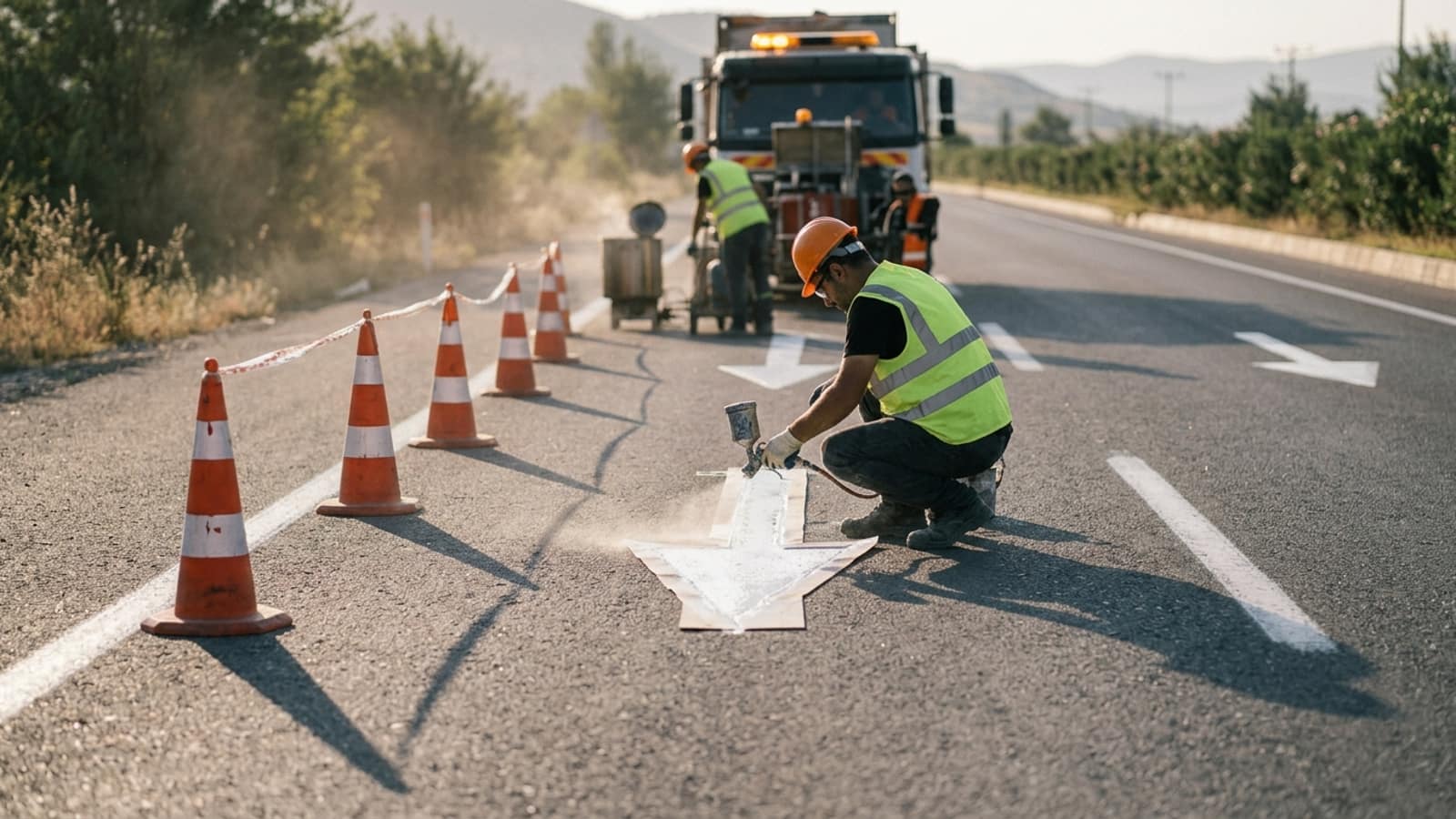
Traffic signs and markings are indispensable measures used to ensure a safe and orderly flow of traffic. Traffic signs and markings are applied for direction, information and safety in many places such as car parks, roads, industrial facilities and public areas. These markings and signs play a critical part in regulating vehicle and pedestrian traffic, preventing potential accidents and making the area easier to use.
The durable paints and materials used provide long-lasting protection against wear and environmental effects. Traffic signs and markings are applied quickly and accurately by professional teams and improve the functionality of the area.
 Traffic Safety: Improves safety by directing vehicle and pedestrian traffic. Order and Efficiency: Regulates the flow of traffic and ensures the area is used efficiently. Durability: The materials used in the markings and signs are long-lasting and resistant to wear. Easy Visibility: Provides high visibility and makes it easier to direct users. Fast Application: Applied quickly by professional teams so that the area becomes usable within a short time. Road and Lane Lines: Used at road edges and on lanes to regulate the flow of traffic. Pedestrian Crossings: Important markings for pedestrian safety. Car Park Areas: Indicate parking bays and directions. Industrial and Warehouse Areas: Applied for forklift routes, pedestrian crossings and safety markings. Planning and Design: The markings and signs are planned according to the requirements of the area. Surface Cleaning: The surfaces to be marked are prepared. Paint and Marking Application: The markings and signs are applied with durable materials. Inspection and Handover: The visibility and durability of the markings are tested.
With quality materials and professional workmanship in traffic sign and marking services, Likit İzolasyon brings order, safety and functionality to your areas. You can contact us for long-lasting and attractive traffic solutions.
Horizontal marking on urban roads, boulevards and junctions Lane and direction markings on internal roads in housing estates, campuses and factories Pedestrian crossings, cycle lanes and school crossing zones Speed hump, stop line and give-way markings Separating vehicle and pedestrian routes in industrial facilitiesThis is a thick-film system applied molten after heating. It offers high resistance to wear and provides night-time visibility through the glass beads embedded in it. It is the most widely used system on roads with heavy traffic.
This requires no heating and is applied by mixing two components. It allows thick and profiled (rumble) application; rumble lines alert the driver when they leave the lane.
Glass beads broadcast onto the paint surface reflect headlight beams back to the driver and provide night-time visibility. Applying the beads in the correct quantity and at the correct embedment depth is a measurable performance criterion.
1. Design and dimension check: Lane widths, line lengths and gap distances are determined in accordance with the relevant regulations and the design. 2. Surface cleaning: The asphalt or concrete surface is swept and residues of oil and dust are removed. No application is made to a damp surface. 3. Pre-marking: The line routes are measured and set out. The geometry is checked at junctions and crossing points. 4. Application: Paint and glass beads are applied simultaneously with a line marking machine. Thickness and bead consumption are monitored continuously. 5. Opening to traffic: The road is opened to traffic once the drying time appropriate to the system has elapsed. With thermoplastic systems this time is very short. The visibility, slip resistance and colour properties of road markings are defined within the scope of TS EN 1436 . The physical properties of marking materials are assessed according to TS EN 1871 . Retroreflectivity falls markedly on a wet surface; profiled (structured) line systems may be preferred in regions with heavy rainfall. Waiting a while before applying over new asphalt, so that the bitumen oils at the surface can escape, improves adhesion.Thermoplastic is applied hot, solidifies rapidly and is economical. Cold plastic, on the other hand, cures through the reaction of two components; because it requires no heating it can be applied at lower temperatures and generally lasts longer. The choice is made according to the traffic load and the budget.
Night-time visibility is provided by the glass beads reflecting light back. When the beads wear away, become dirty or are embedded too deeply in the paint, this property is lost. In rain, visibility also decreases because the film of water deflects the light.
In indoor areas, epoxy and polyurethane-based paints are generally preferred; thermoplastic is mainly for outdoor and asphalt surfaces. On concrete floors, two-component systems provide better adhesion and durability.
The work should not be carried out in rain, while the surface is damp, or when the surface temperature is below the lower limit for the product. Adhesion problems also occur because of condensation when the surface temperature is close to the dew point.

Likit İzolasyon exceeded our expectations with their waterproofing and floor coating services. Thanks to their meticulous workmanship and on-time delivery, our building is now far safer and more durable.
During our building strengthening works we saw the difference of working with a professional team. With carbon fibre and concrete repair applications they gave our structure a new life. I would definitely recommend them!
We used their epoxy floor coating service and the result is incredible! We gained both an attractive appearance and a long-lasting, durable solution. I appreciate their professional approach.
We received terrace and foundation waterproofing services. With their polyurethane-based solutions in particular, they provided a permanent answer to water leaks. The team's professionalism and on-time delivery are truly commendable.
Concrete cracks and deterioration in our old building were causing serious problems. The Likit İzolasyon team made the structure safe again with concrete repair and protection. They kept us informed in detail at every stage of the process.
They did outstanding work on car park line marking and industrial painting projects. With thermoplastic paint they delivered a solution that is both attractive and long-lasting. The importance they place on occupational safety is a further plus!
We had epoxy and polyurethane floor coating applied in our factory. Our spaces gained both a durable and an attractive appearance. They are also very easy to clean. Thank you to the professional team!
We worked with Likit İzolasyon on building strengthening. Thanks to the carbon fibre application our structure became earthquake resistant. Their transparent and meticulous work from start to finish gave us confidence.
The concrete crack repair service completely solved the problems in our old building. Even the finest details were attended to during the work. We now have a structure we can use safely for many years.