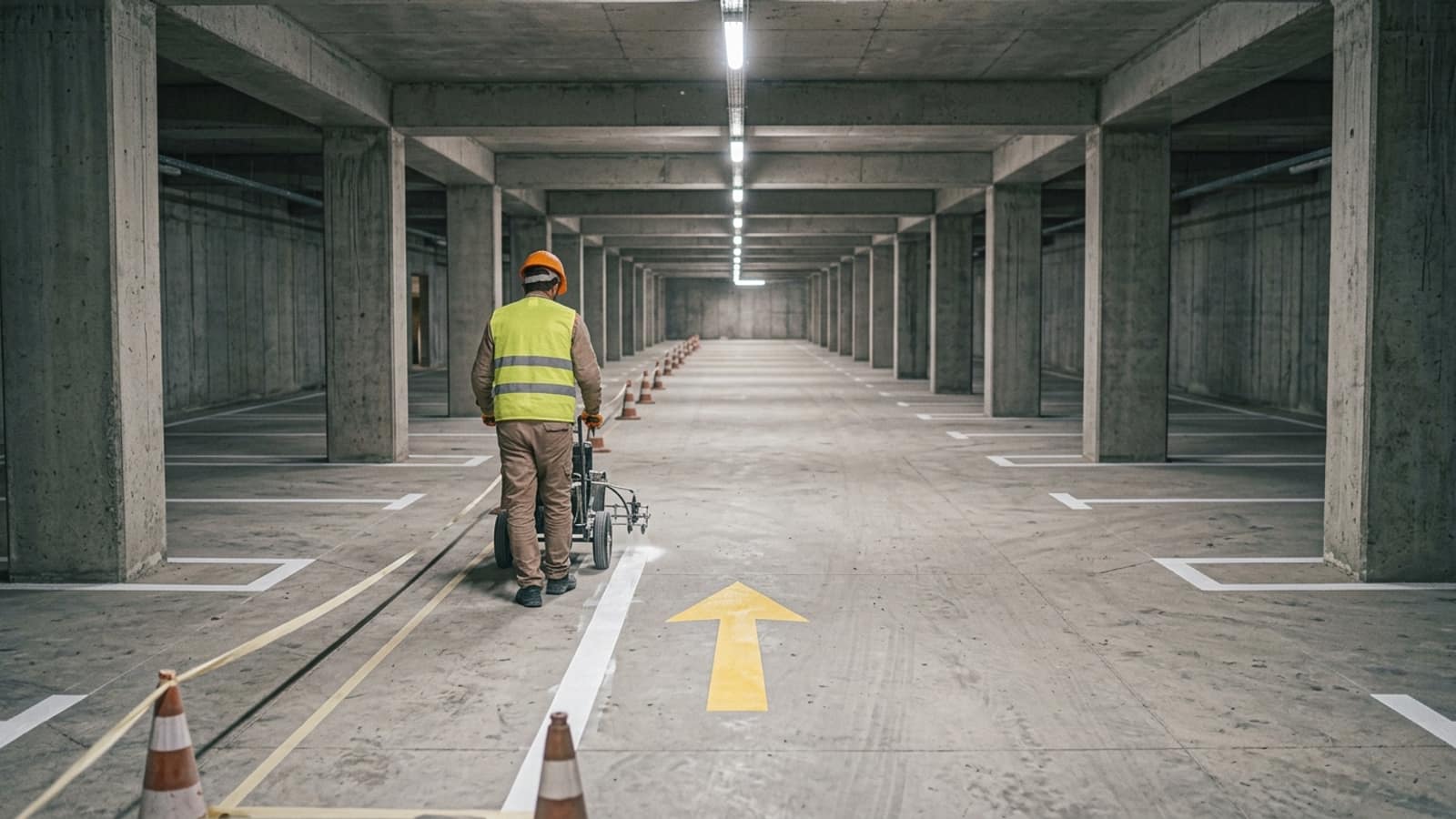
Car park line markings are applications carried out to establish order in car park areas, to help vehicles park safely and to direct traffic. These lines make the car park easier to use, both visually and functionally, and improve safety.
Car park markings are applied with durable, long-lasting paints. The clarity of the lines, their resistance to wear and their resistance to UV determine the quality and life of the work. Details such as arrows directing vehicle traffic, lines defining parking bays and symbols marking pedestrian routes keep the car park orderly and functional.
 Order and Traffic Management: Ensures vehicles are directed correctly and parked in an orderly way. Safety: Reduces the risk of accidents by defining pedestrian routes and vehicle circulation areas. Durability: Offers a long-lasting solution with paints resistant to wear, weather and UV. Attractive Appearance: Gives car park areas a tidy, clean appearance. Fast Application: Applied in a short time by professional teams. Planning and Design: The layout of the car park area and the marking plan are prepared. Surface Preparation: The surface on which the lines are to be applied is cleaned and the necessary preparations are made. Paint Application: The lines and symbols are applied using durable road marking paints. Inspection and Handover: The accuracy and durability of the lines are checked.
With the use of quality materials and its professional teams, Likit İzolasyon makes your car park areas functional and orderly in car park line marking services. You can contact us for durable and attractive car park markings.
Bay boundaries, arrows and direction markings in covered and open car parks Level and block numbering in shopping centre, hospital and business centre car parks Accessible and priority parking bays and electric vehicle charging areas Loading and unloading ramps and lorry manoeuvring areas Pedestrian crossings, escape routes and fire lane markingsThese are preferred in covered car parks with heavy vehicle traffic. Because they react chemically with a hardener, they show high resistance to tyre friction and to oil and fuel drips. Their service life is markedly longer than that of single-component paints.
These dry quickly and are economical. They are a suitable solution in areas with low traffic density or where the markings are changed periodically. The renewal interval is short.
These are used in open car parks and on entry and exit ramps, at points where wear is heavy. They form a thick film and provide a long life; night-time visibility can be improved by adding glass beads.
1. Layout plan: The parking bay layout is set out taking into account vehicle dimensions, manoeuvring space, column positions and turning radii. The balance between capacity and usability is established at this stage. 2. Surface preparation: The floor is cleared of oil, dust and tyre marks. If necessary, cleaning is carried out by grinding or with high-pressure water. 3. Setting out: The plan is transferred to the floor with string lines and templates. The dimensions are checked and approval obtained before application. 4. Paint application: Application is carried out with a line marking machine or by stencil. The line width and thickness are checked; colour edges are kept sharp. 5. Numbers and symbols: Bay numbers, accessibility symbols and direction arrows are applied by stencil. The performance requirements for road marking materials TS EN 1436, and their physical properties in TS EN 1871 . Before applying to newly poured concrete, the concrete must be allowed to cure and its moisture content to fall. Wear is far faster at ramps and turning points; choosing a more durable system in these areas lowers the total cost. The dimensional and symbol requirements for accessible parking bays are determined by accessibility legislation.This depends on the system used and the traffic. Single-component acrylic paints wear noticeably within 1–2 years in busy car parks, while two-component epoxy and polyurethane systems remain legible for far longer. Entry ramps and turning points require more frequent renewal.
It does not have to be closed completely. By planning the work area by area, part of the car park can be kept in service. The determining factor is the drying time of the paint; with fast-drying systems the disruption can be reduced to a few hours.
These are determined by the vehicle type and the manoeuvring space. Although narrow dimensions increase capacity, they also make use more difficult and raise the risk of damage to vehicles. Leaving extra allowance at bays beside columns and in corners makes a significant difference in practice.
This is possible if the old paint is sound and the systems are compatible. However, if the new layout differs from the old one, the old lines must be removed by blasting or milling; old lines that are simply painted over become visible again over time and cause confusion.

Likit İzolasyon exceeded our expectations with their waterproofing and floor coating services. Thanks to their meticulous workmanship and on-time delivery, our building is now far safer and more durable.
During our building strengthening works we saw the difference of working with a professional team. With carbon fibre and concrete repair applications they gave our structure a new life. I would definitely recommend them!
We used their epoxy floor coating service and the result is incredible! We gained both an attractive appearance and a long-lasting, durable solution. I appreciate their professional approach.
We received terrace and foundation waterproofing services. With their polyurethane-based solutions in particular, they provided a permanent answer to water leaks. The team's professionalism and on-time delivery are truly commendable.
Concrete cracks and deterioration in our old building were causing serious problems. The Likit İzolasyon team made the structure safe again with concrete repair and protection. They kept us informed in detail at every stage of the process.
They did outstanding work on car park line marking and industrial painting projects. With thermoplastic paint they delivered a solution that is both attractive and long-lasting. The importance they place on occupational safety is a further plus!
We had epoxy and polyurethane floor coating applied in our factory. Our spaces gained both a durable and an attractive appearance. They are also very easy to clean. Thank you to the professional team!
We worked with Likit İzolasyon on building strengthening. Thanks to the carbon fibre application our structure became earthquake resistant. Their transparent and meticulous work from start to finish gave us confidence.
The concrete crack repair service completely solved the problems in our old building. Even the finest details were attended to during the work. We now have a structure we can use safely for many years.