Bentonite-based waterproofing is a long-lasting, environmentally friendly solution produced from 100% natural sodium bentonite mineral. Held between two geotextile layers, the sodium bentonite expands in volume on contact with water to form an impermeable layer, protecting your structures from the harmful effects of water.
Bentonite waterproofing material can be laid horizontally or vertically directly onto the soil surface, with no need for blinding concrete. This makes it easy to install and saves time. Its long-lasting structure provides effective protection even in difficult ground conditions.
 Natural and Environmentally Friendly: Produced from 100% natural sodium bentonite material. High Performance: Forms an impermeable layer on contact with water, providing effective protection against water. Easy Installation: Can be laid directly onto the soil surface without the need for blinding concrete. Flexible Use: Designed for both horizontal and vertical applications. Long-Lasting Protection: Provides a durable structure even in difficult ground conditions.
At Likit İzolasyon we provide long-lasting protection for your structures with our innovative bentonite-based sub-foundation waterproofing applications. Contact us for professional service and natural solutions.
Beneath raft foundations — on the blinding concrete before the pour Bored pile and diaphragm wall faces — areas that cannot be reached later In deep basements, against a high groundwater table Narrow working areas remaining between the shoring wall and the retaining wall Surfaces in contact with soil in tunnel and underpass structuresOn contact with water, sodium bentonite increases its volume many times over and reaches a gel consistency. When it swells within a confined volume it forms an impermeable barrier. In small punctures and tears the bentonite fills the gap and heals itself; this is a decisive advantage in areas that cannot be reached later.
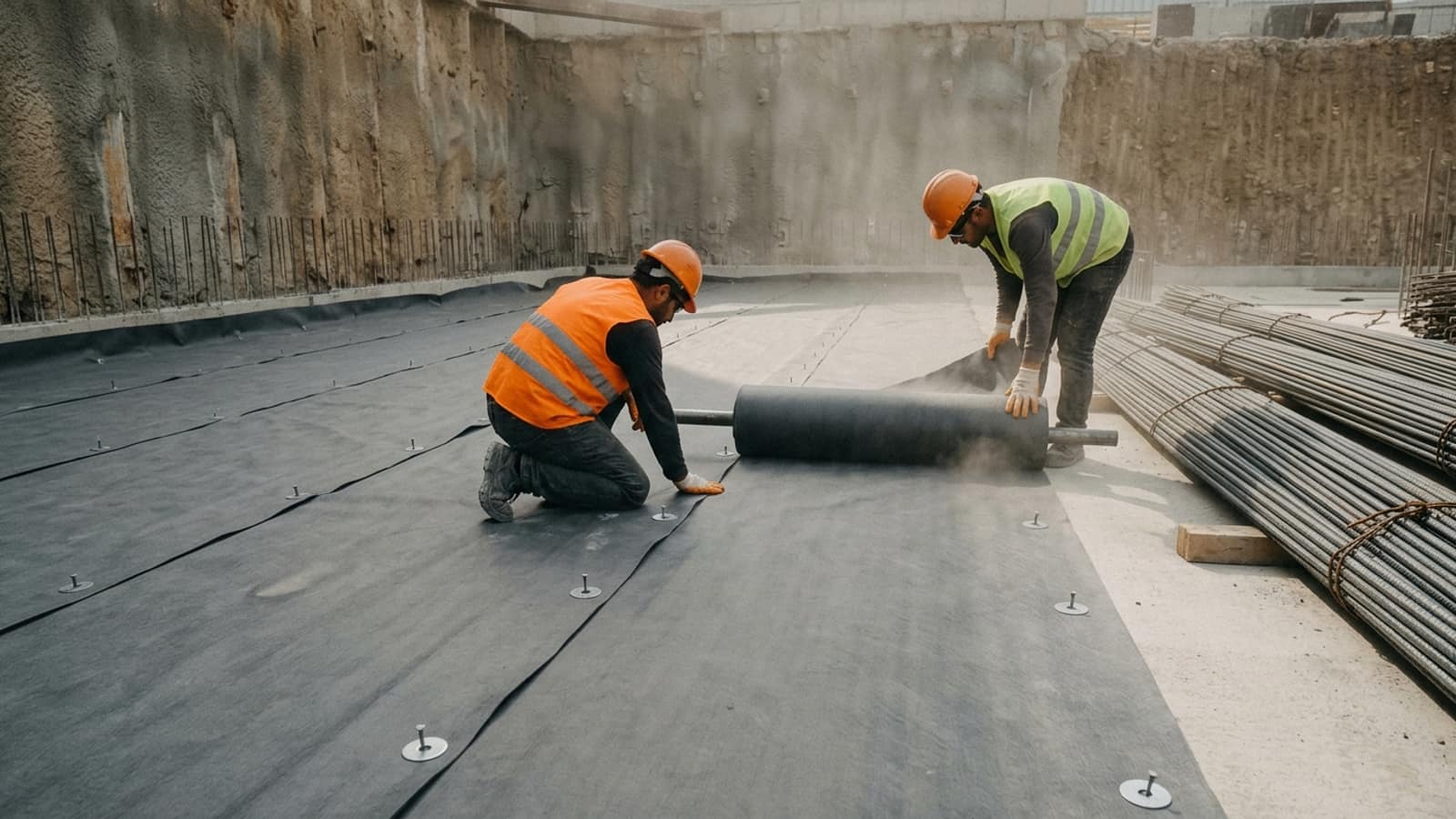
Bentonite granules are compressed between geotextile or cardboard carriers to form panels. They are laid on the blinding concrete, and reinforcement can be tied and concrete poured directly on top. A tight bond forms between the fresh concrete and the bentonite.
Swelling waterstops and sealant pastes are used at discontinuities such as construction joints, pile heads and pipe penetrations. These details are the areas where leaks are most frequently seen in foundation waterproofing.
1. Preparing the blinding concrete surface: The surface must be even, sound and free of sharp protrusions. Standing water and loose material are removed. 2. Laying the panels: The panels are laid with the bentonite face towards the concrete. Overlaps are left in accordance with the manufacturer's data and fixed with nails or tape. 3. Detail solutions: Swelling waterstops and sealant paste are applied around pile heads, column starters and pipe penetrations. Corners are reinforced with additional pieces. 4. Protection: If necessary, a protective layer is laid so that the panels are not damaged during reinforcement fixing; precautions are taken against premature wetting. 5. Concrete pour: The concrete is poured directly onto the panels. Care is taken not to puncture the panels while using the vibrator. Because bentonite systems bond mechanically with the concrete, the interlayer void and water migration problem seen in membrane systems does not occur. The system only works correctly within a confined volume; in areas where free expansion is possible, swelling does not form a barrier. Premature wetting of the panels by rain before the concrete pour can cause a loss of performance; weather conditions must be planned for. In saline groundwater and groundwater containing chemicals, the swelling capacity of standard sodium bentonite falls; specially modified products must be used in these conditions.The area beneath the foundation cannot be reached later, and repairing a leak that develops there is very costly. The self-healing property of bentonite reduces this risk. In addition, being able to pour concrete directly onto it removes the need for a protective screed and shortens the programme.
Yes, and this is one of the main advantages of the system. However, care must be taken that sharp-ended bars do not tear the panels and that cover spacers do not damage them. Damaged areas are repaired before the concrete pour.
Short-term wetting is generally tolerated, but prolonged contact with water can cause the bentonite to swell in an unconfined state and lose its properties. For this reason the period between laying and the concrete pour is kept short and the area is covered if necessary.
Bentonite systems are essentially applied in new structures, before the concrete pour. As there is no access beneath the foundation in existing buildings, negative-side cementitious systems or injection methods are preferred.

Likit İzolasyon exceeded our expectations with their waterproofing and floor coating services. Thanks to their meticulous workmanship and on-time delivery, our building is now far safer and more durable.
During our building strengthening works we saw the difference of working with a professional team. With carbon fibre and concrete repair applications they gave our structure a new life. I would definitely recommend them!
We used their epoxy floor coating service and the result is incredible! We gained both an attractive appearance and a long-lasting, durable solution. I appreciate their professional approach.
We received terrace and foundation waterproofing services. With their polyurethane-based solutions in particular, they provided a permanent answer to water leaks. The team's professionalism and on-time delivery are truly commendable.
Concrete cracks and deterioration in our old building were causing serious problems. The Likit İzolasyon team made the structure safe again with concrete repair and protection. They kept us informed in detail at every stage of the process.
They did outstanding work on car park line marking and industrial painting projects. With thermoplastic paint they delivered a solution that is both attractive and long-lasting. The importance they place on occupational safety is a further plus!
We had epoxy and polyurethane floor coating applied in our factory. Our spaces gained both a durable and an attractive appearance. They are also very easy to clean. Thank you to the professional team!
We worked with Likit İzolasyon on building strengthening. Thanks to the carbon fibre application our structure became earthquake resistant. Their transparent and meticulous work from start to finish gave us confidence.
The concrete crack repair service completely solved the problems in our old building. Even the finest details were attended to during the work. We now have a structure we can use safely for many years.