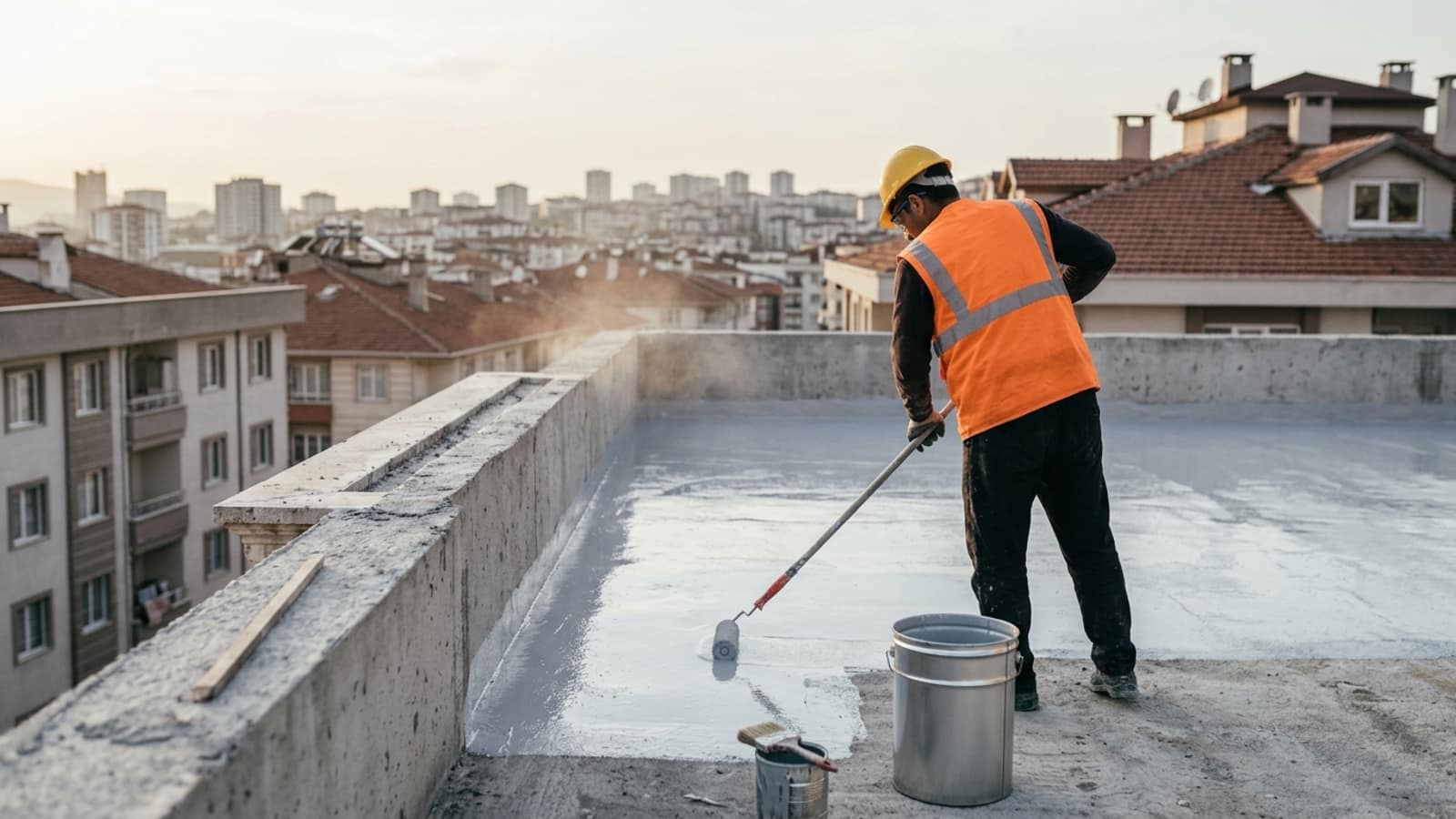
Polyurethane-based waterproofing products are a modern solution that provides superior protection against water and moisture both indoors and outdoors. They are applied with confidence in areas where waterproofing is critical, such as roofs, terraces, foundations, retaining walls and wet areas, and increase the durability of your structures.
Our company offers high-quality services in polyurethane-based waterproofing applications with its expert team and state-of-the-art equipment. Applied by spray and roller methods, polyurethane waterproofing coats surfaces against water and provides protection that is both long-lasting and effective.
 Flexibility: Can be applied easily to different surface types and conforms closely to them. Durability: Offers long-lasting protection against deterioration caused by water and moisture. Aesthetic Solutions: Gives surfaces a smooth appearance. Fast Application: Can be applied easily and quickly by spray and roller methods. Wide Range of Use: Provides effective protection on many different surfaces, from roof to foundation.
At Likit İzolasyon we aim to offer the best service in the sector in polyurethane-based waterproofing applications. You can make use of our professional solutions to protect your structures against the harmful effects of water and to achieve long-lasting waterproofing.
Terraces and balconies — complex surfaces with numerous details, upstands and outlets Green roofs — beneath vegetation, with root-resistant systems Car park decks — together with a traffic-resistant wearing layer Refurbishment applications over metal and existing membrane surfaces Wet areas and confined spaces in roof voidsThese cure by reacting with the moisture in the air. As no mixing is required, the risk of application error is low. They are applied in successive coats by roller or brush and form a seamless, fully elastic membrane. They are common in small and medium-sized terrace applications.
These are prepared by mixing a resin and a hardener. Because curing is independent of moisture, thicker coats can be applied in a single pass and the system works reliably in low-humidity environments as well. They are preferred in areas where high mechanical loads are expected.
Standard polyurethane membranes change colour over time under UV. An aliphatic top coat preserves the colour and surface integrity and extends the life of the system; applied together with anti-slip aggregate, it also provides safe footing.
1. Surface inspection and dryness measurement: The moisture content of the surface is measured. Polyurethane systems are sensitive to surface moisture; high moisture causes adhesion problems and blistering. 2. Mechanical preparation: Loose layers are removed by grinding or blasting and the surface is roughened. Voids and cracks are sealed with polyurethane mastic or repair mortar. 3. Primer selection: The primer is determined according to the type of surface; different primers are used for absorbent concrete, metal and existing membranes. The correct primer is one of the most important choices determining the life of the system. 4. Details and reinforcement: At corners, outlets and pipe penetrations, polyester fleece reinforcement is embedded within the membrane to strengthen the detail. 5. Coat application and top coat: The membrane is applied in at least two coats, observing the recommended consumption rate and the waiting times between coats. A UV-resistant aliphatic top coat and anti-slip aggregate are applied in the required areas. In liquid-applied systems the dry film thickness must be monitored by checking consumption; applying by eye creates areas that end up too thin. The surface temperature must be at least 3 °C above the dew point; otherwise condensation causes a loss of adhesion. Concrete surface protection systems are defined within the scope of TS EN 1504-2 . In green roof applications a root-resistant product must be selected, or a separate root barrier used.Not directly. Because polyurethane forms an elastic surface, a suitable intermediate system or protective screed is required in order to bond ceramic tiles to it. If direct application beneath ceramic tiles is required, cementitious elastic systems are more suitable.
In membrane systems, most water ingress occurs at overlaps and joints. Because liquid-applied polyurethane systems form a single continuous layer on the surface, these weak points are eliminated. The difference is particularly marked on terraces with many details.
Standard aromatic-based products can yellow over time in the sun. Although this does not directly affect performance, an aliphatic top coat should be applied if appearance matters. Aliphatic products retain their colour and gloss for a long time.
Yes, provided that a suitable primer is used and the existing covering is sound. This allows refurbishment without the cost of stripping and without generating debris. However, if the membrane beneath is holding water or has debonded, the problem areas must be dealt with first.

Likit İzolasyon exceeded our expectations with their waterproofing and floor coating services. Thanks to their meticulous workmanship and on-time delivery, our building is now far safer and more durable.
During our building strengthening works we saw the difference of working with a professional team. With carbon fibre and concrete repair applications they gave our structure a new life. I would definitely recommend them!
We used their epoxy floor coating service and the result is incredible! We gained both an attractive appearance and a long-lasting, durable solution. I appreciate their professional approach.
We received terrace and foundation waterproofing services. With their polyurethane-based solutions in particular, they provided a permanent answer to water leaks. The team's professionalism and on-time delivery are truly commendable.
Concrete cracks and deterioration in our old building were causing serious problems. The Likit İzolasyon team made the structure safe again with concrete repair and protection. They kept us informed in detail at every stage of the process.
They did outstanding work on car park line marking and industrial painting projects. With thermoplastic paint they delivered a solution that is both attractive and long-lasting. The importance they place on occupational safety is a further plus!
We had epoxy and polyurethane floor coating applied in our factory. Our spaces gained both a durable and an attractive appearance. They are also very easy to clean. Thank you to the professional team!
We worked with Likit İzolasyon on building strengthening. Thanks to the carbon fibre application our structure became earthquake resistant. Their transparent and meticulous work from start to finish gave us confidence.
The concrete crack repair service completely solved the problems in our old building. Even the finest details were attended to during the work. We now have a structure we can use safely for many years.