Bitumen-based waterproofing products are among the most effective solutions for protecting structures against damage caused by water and moisture. Applied with confidence in critical areas such as foundations, retaining walls and wet areas (bathrooms, kitchens, balconies and so on), they increase the durability of surfaces and provide long-lasting protection.
With over 25 years of experience in waterproofing and an expert staff, our company offers the highest quality standards in bitumen-based applications. While protecting your structures with the modern techniques and environmentally friendly products we use, we offer you economical and reliable solutions.
 Effective Protection: Prevents the damage caused by water and moisture in foundations, retaining walls and wet areas. Durability: Gives structures a long life and reduces maintenance costs. Flexibility: Easy to apply on various surfaces and conforms closely to them. Environmentally Friendly: Provides sustainable protection through the use of environmentally friendly materials. Economical Solution: A waterproofing method that is both budget-friendly and cost-reducing in the long term.
Our company develops solutions suited to the requirements of your projects in bitumen-based waterproofing and keeps quality at the forefront throughout the application process. You can benefit from our professional services to secure your structures against water and moisture.
Beneath foundations and on retaining walls — surfaces that remain below ground and cannot be reached later Terraces and pitched roofs — top coverings exposed to rain, snow and UV Surfaces in contact with soil on retaining walls and garden terraces Bridge and viaduct decks — the protective layer beneath the asphalt surfacing The outer faces of water tanks and pools, and tunnels and underpassesBitumen modified with styrene-butadiene-styrene retains its flexibility at low temperatures. It is preferred in cold climate regions and at details where movement is expected. The cold bending value is the most important parameter showing how the material behaves in winter conditions.
Modified with atactic polypropylene, these sheets offer high temperature resistance and UV resistance. They are advantageous in hot climates and on roofs in direct sun. Because their flow point is high, the risk of softening in summer is low.
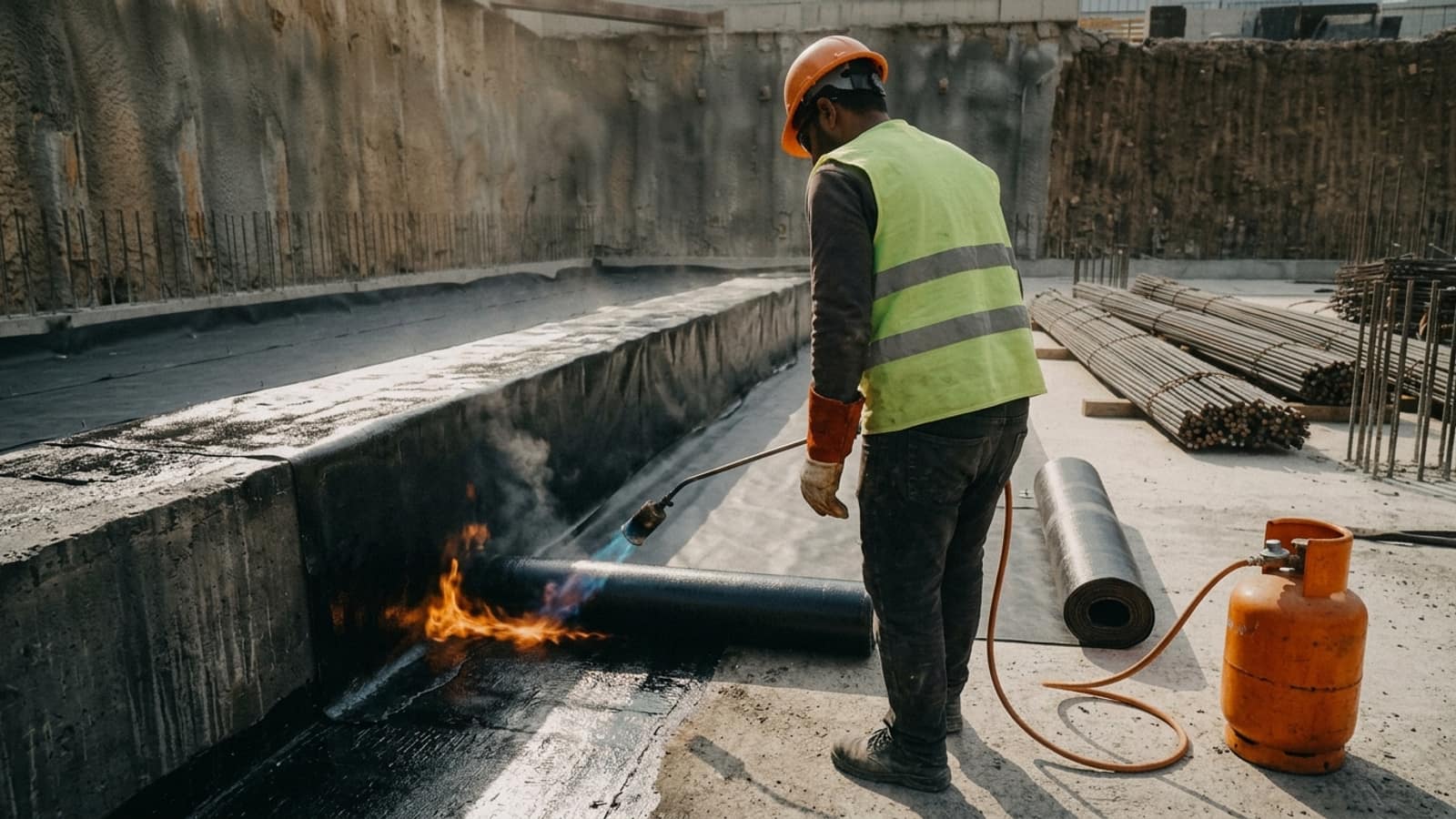
In the torch-on method the underside of the sheet is melted with a flame and bonded to the surface; this is the most common and economical method. Where there is combustible insulation material or a timber deck, self-adhesive sheets or cold adhesives are used instead, eliminating the fire risk.
1. Surface preparation: The surface is cleaned, loose pieces are removed, and voids and cracks are filled with repair mortar. Internal corners are filleted and external corners rounded. 2. Priming: A bitumen-based primer is applied to bind the dust on the surface and increase the bond strength of the membrane. Membrane laying begins once the primer is completely dry. 3. Reinforcement of details: Additional reinforcing pieces are applied at outlet openings, pipe penetrations, corners and junctions. Most failures begin in these areas. 4. Laying the membrane: The rolls are laid perpendicular to the fall; transverse and longitudinal overlaps are left in accordance with the manufacturer's data and full adhesion is achieved. Bitumen bleeding out at the overlap edges is the sign of a complete bond. 5. Testing and protection: A flood test is carried out in suitable sections. The approved surface is protected against mechanical and UV effects with a protective screed, drainage board or gravel ballast. Bituminous sheets used in roof waterproofing are covered by TS EN 13707, and foundation and damp barrier applications by TS EN 13969 . Applying two layers (cross-laid) instead of a single layer provides a significant margin of safety against overlap defects. If the membrane is to remain exposed, a mineral-surfaced type must be selected; bare bitumen ages rapidly under UV. Torch-on application carries a fire risk; a cold system should be preferred near combustible materials.In protected foundation applications the service life is very long. On exposed terraces, however, periodic inspection is required because of UV, temperature differences and mechanical effects. Using a mineral-surfaced sheet, the correct fall and a working drainage system extend the life significantly.
If the existing covering is sound, fully bonded to the surface and not holding water, a second layer can be applied over it. However, if water is trapped underneath, or there is blistering or debonding, the old layer must be stripped; otherwise the trapped moisture will lift the new layer as well.
The climate is the determining factor. SBS is more suitable in regions with low winter temperatures and at details subject to movement, and APP in hot regions with intense sun. Because flexibility matters at detail areas, SBS is preferred in most projects.
The most common causes are a surface that is not sufficiently dry, laying the membrane before the primer has fully dried, and moisture trapped in the layer beneath. Water vapour expanding with temperature separates the membrane from the surface. To remedy this, the blistered area is opened up, dried and patched.

Likit İzolasyon exceeded our expectations with their waterproofing and floor coating services. Thanks to their meticulous workmanship and on-time delivery, our building is now far safer and more durable.
During our building strengthening works we saw the difference of working with a professional team. With carbon fibre and concrete repair applications they gave our structure a new life. I would definitely recommend them!
We used their epoxy floor coating service and the result is incredible! We gained both an attractive appearance and a long-lasting, durable solution. I appreciate their professional approach.
We received terrace and foundation waterproofing services. With their polyurethane-based solutions in particular, they provided a permanent answer to water leaks. The team's professionalism and on-time delivery are truly commendable.
Concrete cracks and deterioration in our old building were causing serious problems. The Likit İzolasyon team made the structure safe again with concrete repair and protection. They kept us informed in detail at every stage of the process.
They did outstanding work on car park line marking and industrial painting projects. With thermoplastic paint they delivered a solution that is both attractive and long-lasting. The importance they place on occupational safety is a further plus!
We had epoxy and polyurethane floor coating applied in our factory. Our spaces gained both a durable and an attractive appearance. They are also very easy to clean. Thank you to the professional team!
We worked with Likit İzolasyon on building strengthening. Thanks to the carbon fibre application our structure became earthquake resistant. Their transparent and meticulous work from start to finish gave us confidence.
The concrete crack repair service completely solved the problems in our old building. Even the finest details were attended to during the work. We now have a structure we can use safely for many years.