PVC and TPO based waterproofing membranes are modern waterproofing solutions used both in new buildings and in refurbishment projects. These systems can be applied easily to different roof decks and protect buildings against external factors such as wind, snow, rain, temperature changes and building movement.
Every building needs a waterproofing solution tailored to it, based on wind load calculations designed in accordance with international norms and standards. PVC membranes can be attached to the substrate by different application methods according to these calculations. This provides a flexible and durable solution suited to each building's particular requirements.
 High Durability: Provides long-term protection against external factors. Flexibility: Can be applied easily to various roof types. Fast and Easy Installation: Time-saving application techniques allow you to complete your projects quickly. International Standards: Offers a reliable solution through design and application in accordance with the norms. Energy Efficiency: Contributes to thermal insulation and helps save energy.
With its expert team, Likit İzolasyon offers quality, long-lasting solutions suited to the needs of your projects in PVC and TPO applications. You can work with us to increase the durability of your roofs and secure them against external factors.
Roofs of long-span industrial and logistics buildings Large-area coverings such as shopping centres, hangars and exhibition halls Root-resistant layer in green roofs and roof gardens Water reservoirs, waste storage areas and pond linings Projects to refurbish existing roofs without stripping themThese are flexible, easily weldable sheets containing plasticisers. Detailing is straightforward and a wide range of accessories is available. A separating layer must be used where they come into direct contact with certain materials such as bitumen and polystyrene.
These are sheets based on thermoplastic polyolefin; because they contain no plasticisers, the risk of hardening over time is lower. They have high chemical resistance and tolerate contact with bitumen. Their light-coloured surface reflects solar radiation and lowers the roof temperature.
In a mechanically fixed system the membrane is fastened to the deck with screws and washers; this is fast and economical. In a fully adhered system it is bonded to the surface and provides the highest security against wind uplift. In a ballasted system it is weighted down with gravel or concrete slabs.
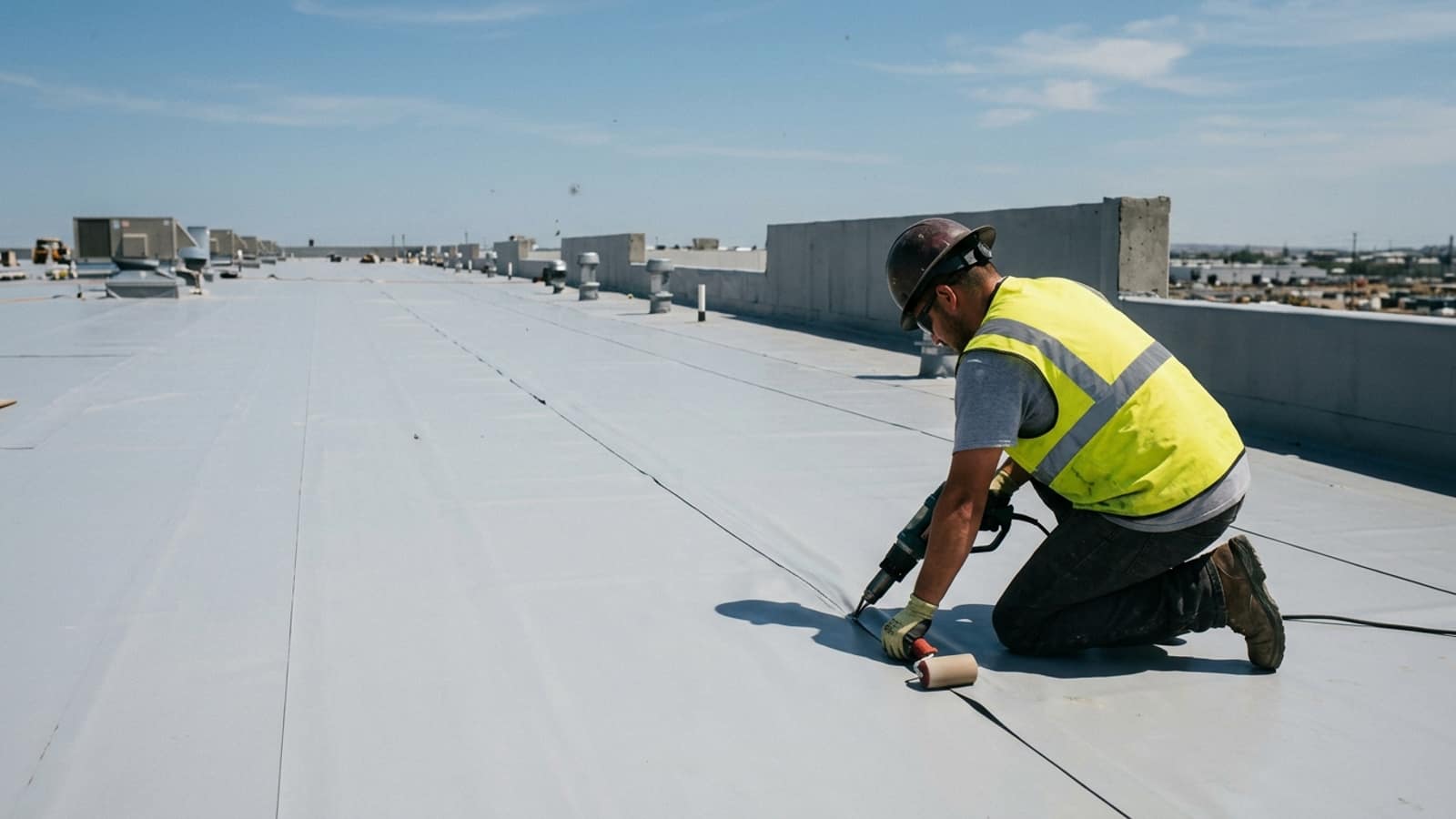
1. Roof assessment: The existing roof deck, the fall, the load-bearing capacity and the wind loads are assessed. The fixing method is selected on the basis of these data. 2. Separating and insulation layers: A geotextile separating layer is laid where required, thermal insulation boards are placed and a vapour control layer is applied. 3. Laying the membrane: The rolls are laid out in the planned direction, overlaps are left and the sheets are temporarily fixed. 4. Hot-air welding: The overlaps are welded with an automatic welding machine or a hand tool. The welding temperature and speed are adjusted to the ambient conditions. 5. Weld testing and details: The weld seams are tested mechanically with a seam probe. Parapets, outlets and pipe penetrations are completed with special accessories. Weld quality determines the performance of the whole system; a test weld should be made at the start of every shift to verify the machine parameters. Wind uplift is far higher at the corner and edge zones of a roof than in the centre; the density of fixings is increased in these zones. Direct contact between PVC membranes and bitumen, polystyrene and certain insulation materials creates incompatibility; a separating layer is mandatory. Light-coloured TPO and PVC surfaces reflect solar radiation and lower the temperature beneath the roof in summer.On roofs with a high density of details and complex geometry, the flexibility of PVC and its range of accessories are an advantage. Where chemical exposure, contact with bitumen or long-term dimensional stability is the priority, TPO comes to the fore. Both systems are long-lasting when correctly applied.
In most cases, yes. If the existing covering is sound, a separating layer can be laid and a new membrane applied over it. This method removes the cost of stripping and the generation of debris, and allows operations to continue without interruption. It must be verified that the structure can carry the additional load.
Hot-air welding carried out at the correct temperature and speed joins the two membranes at molecular level and forms a seam no weaker than the parent material. Leaks generally result from incorrectly set welding parameters or a dirty surface; seam testing is therefore mandatory.
Walking for maintenance purposes is possible, but a protective walkway membrane should be applied on routes with continuous traffic. Since sharp tools and falling hard objects can puncture the sheet, protective measures must be taken during work on the roof.

Likit İzolasyon exceeded our expectations with their waterproofing and floor coating services. Thanks to their meticulous workmanship and on-time delivery, our building is now far safer and more durable.
During our building strengthening works we saw the difference of working with a professional team. With carbon fibre and concrete repair applications they gave our structure a new life. I would definitely recommend them!
We used their epoxy floor coating service and the result is incredible! We gained both an attractive appearance and a long-lasting, durable solution. I appreciate their professional approach.
We received terrace and foundation waterproofing services. With their polyurethane-based solutions in particular, they provided a permanent answer to water leaks. The team's professionalism and on-time delivery are truly commendable.
Concrete cracks and deterioration in our old building were causing serious problems. The Likit İzolasyon team made the structure safe again with concrete repair and protection. They kept us informed in detail at every stage of the process.
They did outstanding work on car park line marking and industrial painting projects. With thermoplastic paint they delivered a solution that is both attractive and long-lasting. The importance they place on occupational safety is a further plus!
We had epoxy and polyurethane floor coating applied in our factory. Our spaces gained both a durable and an attractive appearance. They are also very easy to clean. Thank you to the professional team!
We worked with Likit İzolasyon on building strengthening. Thanks to the carbon fibre application our structure became earthquake resistant. Their transparent and meticulous work from start to finish gave us confidence.
The concrete crack repair service completely solved the problems in our old building. Even the finest details were attended to during the work. We now have a structure we can use safely for many years.