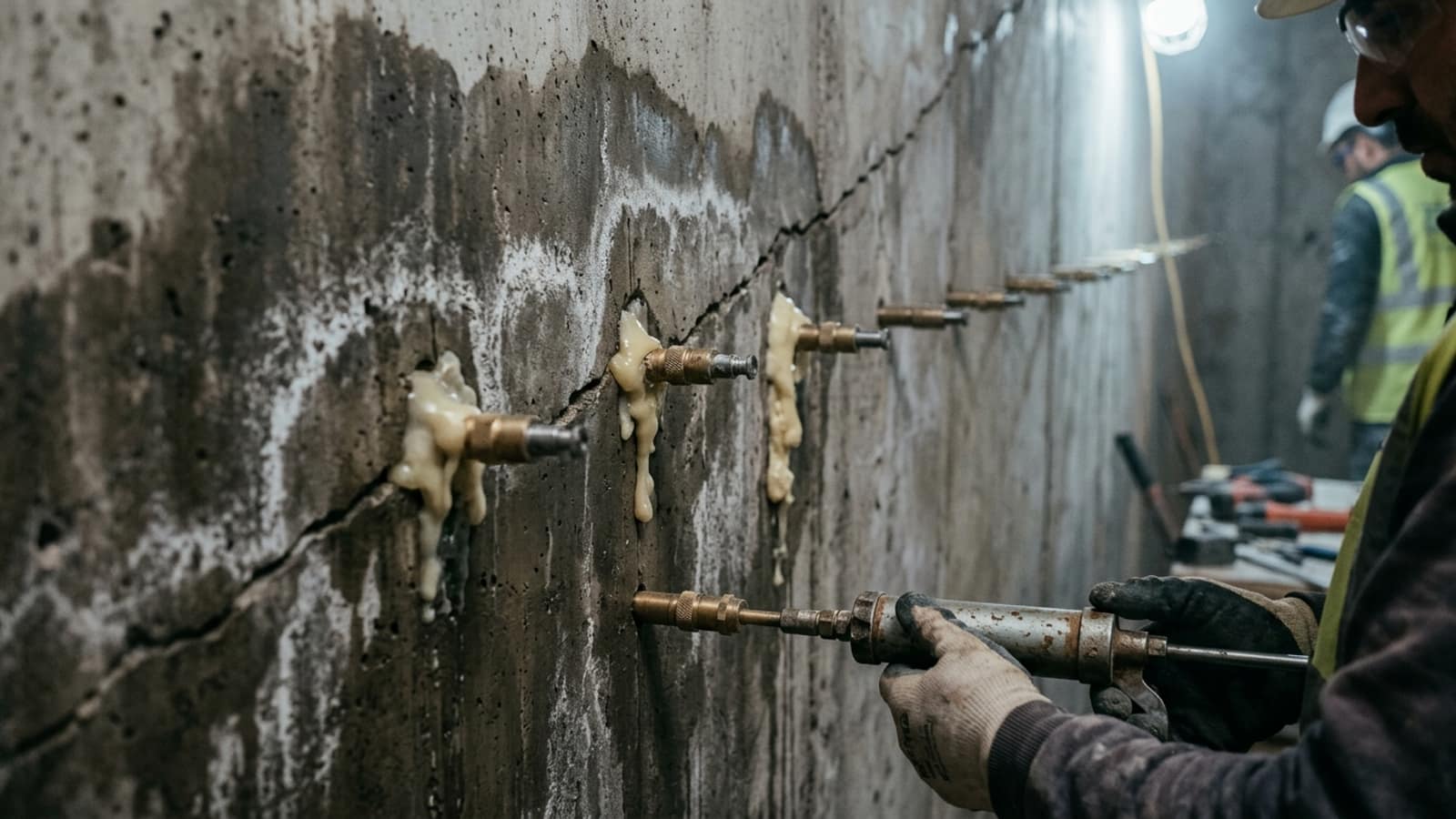
Injection waterproofing is an effective method for preventing water ingress through cracks that form in basement retaining walls, car park walls and terrace-level ceiling slabs. Where waterproofing from the positive side is not possible, this application is carried out from the negative side and prevents water from damaging the structure.
During the application the cracked areas are opened up, injection packers are installed in a staggered pattern and the injection waterproofing process is then carried out. This method stops water ingress completely, increases the durability of the structure and provides long-lasting protection.
 Application from the Negative Side: Offers an effective solution where positive-side waterproofing is not possible. Long-Lasting Protection: Completely prevents water ingress through cracks. Flexible Application: Can be used in various areas such as basements, car park walls and ceiling slabs. Targeted Solution: Provides a pinpoint solution in the areas where water is entering. Application without Damaging the Structure: Provides effective waterproofing while preserving the existing structure.
At Likit İzolasyon, our experienced teams stop water ingress permanently in injection waterproofing applications. You can benefit from our professional solutions to secure your structures against the harmful effects of water.
Cracks with active water leakage in basements and retaining walls Making structural cracks in reinforced concrete elements monolithic again Water leaks from construction joints and cold joints Structures with limited access such as lift pits, water tanks and tunnels Stabilising ground and fill voids by filling themOn contact with water these foam rapidly, expand in volume and fill the void. They are the first-response product in cracks with active water under pressure, where stopping the water is the priority. Remaining elastic gives them an advantage in moving cracks.
Low-viscosity epoxy is injected into static cracks to restore the sectional integrity of the concrete. When cured it reaches a higher strength than the concrete itself, which is why it is preferred in structural repair. It is not used in cracks with water ingress.
Thanks to their very low viscosity these penetrate fine cracks and voids in the ground. They are also used to form an impermeable curtain between the structure and the soil by injecting behind a retaining wall.
1. Crack analysis: The width and depth of the crack, whether it is moving, and whether water is entering are all determined. The choice of resin rests entirely on this assessment. 2. Placing the packers: Holes are drilled along the line of the crack at an angle that intersects it, and mechanical packers are fitted. The spacing of the packers is determined by the thickness of the element. 3. Sealing the surface: The crack surface is sealed with rapid-setting mortar so that the resin does not flow out. 4. Injection: The resin is pumped in, starting from the lowest packer; resin emerging from the adjacent packer indicates that the crack is full. The pressure is increased in stages. 5. Cleaning and inspection: After curing the packers are removed, the holes are made good with repair mortar and the surface is levelled. It is confirmed by observation that the leak has stopped. Injection products are classified under TS EN 1504-5 ; for use in structural bonding, the provisions of TS EN 1504-4 apply. Injecting epoxy into a crack with water ingress will fail; the water must first be stopped with polyurethane and, if necessary, structural repair carried out afterwards with epoxy. Injection does not remove the cause of the crack. If structural movement is continuing the crack will open again; the cause must therefore be identified first. Drilling the packer holes at an angle that intersects the crack allows the resin to spread along its length.Yes — indeed, polyurethane foam resins were developed for precisely this condition. They react on contact with water and expand to stop it. This makes it possible to intervene without waiting for a dry environment.
It is permanent if the crack is static and the cause of the water ingress has been removed. However, if there is continuous movement in the structure from settlement, vibration or temperature, the crack may open again. In such cases an elastic resin is chosen and structural measures are taken if necessary.
Yes. Injection is a low-intervention method carried out only by drilling packer holes. It requires no stripping of finishes, excavation or extensive breaking out, which is why it is preferred in buildings that remain in use.
This depends on the viscosity of the resin. Acrylic gels can penetrate very fine hairline cracks, while polyurethane foams are effective in wider voids. In very wide voids the volume is first reduced with a filling mortar.

Likit İzolasyon exceeded our expectations with their waterproofing and floor coating services. Thanks to their meticulous workmanship and on-time delivery, our building is now far safer and more durable.
During our building strengthening works we saw the difference of working with a professional team. With carbon fibre and concrete repair applications they gave our structure a new life. I would definitely recommend them!
We used their epoxy floor coating service and the result is incredible! We gained both an attractive appearance and a long-lasting, durable solution. I appreciate their professional approach.
We received terrace and foundation waterproofing services. With their polyurethane-based solutions in particular, they provided a permanent answer to water leaks. The team's professionalism and on-time delivery are truly commendable.
Concrete cracks and deterioration in our old building were causing serious problems. The Likit İzolasyon team made the structure safe again with concrete repair and protection. They kept us informed in detail at every stage of the process.
They did outstanding work on car park line marking and industrial painting projects. With thermoplastic paint they delivered a solution that is both attractive and long-lasting. The importance they place on occupational safety is a further plus!
We had epoxy and polyurethane floor coating applied in our factory. Our spaces gained both a durable and an attractive appearance. They are also very easy to clean. Thank you to the professional team!
We worked with Likit İzolasyon on building strengthening. Thanks to the carbon fibre application our structure became earthquake resistant. Their transparent and meticulous work from start to finish gave us confidence.
The concrete crack repair service completely solved the problems in our old building. Even the finest details were attended to during the work. We now have a structure we can use safely for many years.