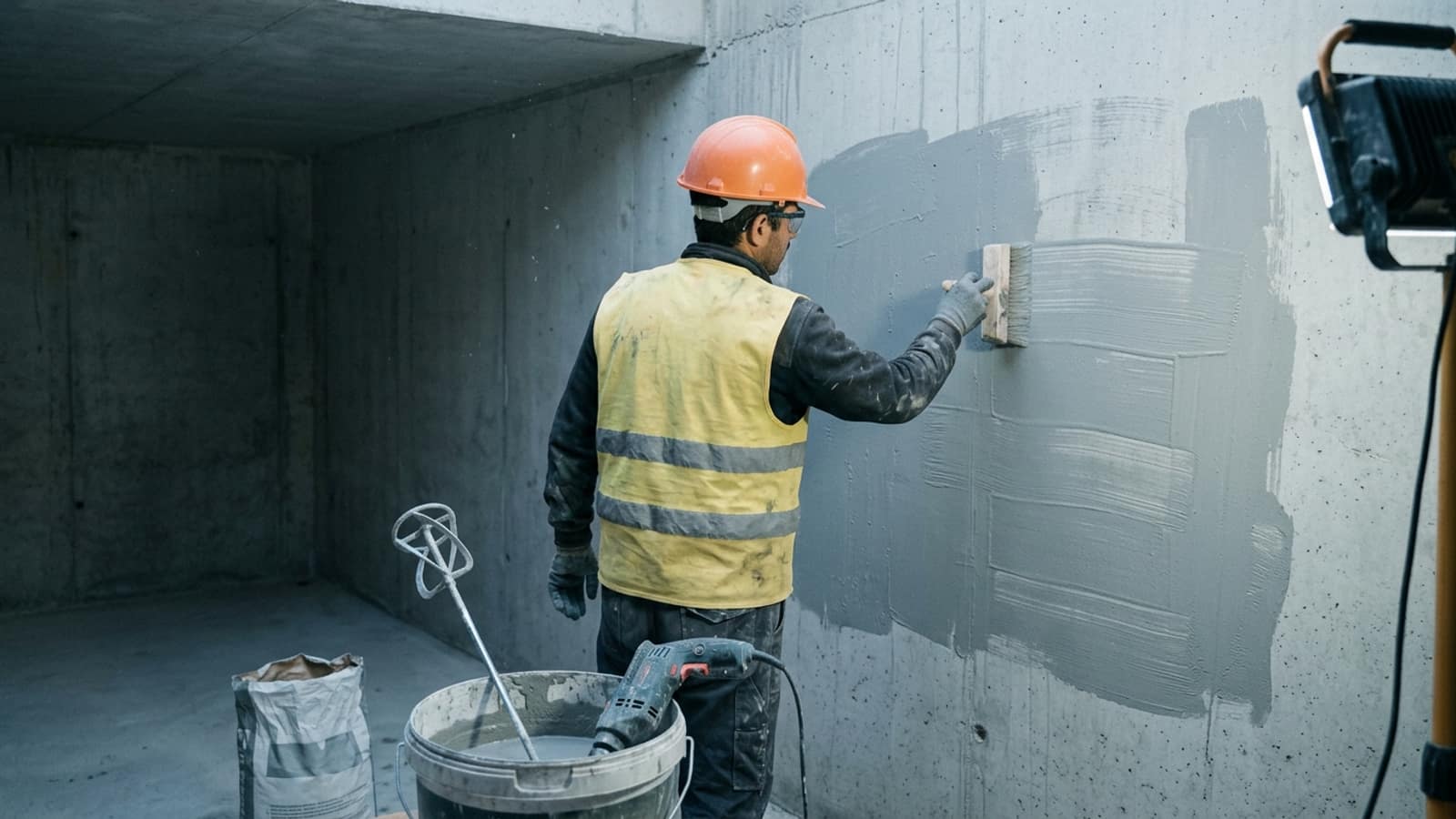
Cementitious and acrylic-based waterproofing materials provide effective protection against leaks and surface water on concrete, retaining walls and cement-based renders. Applicable from both inside and outside, this two-component material offers an ideal solution for water and damp proofing.
This fully flexible waterproofing material provides durability and flexibility on surfaces, creating long-lasting protection against the damaging effects of water. It can be chosen with confidence to prevent leaks indoors and to protect surfaces outdoors.
 Two-Component Formula: Provides superior protection against leaks and surface water. Flexible Structure: Offers resistance to surface movement and prevents cracking. Wide Field of Application: Easily applied to concrete, retaining wall and render surfaces indoors and outdoors. Durability: Offers long-lasting protection and a damp-proof barrier. Easy Application: Saves time thanks to practical application methods.
At Likit İzolasyon we increase the durability of your structures with quality materials and professional teams in cementitious waterproofing applications. Our waterproofing solutions give you long-term safety and comfort.
Drinking water tanks and reservoirs — with products certified as suitable for human health Swimming pools — a watertight layer beneath ceramic or mosaic tiling Wet areas — bathroom, shower and kitchen floors and skirting zones Against negative-side (internal) water pressure in basements and retaining walls Lift pits, water channels and treatment structuresThese are powder products containing cement and special additives, prepared by mixing with water alone. They are used on surfaces requiring high compressive strength where no movement is expected. The internal surfaces of water tanks and lift pits are typical applications.
These are prepared by adding a polymer-based liquid component to the powder component. On curing they form a flexible film and gain the ability to bridge fine cracks. They are preferred on terraces, balconies and pools where temperature change and slight movement are expected.
This is application from the side opposite to the incoming water — that is, from the internal surface of the structure. It is used in basements where intervention from outside is impossible. Because it works against water pressure, bond strength to the surface and compressive strength are critical.
1. Surface preparation: Loose concrete, laitance and oil residues on the surface are removed mechanically. An open-pored, rough and sound substrate is obtained. 2. Detail repairs: Points of active water ingress are stopped with plugging mortar. Cracks are opened up and filled with repair mortar, and coving is formed at internal corners. 3. Saturating the surface: Before application the surface is saturated with water, but no standing water is left. The saturated surface-dry condition allows the mortar to cure without losing its water. 4. Application in coats: The product is applied by brush, trowel or spray in at least two coats, with each coat at right angles to the previous one. Total thickness is checked against the manufacturer's data. 5. Curing and testing: Curing is carried out to prevent early loss of water. In water tanks and pools the specified waiting time before filling is observed and a water-holding test is performed. For liquid-applied waterproofing products used beneath ceramic tiling, TS EN 14891 is required. For applications that will be in contact with drinking water, the product must carry a certificate of suitability for human health. Rigid systems cannot bridge moving cracks; a flexible system must be chosen on surfaces where movement is expected. Application must not be carried out in direct sunlight or windy weather; otherwise rapid loss of water causes shrinkage cracks.Yes, this is one of the most important advantages of these systems. Once the cementitious waterproofing layer has cured sufficiently, tiling can be fixed over it with a suitable class of tile adhesive. No intermediate layer or protective screed is needed.
It is effective when correctly applied, but the ideal solution is always to waterproof from the side the water comes from. Because negative-side application holds the water pressure within the structural section, the concrete continues to remain wet. If intervention from outside is possible, that should be considered first.
Filling must not take place before the product's curing period is complete. As a general rule a few days' wait is required; in drinking water tanks, rinsing and emptying after the first fill is recommended. The product's technical data sheet governs the exact period.
Hairline shrinkage cracks are mostly caused by inadequate curing and can affect watertightness. In flexible systems this risk is low. In areas where cracks appear, an additional coat must be applied or a flexible system adopted.

Likit İzolasyon exceeded our expectations with their waterproofing and floor coating services. Thanks to their meticulous workmanship and on-time delivery, our building is now far safer and more durable.
During our building strengthening works we saw the difference of working with a professional team. With carbon fibre and concrete repair applications they gave our structure a new life. I would definitely recommend them!
We used their epoxy floor coating service and the result is incredible! We gained both an attractive appearance and a long-lasting, durable solution. I appreciate their professional approach.
We received terrace and foundation waterproofing services. With their polyurethane-based solutions in particular, they provided a permanent answer to water leaks. The team's professionalism and on-time delivery are truly commendable.
Concrete cracks and deterioration in our old building were causing serious problems. The Likit İzolasyon team made the structure safe again with concrete repair and protection. They kept us informed in detail at every stage of the process.
They did outstanding work on car park line marking and industrial painting projects. With thermoplastic paint they delivered a solution that is both attractive and long-lasting. The importance they place on occupational safety is a further plus!
We had epoxy and polyurethane floor coating applied in our factory. Our spaces gained both a durable and an attractive appearance. They are also very easy to clean. Thank you to the professional team!
We worked with Likit İzolasyon on building strengthening. Thanks to the carbon fibre application our structure became earthquake resistant. Their transparent and meticulous work from start to finish gave us confidence.
The concrete crack repair service completely solved the problems in our old building. Even the finest details were attended to during the work. We now have a structure we can use safely for many years.