
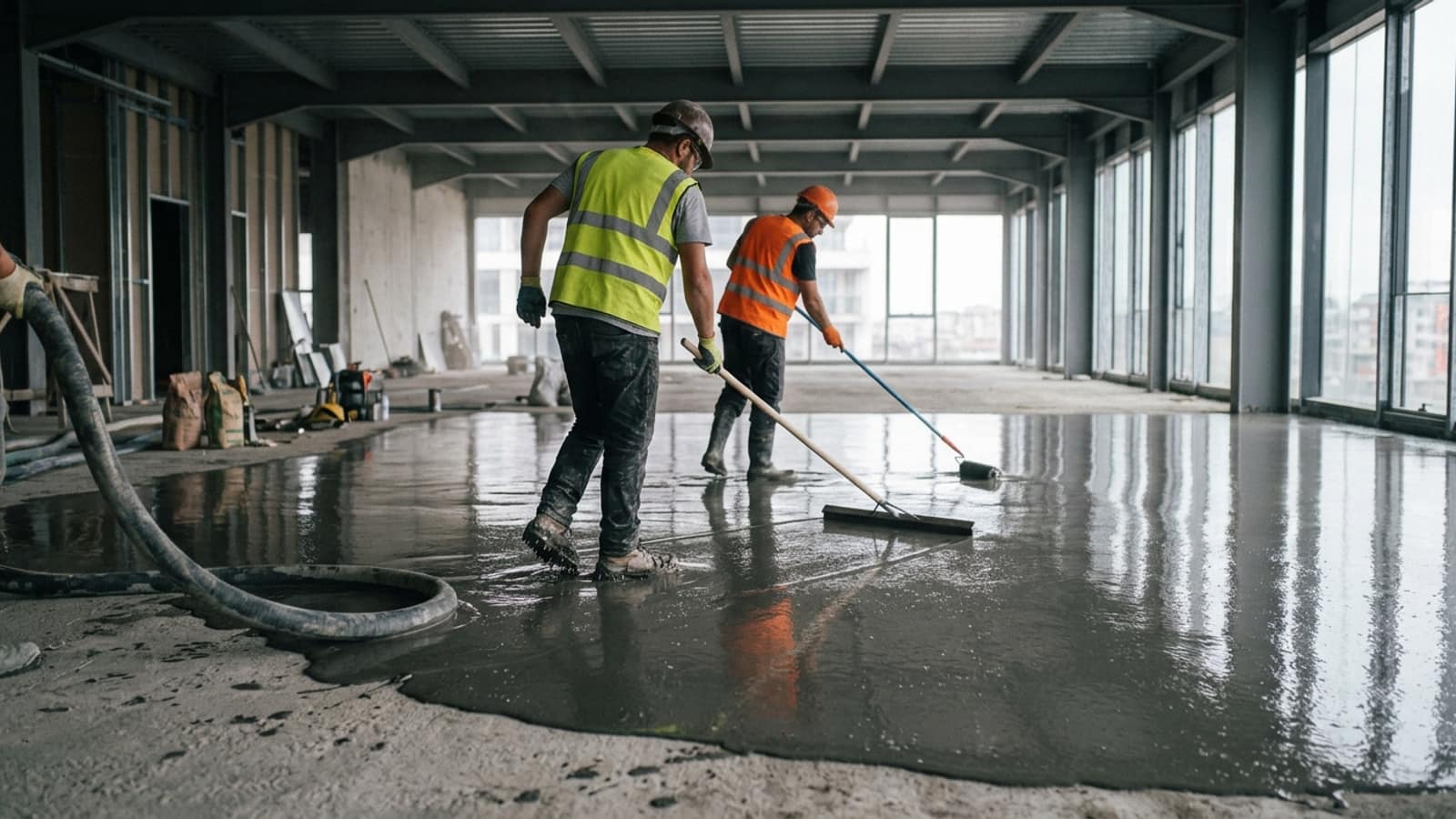
Self-levelling screed is a ready-mixed floor levelling screed that is cement-based, polymer-modified and self-spreading. This modern solution is an excellent choice for correcting irregularities in the floor and creating an even surface.
It is used in the installation of flooring elements such as epoxy coating, PVC flooring, carpet tiles and rolls, engineered parquet, laminate flooring and rubber. By levelling concrete and screed floors it creates an ideal substrate for flooring applications. Thanks to its self-spreading property, self-levelling screed saves time and produces a flawless surface.
 Self-Spreading Property: Easy to apply to the floor and produces a smooth surface. Even Floor Levelling: Eliminates uneven surfaces and creates a flat substrate. Wide Field of Use: Provides an ideal substrate for epoxy, PVC, parquet and other flooring materials. Savings in Time and Labour: Its quick application shortens project durations. A Long-Lasting Solution: Creates a solid and durable levelling layer.
Likit İzolasyon provides self-levelling screed applications with quality materials and professional teams. Choose our expert solutions to make your floors flatter and more durable.
Residential and office floors with underfloor heating Large commercial premises — projects requiring fast, even flooring A levelling layer before sensitive finishes such as parquet, ceramic tiles and carpet Correcting level differences and flatness on existing floors Refurbishment projects that must be ready for the finish in a short timeWhen mixed with water and poured, the material spreads by itself to create an even surface. It achieves far higher flatness values than traditional screed and requires no trowel work. The thickness can generally be adjusted from a few millimetres to a few centimetres.
Because their shrinkage is very low they reduce the need for joints over large areas. Their thermal conductivity is high, which gives an efficiency advantage in underfloor heating systems. They are not used in areas subject to persistent moisture.
Because the material encases the pipes completely and leaves no voids, heat transfer is efficient. The heating system must be commissioned for the first time using a controlled heating programme.
1. Floor preparation: The surface is cleaned and loose particles are removed. Levels are checked and the screed thickness is determined. 2. Priming: A primer is applied to balance absorbency. Without a primer the screed loses its water rapidly and its strength falls. 3. Edge strip and joints: An edge strip is applied at the base of walls so that the screed can move freely. A joint layout is set out where required. 4. Pouring: The mix is poured by pump or by hand and spread; a spiked roller is used to release air. Uninterrupted pouring is important over large areas. 5. Drying and preparation for the finish: The screed is cured in an environment free of draughts. Before the finish is laid, a moisture reading is taken to confirm that adequate dryness has been reached. Screed materials are divided into strength classes within the scope of TS EN 13813 ; the appropriate class must be chosen according to the type of finish. Measuring residual moisture before laying the finish is critical; screed covered too early causes blistering and deformation in parquet and PVC. Air movement and direct sunlight during application cause rapid drying at the surface and lead to cracking; the environment must be controlled. Anhydrite-based screeds must not be used in persistently damp environments.Because it spreads by itself it gives a far more even surface; the difference is clear with finishes that demand high flatness, such as parquet and large-format ceramic tiles. Application is also faster and the margin for workmanship error is lower.
This depends on thickness, product type and ambient conditions. A few days may be enough for thin applications, while thick screeds take longer. The decision must be based on a residual moisture reading, not on estimation.
Yes, this is one of its most common applications. Because it encases the pipes without voids, heat transfer is efficient. The first heating must follow a gradual programme in line with the product instructions; sudden heating can cause cracking.
With the correct primer, a suitable edge strip and controlled drying, the risk is low. Most cracking is caused by application without a primer, adding too much water, air movement, or neglecting the joint layout.

Likit İzolasyon exceeded our expectations with their waterproofing and floor coating services. Thanks to their meticulous workmanship and on-time delivery, our building is now far safer and more durable.
During our building strengthening works we saw the difference of working with a professional team. With carbon fibre and concrete repair applications they gave our structure a new life. I would definitely recommend them!
We used their epoxy floor coating service and the result is incredible! We gained both an attractive appearance and a long-lasting, durable solution. I appreciate their professional approach.
We received terrace and foundation waterproofing services. With their polyurethane-based solutions in particular, they provided a permanent answer to water leaks. The team's professionalism and on-time delivery are truly commendable.
Concrete cracks and deterioration in our old building were causing serious problems. The Likit İzolasyon team made the structure safe again with concrete repair and protection. They kept us informed in detail at every stage of the process.
They did outstanding work on car park line marking and industrial painting projects. With thermoplastic paint they delivered a solution that is both attractive and long-lasting. The importance they place on occupational safety is a further plus!
We had epoxy and polyurethane floor coating applied in our factory. Our spaces gained both a durable and an attractive appearance. They are also very easy to clean. Thank you to the professional team!
We worked with Likit İzolasyon on building strengthening. Thanks to the carbon fibre application our structure became earthquake resistant. Their transparent and meticulous work from start to finish gave us confidence.
The concrete crack repair service completely solved the problems in our old building. Even the finest details were attended to during the work. We now have a structure we can use safely for many years.