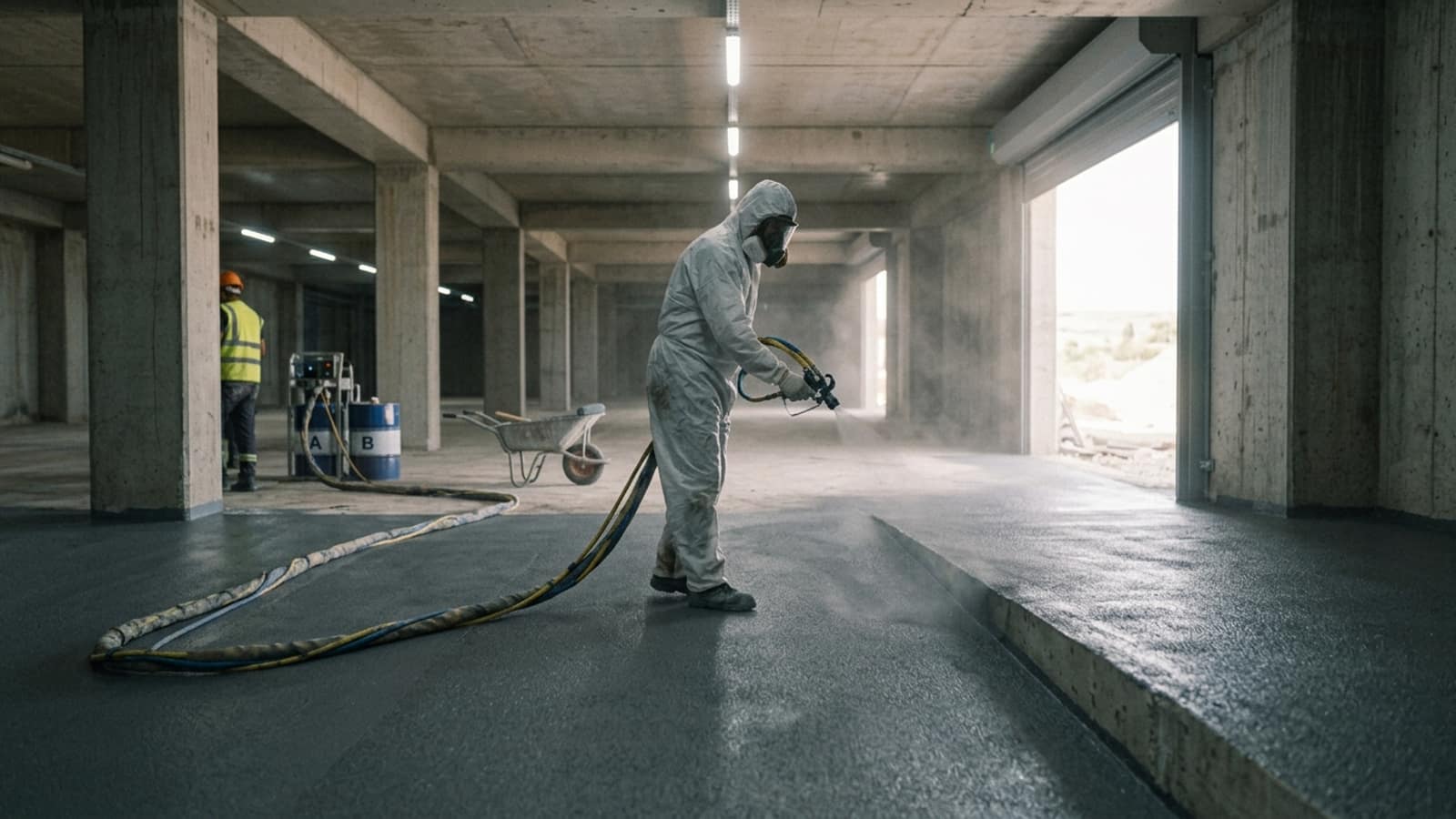
Polyurea coatings bring together durability and appearance with next-generation spray floor coating technology. Applied by spray, pure polyurea coatings offer outstanding waterproofing, excellent floor protection and a decorative finish.
Free of the weak points found in traditional coating systems — overlaps, joints and seams — polyurea coatings form a seamless structure through the spray method. Thanks to their crack-bridging property, excellent results are achieved even at complex details such as movement joints, chimney bases and recesses and protrusions.
 A Seamless Surface: Eliminates the weak points found in traditional coatings. High Waterproofing: Provides a 100% watertight structure. Attractive Appearance: Offers visual superiority with its decorative surface. Long-Lasting Protection: Offers high resistance to abrasion, impact and environmental factors. Fast Application: Provides quick, effective coating through the spray method.
With expert staff and high-quality application methods, Likit İzolasyon brings durability and beauty to your structures through polyurea coating services. Discover our polyurea solutions tailored to your projects.
Rapid floor renewal in facilities where production cannot be halted Loading ramps, lorry parking areas and zones exposed to heavy impact Chemical spillage pits and containment areas Cold stores — areas requiring application at low temperatures Car park and bridge decks — surfaces that must be reopened to traffic quicklyIt gels within seconds of application and can be walked on within minutes. Being able to apply it within one shift and return to production the next day is a decisive advantage in facilities where downtime is costly.
Thanks to its high elongation at break it absorbs impact energy and displays crack-bridging capability. It is superior to epoxy in areas where there is a risk of heavy objects being dropped.
High slip resistance is achieved by broadcasting quartz or aluminium oxide aggregate during or after spraying. This detail is essential on ramps and in wet areas.
1. Surface preparation: The concrete is opened up by shot blasting or milling; any loose layer is removed completely. 2. Repairs and anchoring: Cracks and voids are filled and anchor grooves are cut at the edge zones. 3. Primer: On porous concrete a primer is applied to prevent gas escape; otherwise pinholes form on the surface during spraying. 4. Spraying: The target thickness is reached in a single pass using heated high-pressure equipment. The mixing ratio and temperature are monitored continuously. 5. Inspection and return to service: Dry film thickness is measured and, where necessary, a holiday (continuity) test is carried out. After a short curing period the area is opened for use. Because polyurea cures so quickly it leaves no opportunity to correct the surface; the applicator's experience directly determines the result. Aromatic polyurea changes colour under UV; if appearance matters, an aliphatic top coat must be applied. Its tolerance of moisture and low temperature is high; it delivers reliable results even in adverse site conditions. Surface protection systems fall within TS EN 1504-2 .Yes. Polyurea becomes walkable within minutes and can generally be opened to light vehicle traffic a few hours later. This makes floor renewal possible with a weekend or single-shift shutdown; when the cost of lost production is taken into account, this more than offsets the material cost.
The unit cost per square metre is higher than epoxy because it requires special equipment and a trained applicator. However, the short downtime, long service life and low maintenance requirement make the total cost of ownership advantageous on many projects.
It is not as smooth as self-levelling epoxy; a sprayed texture remains. In most industrial areas this texture is an advantage in terms of slip resistance. If a smooth, glossy surface is required, polyurea is not the right choice.
Static cracks must first be filled with resin. Thanks to its elastic structure polyurea can bridge fine cracks with limited movement, but wide, actively moving joints must be carried through into the coating and resolved with an elastic sealant.

Likit İzolasyon exceeded our expectations with their waterproofing and floor coating services. Thanks to their meticulous workmanship and on-time delivery, our building is now far safer and more durable.
During our building strengthening works we saw the difference of working with a professional team. With carbon fibre and concrete repair applications they gave our structure a new life. I would definitely recommend them!
We used their epoxy floor coating service and the result is incredible! We gained both an attractive appearance and a long-lasting, durable solution. I appreciate their professional approach.
We received terrace and foundation waterproofing services. With their polyurethane-based solutions in particular, they provided a permanent answer to water leaks. The team's professionalism and on-time delivery are truly commendable.
Concrete cracks and deterioration in our old building were causing serious problems. The Likit İzolasyon team made the structure safe again with concrete repair and protection. They kept us informed in detail at every stage of the process.
They did outstanding work on car park line marking and industrial painting projects. With thermoplastic paint they delivered a solution that is both attractive and long-lasting. The importance they place on occupational safety is a further plus!
We had epoxy and polyurethane floor coating applied in our factory. Our spaces gained both a durable and an attractive appearance. They are also very easy to clean. Thank you to the professional team!
We worked with Likit İzolasyon on building strengthening. Thanks to the carbon fibre application our structure became earthquake resistant. Their transparent and meticulous work from start to finish gave us confidence.
The concrete crack repair service completely solved the problems in our old building. Even the finest details were attended to during the work. We now have a structure we can use safely for many years.