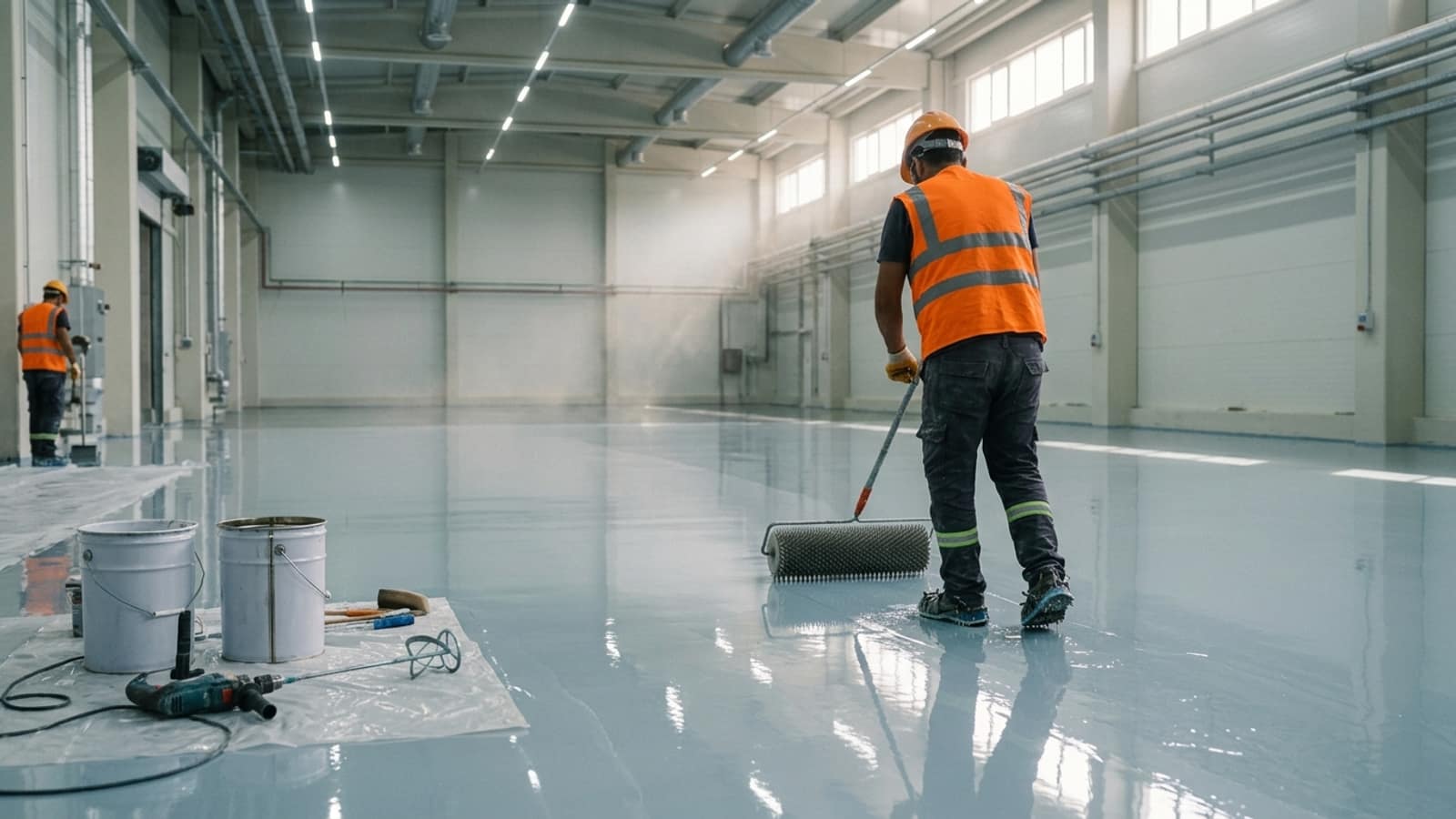
Epoxy is a durable, long-lasting floor coating solution that, once applied in liquid form and cured, acquires high resistance to water, acids and alkalis. Thanks to its high-strength structure it is easy to clean and does not lose its resistance over time. These properties make epoxy floor coating one of the most widely chosen solutions in both industrial and decorative areas.
During application, epoxy passes from a liquid to a solid state as it cures and reaches its final hardness. As well as being durable, it offers an attractive appearance and is used in many fields, from wind turbine blades to boatbuilding. In floor coating applications there are various types of epoxy that can be tailored to different requirements:
 Self-Levelling Epoxy Coating: A type of epoxy that spreads by itself and forms a smooth surface. Antistatic Epoxy Coating: A coating that controls electrical conductivity, used particularly in industrial areas. Multilayer Epoxy Coating: Offers high durability with its multi-layered structure. 3D Epoxy Coating: A type of coating used for decorative purposes, adding depth and visual interest to floors. Orange-Peel Epoxy Coating: A coating chosen for its anti-slip surface and attractive appearance. Clear Epoxy Coating: A type of epoxy that protects the materials beneath and offers a natural appearance. High Durability: Provides superior protection against water, acids and alkalis. Easy Cleaning: Hygienic and easy to clean thanks to its smooth surface. Long-Lasting Protection: Offers a durable solution that does not lose its resistance over time. Various Areas of Application: Has a wide range of use, from industrial facilities to decorative areas. Attractive Appearance: Adds elegance to the space with different design options. Fast Application: Completes your projects within a short time with practical application methods.
With the use of quality materials and professional application services in epoxy floor coating solutions, Likit İzolasyon offers both durability and good looks together. Discover our epoxy coating services suited to your different requirements.
Food and beverage production facilities — production lines requiring hygiene and ease of cleaning Pharmaceutical and cosmetics factories, clean rooms and laboratories Automotive and machinery manufacturing workshops — floors exposed to oil, solvents and mechanical loads Warehouses and logistics centres — large areas under forklift traffic and racking loads Hospital, outpatient clinic and operating theatre corridors Car parks, showrooms and commercial spacesThis is the thinnest system, penetrating the pores of the concrete to reduce dusting and consolidate the surface. It is low in cost, but chemical and mechanical protection is limited. It is chosen as an economical solution in warehouses and plant rooms.
This is a coloured coating applied by roller or trowel. It seals the surface, makes cleaning easier and provides moderate chemical resistance. It is suitable for areas with light to moderate traffic.
This is a system in which a flowing resin spreads by itself to form a smooth surface. It offers high visual quality, a seamless appearance and good chemical resistance. It is the standard solution for food, pharmaceutical and laboratory applications.
This is the system with the highest mechanical strength, in which resin is mixed with quartz aggregate and applied by trowel. It is used in production areas with heavy impact, dropped pallets and intensive forklift traffic.
1. Floor testing: The surface tensile strength, relative humidity and flatness are measured. The coating thickness and system type are finalised on the basis of these data. 2. Mechanical preparation: The cement laitance is removed by shot blasting or diamond grinding to obtain an open-pored surface. This is the stage that most affects the life of the coating. 3. Repair and anchor grooves: Cracks are filled with resin and voids are made good with repair mortar. Anchor grooves are cut at the foot of walls and around outlets to prevent the coating lifting at the edges. 4. Primer and quartz broadcast: An epoxy primer is applied; in thick systems quartz is broadcast over the primer to increase mechanical keying. 5. Body coat and top coat: Application is carried out in successive coats according to the system thickness. A spiked roller is used for deaeration. In areas requiring slip resistance, aggregate is broadcast before the top coat. 6. Curing and return to service: Approximately 24 hours is allowed for foot traffic, 2–3 days for vehicle traffic and 7 days for full chemical resistance. The tensile strength of the concrete surface should generally be above 1.5 N/mm² ; at lower values the floor is improved first. High relative humidity in the concrete causes blistering and debonding in epoxy coatings; a moisture-barrier primer or a moisture-tolerant system may be required. Screeds and floor mortars are classified under TS EN 13813, and surface protection systems under TS EN 1504-2 . Epoxy can yellow over time under UV; a polyurethane top coat is recommended outdoors and in areas receiving plenty of light. During application the ambient temperature should generally not fall below 10 °C; curing stops at low temperatures.The load in use determines this. In areas for foot traffic and hygiene, a 1.5–2 mm self-levelling system is sufficient. If forklift traffic is heavy, 3 mm and above is recommended, and 4–9 mm trowel mortar where there is a risk of heavy impact and dropped pallets. Thin systems are more economical but have a shorter life.
Epoxy is a rigid material; if the concrete beneath cracks, the coating follows that line. For this reason existing cracks are filled with resin before application and moving joints are carried through into the coating. On floors where movement is expected, polyurethane is more suitable.
A resin odour is noticeable during application and in the first hours of curing. In solvent-free systems this odour is markedly less. Once curing is complete no odour remains; solvent-free products are preferred in food and healthcare facilities.
It does not affect performance, but it makes a difference in use. Light colours improve lighting efficiency and make spills visible; dark colours conceal dirt. In production areas, different colours are also used to distinguish zones.

Likit İzolasyon exceeded our expectations with their waterproofing and floor coating services. Thanks to their meticulous workmanship and on-time delivery, our building is now far safer and more durable.
During our building strengthening works we saw the difference of working with a professional team. With carbon fibre and concrete repair applications they gave our structure a new life. I would definitely recommend them!
We used their epoxy floor coating service and the result is incredible! We gained both an attractive appearance and a long-lasting, durable solution. I appreciate their professional approach.
We received terrace and foundation waterproofing services. With their polyurethane-based solutions in particular, they provided a permanent answer to water leaks. The team's professionalism and on-time delivery are truly commendable.
Concrete cracks and deterioration in our old building were causing serious problems. The Likit İzolasyon team made the structure safe again with concrete repair and protection. They kept us informed in detail at every stage of the process.
They did outstanding work on car park line marking and industrial painting projects. With thermoplastic paint they delivered a solution that is both attractive and long-lasting. The importance they place on occupational safety is a further plus!
We had epoxy and polyurethane floor coating applied in our factory. Our spaces gained both a durable and an attractive appearance. They are also very easy to clean. Thank you to the professional team!
We worked with Likit İzolasyon on building strengthening. Thanks to the carbon fibre application our structure became earthquake resistant. Their transparent and meticulous work from start to finish gave us confidence.
The concrete crack repair service completely solved the problems in our old building. Even the finest details were attended to during the work. We now have a structure we can use safely for many years.