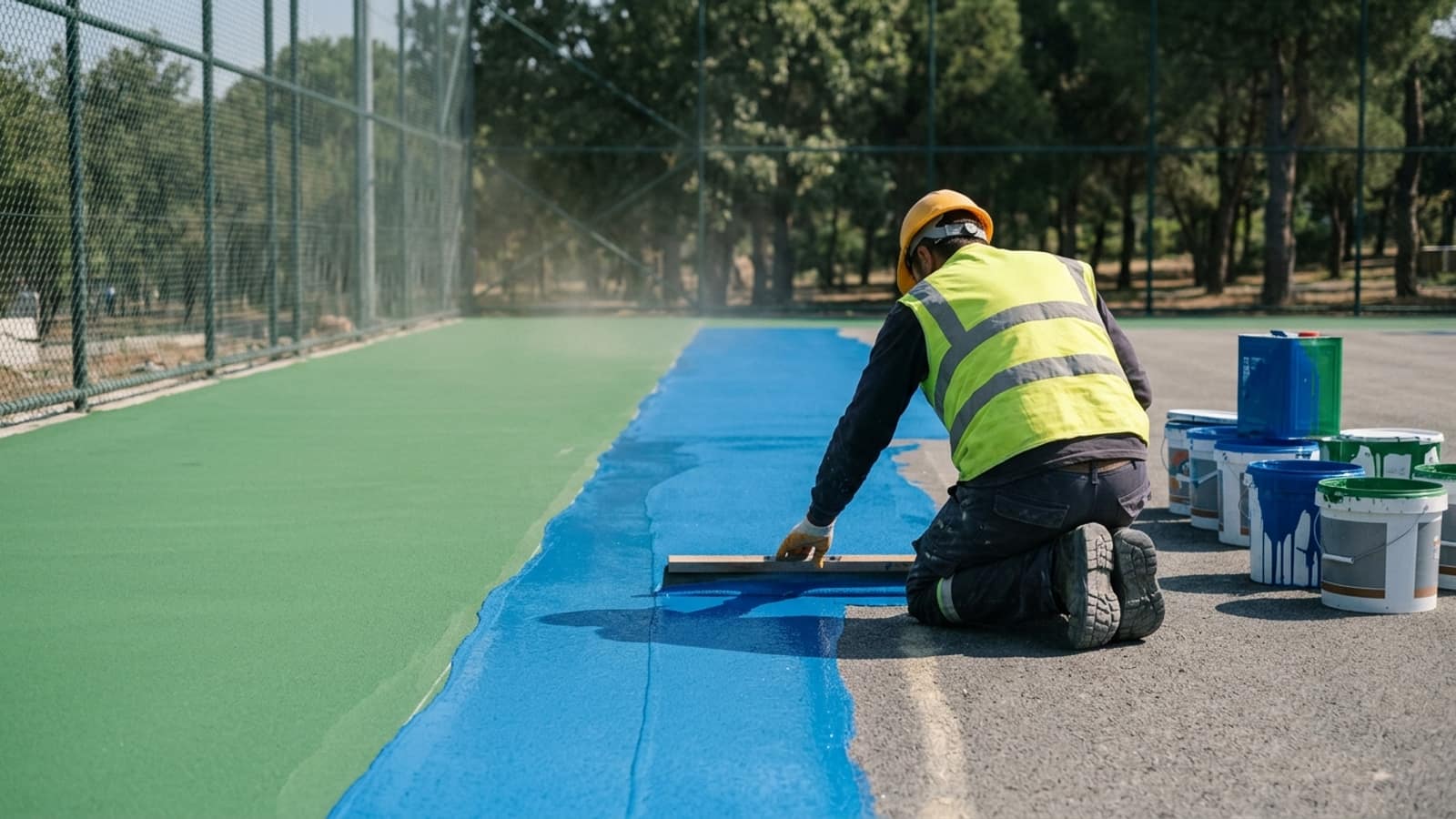
Acrylic floor coating offers an ideal solution for sports courts both outdoors and indoors. With hard and cushioned surface options, this coating system delivers high performance for the sport and the athletes and stands out for its durability and appearance.
Thanks to its economical nature and wide range of colours, acrylic floor coating can be used both for tennis courts built to professional standards and for other sports areas. This surfacing increases the comfort of athletes while providing a long-lasting floor solution.
 Hard and Cushioned Surface Options: Offers surface choices that support athletes' performance. Economical and Durable: Advantageous in terms of cost and long-lasting. Attractive, Colourful Appearance: Provides a professional look with a wide range of colours. Versatile Use: Can be used on outdoor and indoor sports courts. Professional Standards: Creates tennis courts and sports areas that meet world standards.
With quality materials and expert application services, Likit İzolasyon offers athletes and facilities durable, attractive and economical acrylic floor coating solutions.
Tennis, basketball and volleyball courts — outdoor sports surfaces School playgrounds and multi-purpose play areas Walking and running tracks Outdoor surfaces exposed to UV such as car parks and terraces Indoor applications requiring rapid return to service (MMA-based systems)These systems are applied coat by coat over asphalt or concrete and consist of cushion and colour layers. Ball bounce and player comfort can be adjusted by the number of cushion layers. UV resistance is high and colour stability is retained for a long time.
These are reactive systems that cure very quickly and can be returned to service within a few hours. Because they can be applied even at low temperatures, they are advantageous in cold stores and in winter projects.
Surface speed and slip resistance are adjusted by changing the fineness of the aggregate within the system. This is how the pace of play is set on tennis courts; fast, medium and slow court options can be created.
1. Assessment of the substrate: The flatness of the asphalt or concrete, the condition of any cracks and water drainage are checked. Areas where water ponds are identified. 2. Surface repair and levelling: Cracks are filled and ponding areas are levelled with a levelling mortar. Standing water is not acceptable on sports surfaces. 3. Primer: A primer suited to the surface is applied to balance adhesion and absorbency. 4. Cushion and colour coats: The surface texture is built up with cushion coats, after which the colour coats are applied. The number of coats is determined according to the desired comfort and pace of play. 5. Line marking: Lines are applied with stencils to the federation dimensions of the relevant sport and the final protective coat is applied. On outdoor sports surfaces, water drainage is an integral part of performance; ponding shortens the life of the surface. Water-based acrylic systems must not be applied on days when rain is expected; an uncured surface will be washed away. For synthetic outdoor sports surfaces, EN 14877may be used as a reference, and for indoor hall floors, TS EN 14904 . Colour choice affects surface temperature; dark colours become noticeably hotter during the summer months.This depends on intensity of use and climate conditions. Correctly applied systems serve for many years; renewing the colour coats at regular intervals preserves both appearance and playing characteristics. The soundness of the substrate directly determines service life.
Yes, asphalt is the most common substrate for outdoor sports surfaces. The asphalt must be sufficiently cured and the surface oils must have evaporated. Application proceeds once flatness and water drainage have been checked.
Yes. On tennis courts in particular, the fineness of the surface aggregate and the structure of the cushion layers determine the speed at which the ball bounces. Fine-textured surfaces give a fast court character, coarse-textured surfaces a slow one.
The system is designed to withstand freeze-thaw cycles. The real risk is water ponding on the surface and freezing; correct falls and drainage are therefore critical. Metal-tipped tools must not be used when clearing snow.

Likit İzolasyon exceeded our expectations with their waterproofing and floor coating services. Thanks to their meticulous workmanship and on-time delivery, our building is now far safer and more durable.
During our building strengthening works we saw the difference of working with a professional team. With carbon fibre and concrete repair applications they gave our structure a new life. I would definitely recommend them!
We used their epoxy floor coating service and the result is incredible! We gained both an attractive appearance and a long-lasting, durable solution. I appreciate their professional approach.
We received terrace and foundation waterproofing services. With their polyurethane-based solutions in particular, they provided a permanent answer to water leaks. The team's professionalism and on-time delivery are truly commendable.
Concrete cracks and deterioration in our old building were causing serious problems. The Likit İzolasyon team made the structure safe again with concrete repair and protection. They kept us informed in detail at every stage of the process.
They did outstanding work on car park line marking and industrial painting projects. With thermoplastic paint they delivered a solution that is both attractive and long-lasting. The importance they place on occupational safety is a further plus!
We had epoxy and polyurethane floor coating applied in our factory. Our spaces gained both a durable and an attractive appearance. They are also very easy to clean. Thank you to the professional team!
We worked with Likit İzolasyon on building strengthening. Thanks to the carbon fibre application our structure became earthquake resistant. Their transparent and meticulous work from start to finish gave us confidence.
The concrete crack repair service completely solved the problems in our old building. Even the finest details were attended to during the work. We now have a structure we can use safely for many years.