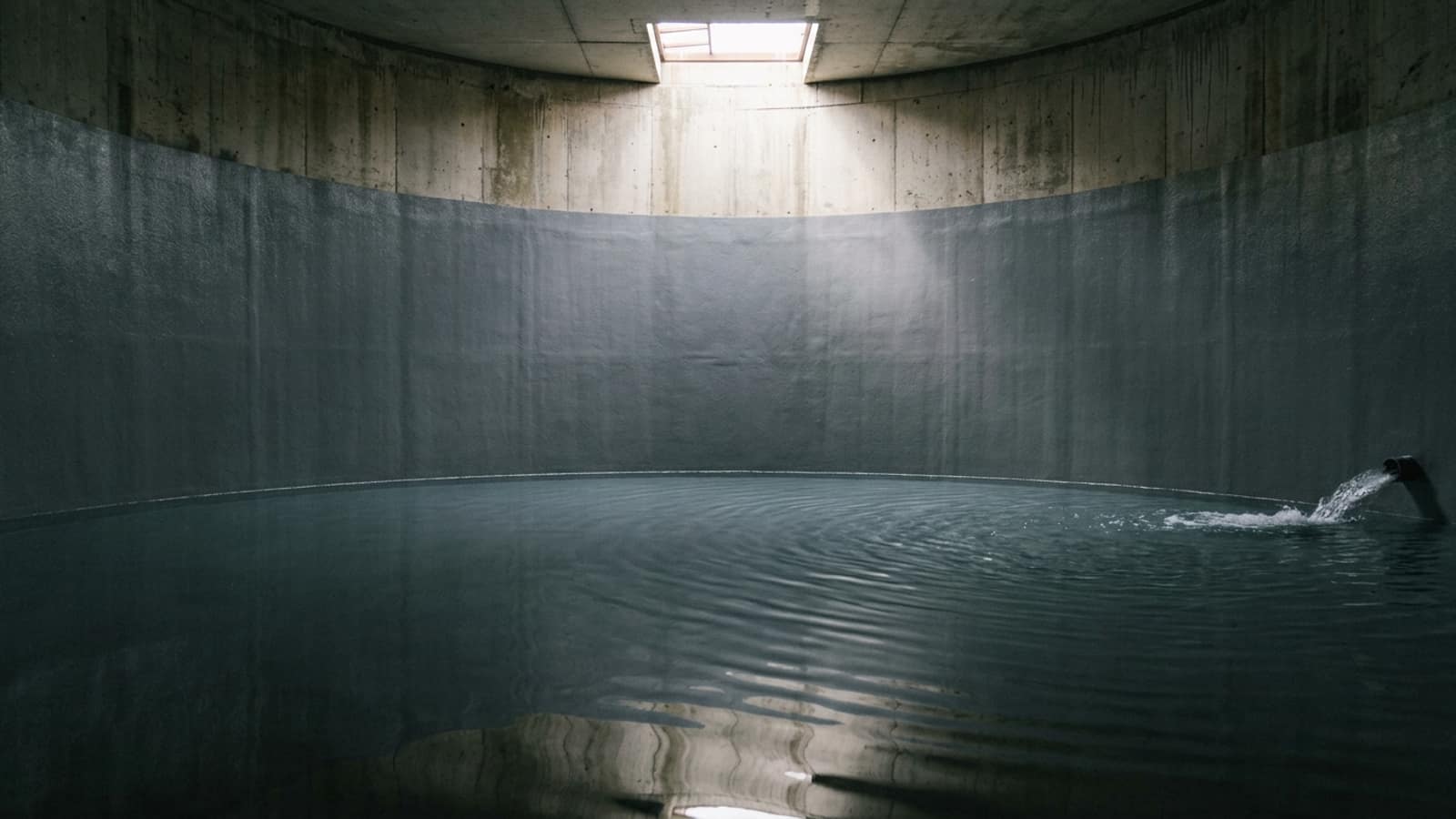
The first criterion for a product to be used in a potable water tank is not its technical performance but its health certification. A product without certification, however good it may be, is not used in that volume.

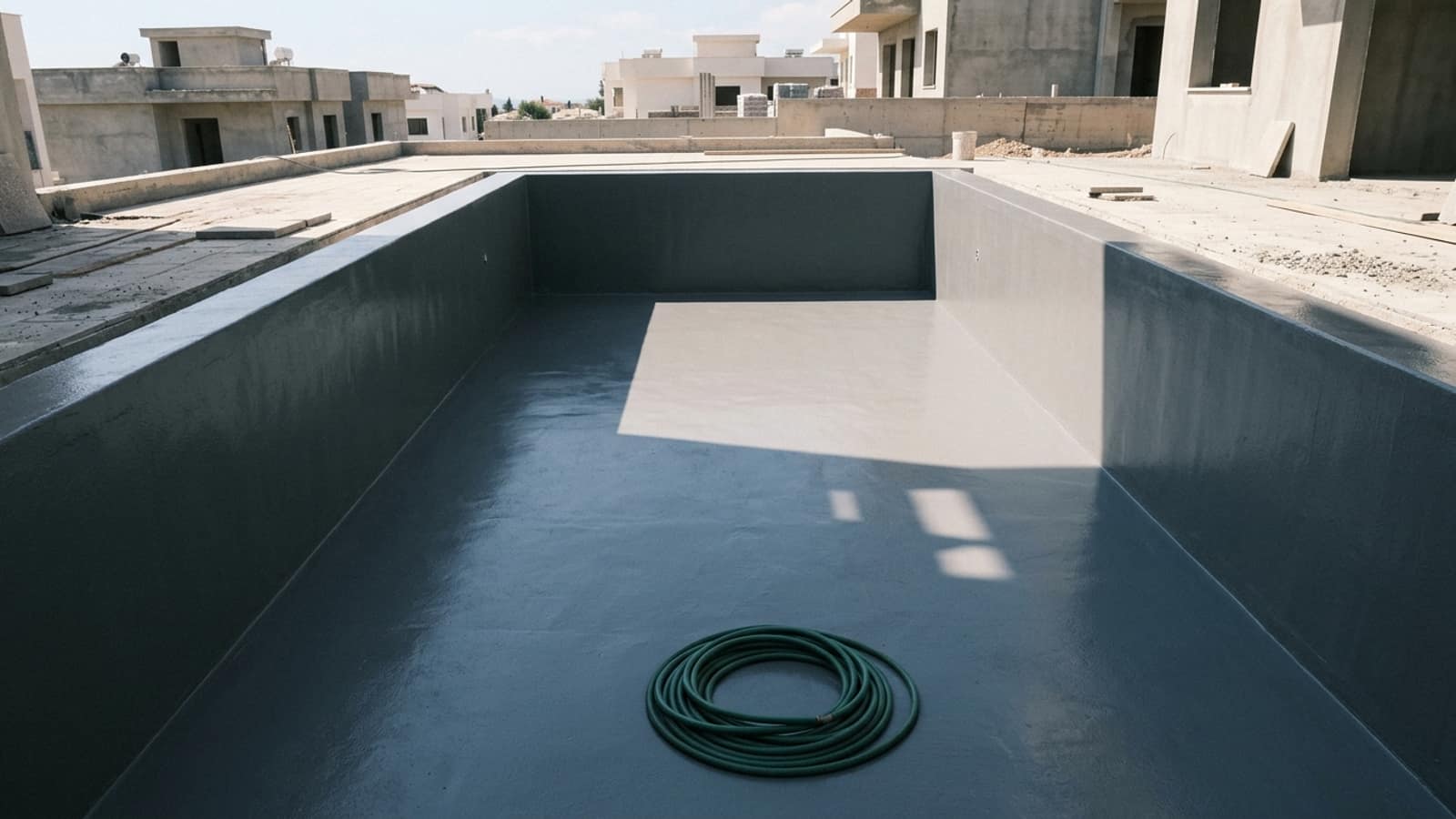
Water-retaining structures are the most demanding area of waterproofing. The reason is simple: here water is not a temporary threat but the permanent operating condition of the structure. The surface is submerged every day of the year, pressure is applied without interruption, and a failure becomes visible immediately — the water level drops.
Three additional constraints come into play when deciding on pool and water tank waterproofing: health certification, compatibility with the finish that will go over it, and the cost of the time the tank spends empty. In this article we address system selection, application steps, water testing and leak detection through these constraints.

The first criterion for a product to be used in a potable water tank is not its technical performance but its health certification. A product without certification, however good it may be, is not used in that volume.
Ahmet Toka, General Manager
On a terrace, water stays for a few hours and drains away. In a pool it stays for years. That difference changes what is expected of the waterproofing.
Three system groups stand out in water-retaining structures. The choice is made according to how the structure is used and whether it can be emptied.
This group accounts for the majority of pool and water tank applications. It can be applied to a damp surface, bonds chemically to concrete and can also work on the negative side. Most importantly, ceramic and mosaic can be adhered directly over it; in pools this eliminates the need for a separate intermediate layer. Health-certified types are used in potable water reservoirs. Details: cementitious applications.
It forms the waterproofing not on the surface but within the concrete mass. Even if the surface layer wears away, impermeability remains within the cross-section; in continuous water contact this is a significant durability advantage. Its ability to self-seal hairline cracks on contact with water is valuable in tanks that are difficult to empty. It is usually designed together with a cementitious system, as two-layer assurance. Details: crystalline concrete admixture applications.
Used in large-volume tanks, treatment structures and free-form pools. Polyurea allows a structure to be put back into service within hours; its chemical and abrasion resistance is high. In wide ponds and pools with irregular geometry, PVC membrane is a fast and economical solution. In both cases the health certificate must be separately verified for potable water use.
A water test in a pool or tank is more measurable than on a terrace: the drop in level can be read directly. However, evaporation and temperature differences also lower the level, so the test has to be set up correctly.
The correct method: The volume is filled and the level is marked. An open container filled with water is placed in the same environment and its level is marked too. After 24–72 hours the drop in the two levels is compared. If the drop in the pool is clearly greater than the evaporation in the container, there is a leak.
Methods used to locate the leak include narrowing down the area by closing and opening plumbing valves, testing the bottom drain and overflow lines separately, introducing dyed water at suspect points to follow the direction of flow, and pressure testing where necessary. Distinguishing whether the water loss comes from the plumbing or the structure is the first step towards the correct intervention.
For an overview see waterproofing page.
Prevent the damaging effects of leaks and damp on your concrete, retaining wall and render surfaces with cementitious waterproofing. Achieve long-lasting protection with Likit İzolasyon's two-component flexible solutions!
Service details →Crystalline concrete admixture penetrates the mass of the concrete to provide permanent waterproofing. It also works on the negative side in water tanks, basements, lift pits and pools. Applied with Likit İzolasyon expertise.
Service details →Achieve 100% waterproofing, seamless durability and attractive floor protection with pure polyurea coating. Get excellent results even on complex surfaces with Likit İzolasyon's innovative technologies!
Service details →Give your structures complete protection against the harmful effects of water and damp with Likit İzolasyon! With our foundation, roof, wet area and façade waterproofing services we make your buildings durable and long-lasting. Get in touch now for professional service!
Service details →They can, but it will not hold water. Tile adhesive and grout are not a watertight system; water passes through the joints and reaches the concrete. There must be a separate waterproofing layer beneath the finish.
Only products holding a certificate of suitability for human health. These are usually certified cementitious systems and certain polyurea products. Product documentation must always be requested before application and kept on file.
No. Evaporation causes a noticeable drop in level, particularly in hot and windy weather. For a correct assessment, a comparison must be made with a container of water placed in the same environment. If the difference is clear, there is a leak.
Not for a surface application; the volume must be emptied. However, where emptying is not possible, stopping active leaks by injection from outside can provide a temporary solution. A permanent solution requires emptying.
With cementitious systems, curing and the subsequent tiling generally require one to two weeks in total. With polyurea this drops to hours; in facilities where speed of return to service is critical, this difference can determine the choice. The manufacturer's waiting period must always be observed before filling with water.
Yes. The existing finish is stripped, the surface is cleaned and repaired, active leaks are stopped and the new system is applied. If there is a structural crack or settlement, that must be dealt with first; otherwise the new waterproofing will be stressed at the same point.
With over 25 years of field experience, let us determine the right solution for your building together. Contact us for a survey and quotation.
Over 25 years of field experience in waterproofing, floor coatings and structural strengthening. This article is based on applications encountered on site and the standards currently in force.