The most valuable property of a crystalline system is that it keeps working even on surfaces that can no longer be reached. A hairline crack forming years later can close again on contact with water.

We usually think of waterproofing as a layer laid on top of concrete. Crystalline systems turn that logic around: they place the waterproofing not on top of but inside the concrete. The concrete mass itself becomes impermeable and dependence on an external skin layer disappears.
This is a significant advantage, particularly for structures whose surfaces cannot be reached again later. In this article we look at how crystalline admixture works chemically, which structures it is preferred in, how it differs from membrane systems, and what its limits are.

The most valuable property of a crystalline system is that it keeps working even on surfaces that can no longer be reached. A hairline crack forming years later can close again on contact with water.
Ahmet Toka, General Manager
Concrete is not as solid a material as it appears. During setting, part of the mix water does not react with the cement and, as it evaporates, leaves capillary voids behind. It is through this capillary network that water penetrates concrete.
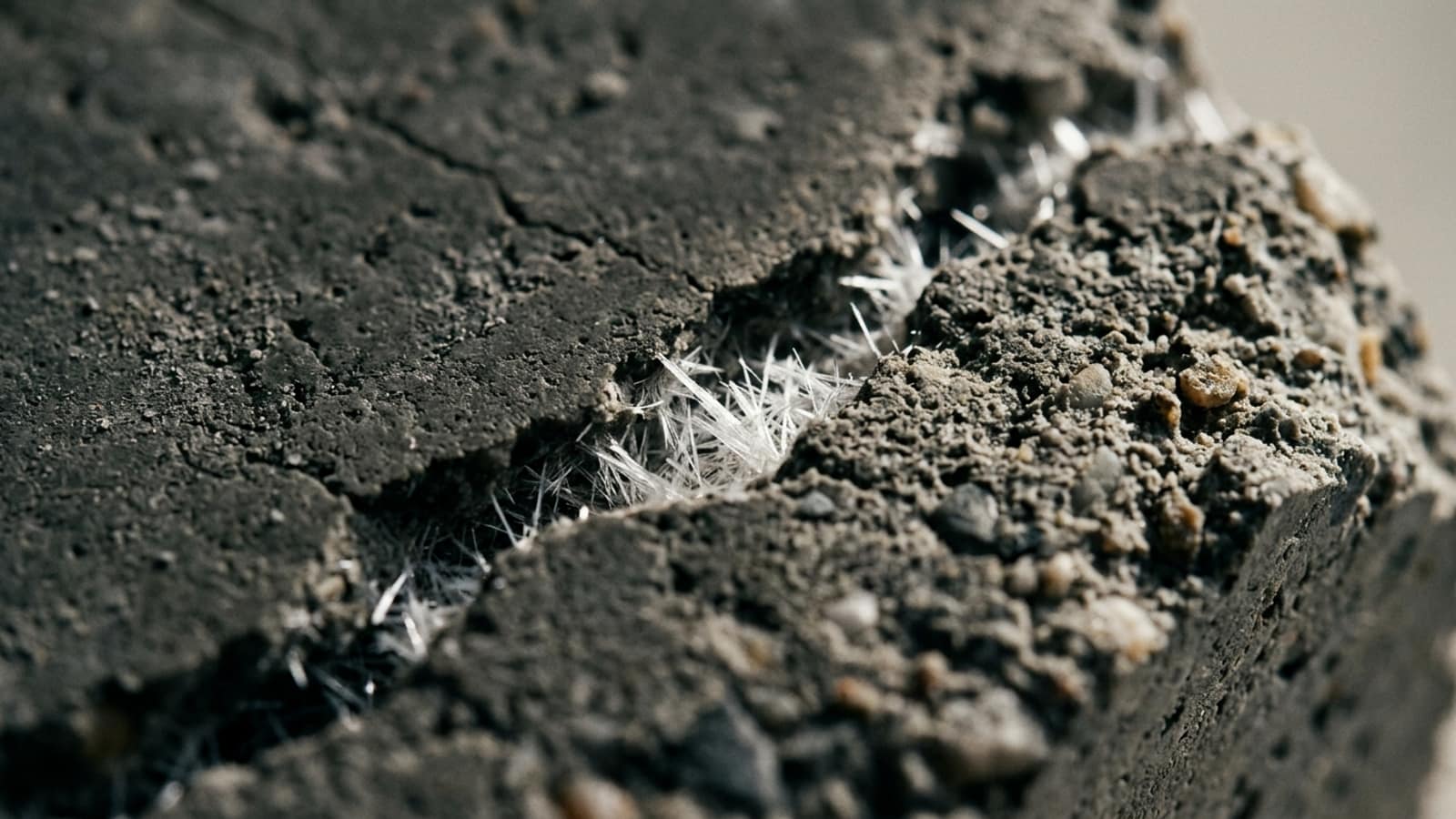
Crystalline admixture reacts with the lime and moisture present in the concrete to form insoluble needle-like crystals. These crystals fill the capillary voids and micro-cracks, leaving no continuous path for water. The reaction continues while moisture is present, goes dormant in a dry environment and restarts when water returns.
This "reawakening" is the system's most striking feature: a hairline crack forming years later can close by itself as water contact restarts crystallisation. The limit is generally cracks of hair-like fineness; for wide and moving cracks this mechanism is not sufficient.
Crystalline technology reaches the site in two different forms.
The powder product is added to the concrete mix in the truck mixer or at the batching plant. As soon as the concrete is poured it acquires impermeability throughout its full section. No separate application labour, surface preparation or drying time is needed; it is the method that places the least burden on the programme.
The greatest advantage of this method is that it needs no protection layer. Unlike a membrane it cannot be punctured or torn and is not damaged during backfilling, because there is no separate layer to protect.
The powder product is mixed with water and applied to the hardened concrete surface by brush or spray. The active ingredients migrate inwards through the concrete's capillary network and crystallisation takes place within the section. In other words the surface layer is not a coating but a carrier; even when that layer wears away, the waterproofing remains inside the concrete.
This method can be applied on the negative side in existing structures, on the internal surfaces of water tanks, in lift pits and on basement retaining walls. Details: crystalline concrete admixture applications.
| Crystalline | Membrane | |
|---|---|---|
| Location | Within the concrete mass | On the concrete surface |
| Risk of puncture | None | Yes (protection required) |
| Negative side | Works | Does not work |
| Closing hairline cracks | Automatically | None |
| Moving joint / wide crack | Cannot solve | Elastic types can solve |
| Inspection after application | Not visible | Visible |
| Effect on programme | Very little | A separate work item |
The most important row in the table is the third from the bottom: a crystalline system cannot solve moving joints and wide cracks. These areas must in every case be addressed separately with waterstops, joint sealing applications and, where necessary, injection .
For an overview of waterproofing as a whole see our waterproofing page.
Because crystalline systems work invisibly, expectations are easily set wrong. The misunderstandings we encounter most often on site are these:
When these expectations are set correctly, crystalline systems provide a very valuable layer of assurance, especially on surfaces that cannot be reached again later.
Crystalline concrete admixture penetrates the mass of the concrete to provide permanent waterproofing. It also works on the negative side in water tanks, basements, lift pits and pools. Applied with Likit İzolasyon expertise.
Service details →Prevent the damaging effects of leaks and damp on your concrete, retaining wall and render surfaces with cementitious waterproofing. Achieve long-lasting protection with Likit İzolasyon's two-component flexible solutions!
Service details →Give your structures complete protection against the harmful effects of water and damp with Likit İzolasyon! With our foundation, roof, wet area and façade waterproofing services we make your buildings durable and long-lasting. Get in touch now for professional service!
Service details →Make your surfaces durable and attractive with joint sealing applications. Achieve long-lasting results with the professional joint sealing solutions of Likit İzolasyon!
Service details →In many structures it does, in some it does not. It is strong in terms of integral impermeability and closing hairline cracks; however it cannot solve moving joints, wide cracks or junctions between structural elements. In critical structures the two systems are used together, each backing up the other.
Used at the correct dosage it does not adversely affect strength; because capillary voids are filled, permeability falls while strength is usually maintained or slightly increased. Excessive dosage can extend setting time, so the manufacturer's limits must be observed.
Generally only very fine, hair-thin cracks close by themselves. For wider cracks, and especially for moving cracks, the mechanism is insufficient; in those cases injection or elastic joint solutions are required.
Only products with a certificate of suitability for human health can be used. No uncertified product should be used in a drinking water reservoir, even if it appears technically suitable. Product documentation must always be requested by the client.
Because the waterproofing is invisible, checking is indirect: flood testing, permeability testing and, where necessary, measurement of water penetration depth on a sample. In integral applications, documenting dosage and mixing records is also important.
Yes, as a surface application. The tank is emptied, the surface is mechanically cleaned and opened up, any active leaks are stopped first and the crystalline coating is then applied. If there is a structural crack it must be repaired beforehand.
With over 25 years of field experience, let us determine the right solution for your building together. Contact us for a survey and quotation.
Over 25 years of field experience in waterproofing, floor coatings and structural strengthening. This article is based on applications encountered on site and the standards currently in force.