The repair of cracks is an important process for increasing the durability of a structure and restoring its appearance. However, crack repair is not merely a surface operation. The underlying cause of cracks may be a force acting on the structure or an inadequacy in strength. For this reason, before repairing cracks, the factors that led to them must be removed.
In general all cracks open and close in response to structural movement. Filling cracks with a flexible filler material can reduce the effect of this movement. For example, while materials such as expanded polystyrene can accommodate movement in cracks, more elastic materials (mastic sealant, for instance) give a more effective result in sealing them. Even so, repairing cracks may not entirely prevent new cracks forming in other parts of the structure. The repair process must therefore be planned carefully and carried out by specialists.
 Increased Durability: Increases durability by preserving structural integrity. Attractive Appearance: Restores the appearance of surfaces by sealing cracks. Use of Flexible Materials: Provides effective solutions in moving cracks with flexible filler materials. Structural Safety: Improves structural safety by removing the underlying causes of cracks. Long-Lasting Solution: Repairs carried out with the right materials and methods give long-lasting results. Damage Analysis: The factors causing the crack are identified and assessed. Selection of Filler and Materials: A flexible filler material suited to the type and size of the crack is determined. Application: The cracks are filled and sealed by an expert team using appropriate methods. Inspection: The durability of the surface is tested after the repair and structural integrity is checked.
With its expert team and high-quality materials in crack repair services, Likit İzolasyon offers your buildings long-lasting and attractive solutions. Contact us to repair your cracks by professional methods.
Structural cracks in reinforced concrete columns, beams and walls Surface cracks caused by shrinkage in slabs and screeds Cracks leaking water in basements and retaining walls Cracks impairing watertightness in retaining walls and pools Cracks spoiling the appearance of plaster and façade surfacesLow-viscosity epoxy is injected into cracks that have finished developing and are not moving. When cured it reaches a higher strength than the concrete and restores the integrity of the section. This is the standard method of structural repair.
Rigid resin is not used in cracks that open and close because of temperature, vibration or changes in load; the crack opens again. Instead, elastic polyurethane injection is preferred, or the crack is formed into a joint and filled with an elastic sealant.
In cracks with active water leakage, polyurethane foam resins that react with water and expand are used. The water is stopped first; if structural repair is required, reinforcement with epoxy follows at a second stage.
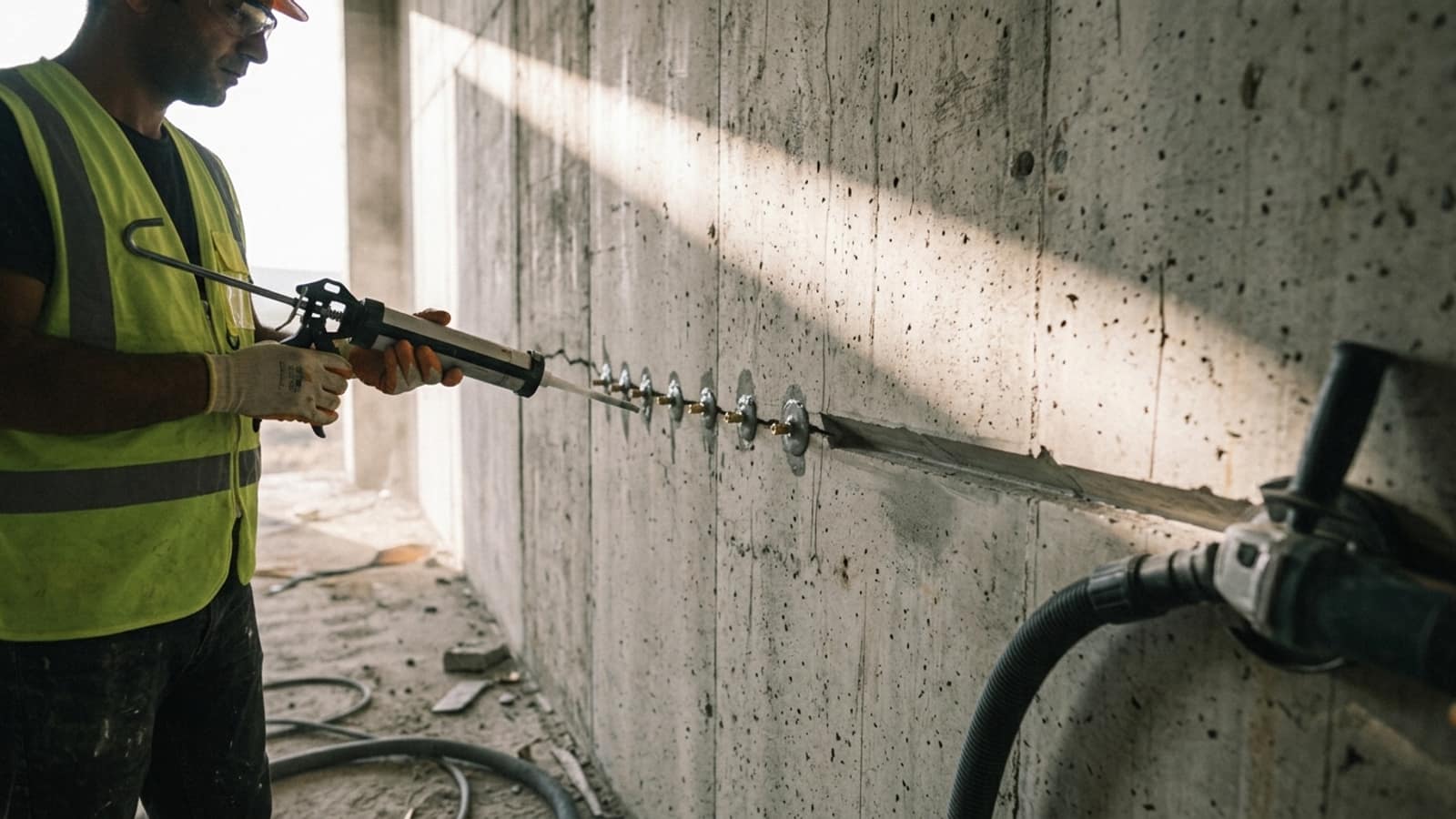
1. Crack analysis: The width, depth, direction and movement condition are determined. If necessary an observation plate is placed over the crack to monitor movement. 2. Identifying the cause: A distinction is drawn between shrinkage, settlement, overloading, corrosion and thermal movement. A repair carried out without knowing the cause will not last. 3. Placing the packers: Holes are drilled at an angle that intersects the crack and mechanical packers are fitted. 4. Sealing the surface: The crack surface is sealed with rapid-setting mortar so that the resin does not flow out. 5. Injection and inspection: The resin is pumped in starting from the bottom; resin emerging from the adjacent packer indicates that the crack is full. After curing the packers are removed and the surface is made good. Injection products are classified under TS EN 1504-5, and use for structural bonding by TS EN 1504-4 . Injecting epoxy into a crack with water ingress will fail; the water must first be stopped with polyurethane. If the crack is moving, a rigid repair will crack again within a short time; the method must not be selected without measuring the movement. Shrinkage cracks generally carry no structural risk, but they can accelerate corrosion by allowing water and carbon dioxide to enter.Cracks that run along the line of the reinforcement, that appear together with rust staining, that widen over time, or that appear diagonally in the shear zone of an element require attention. Fine, scattered surface cracks are generally caused by shrinkage and carry no structural risk.
A glass or plaster plate is placed over the crack and observed at intervals; if the plate breaks, there is movement. For more precise measurement, crack gauges or dial gauges are used. The observation period should span a change of season.
A visible mark may remain on the surface, but the void in the crack is filled with resin and the integrity of the section is restored. In epoxy injection the joint is no weaker than the surrounding concrete. If appearance matters, the surface is finished separately.
No. Plaster only hides the appearance; if the crack is still active it will show through the plaster within a short time. In addition, because water and carbon dioxide ingress is not prevented, corrosion of the reinforcement continues to progress.

Likit İzolasyon exceeded our expectations with their waterproofing and floor coating services. Thanks to their meticulous workmanship and on-time delivery, our building is now far safer and more durable.
During our building strengthening works we saw the difference of working with a professional team. With carbon fibre and concrete repair applications they gave our structure a new life. I would definitely recommend them!
We used their epoxy floor coating service and the result is incredible! We gained both an attractive appearance and a long-lasting, durable solution. I appreciate their professional approach.
We received terrace and foundation waterproofing services. With their polyurethane-based solutions in particular, they provided a permanent answer to water leaks. The team's professionalism and on-time delivery are truly commendable.
Concrete cracks and deterioration in our old building were causing serious problems. The Likit İzolasyon team made the structure safe again with concrete repair and protection. They kept us informed in detail at every stage of the process.
They did outstanding work on car park line marking and industrial painting projects. With thermoplastic paint they delivered a solution that is both attractive and long-lasting. The importance they place on occupational safety is a further plus!
We had epoxy and polyurethane floor coating applied in our factory. Our spaces gained both a durable and an attractive appearance. They are also very easy to clean. Thank you to the professional team!
We worked with Likit İzolasyon on building strengthening. Thanks to the carbon fibre application our structure became earthquake resistant. Their transparent and meticulous work from start to finish gave us confidence.
The concrete crack repair service completely solved the problems in our old building. Even the finest details were attended to during the work. We now have a structure we can use safely for many years.