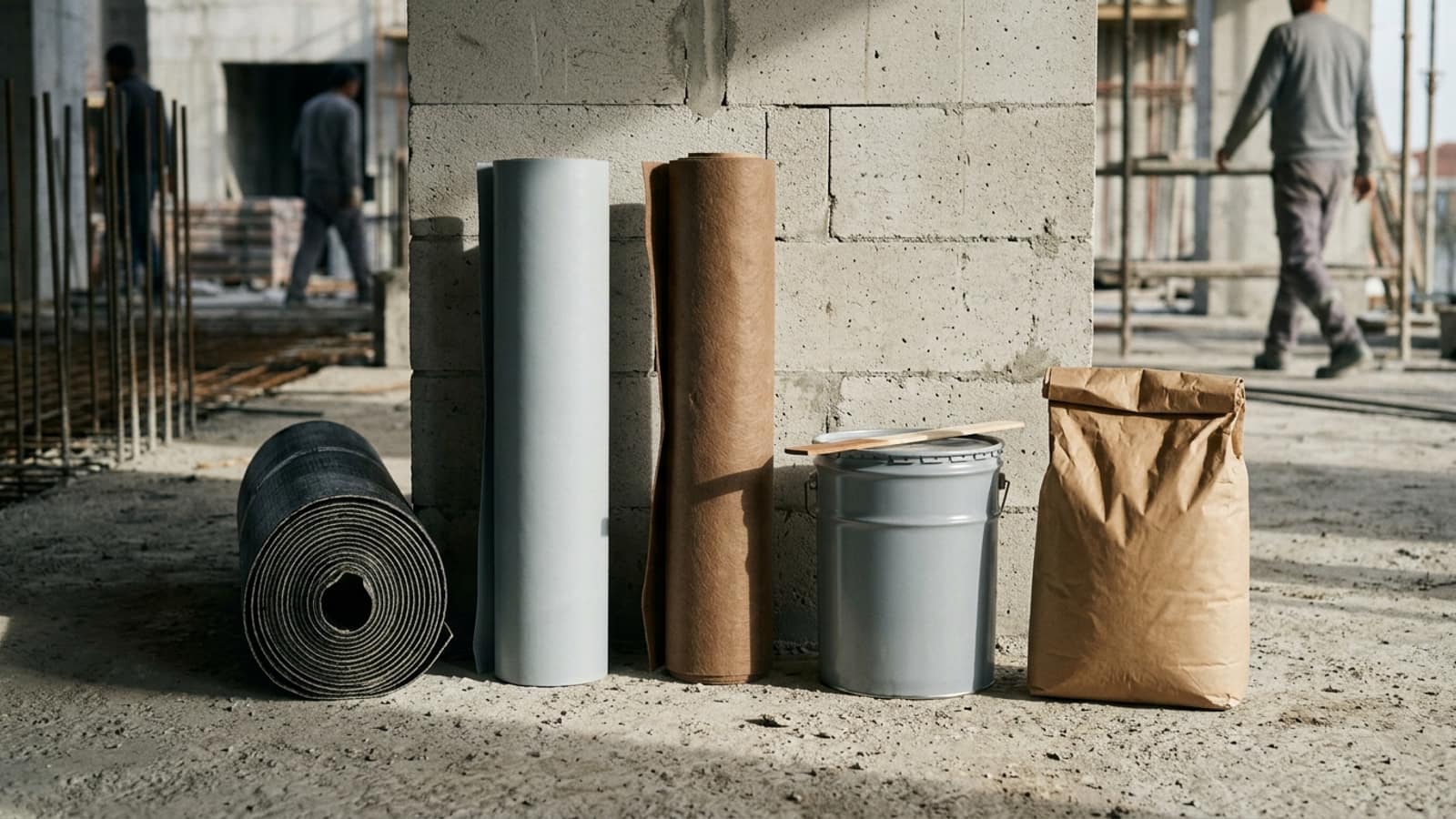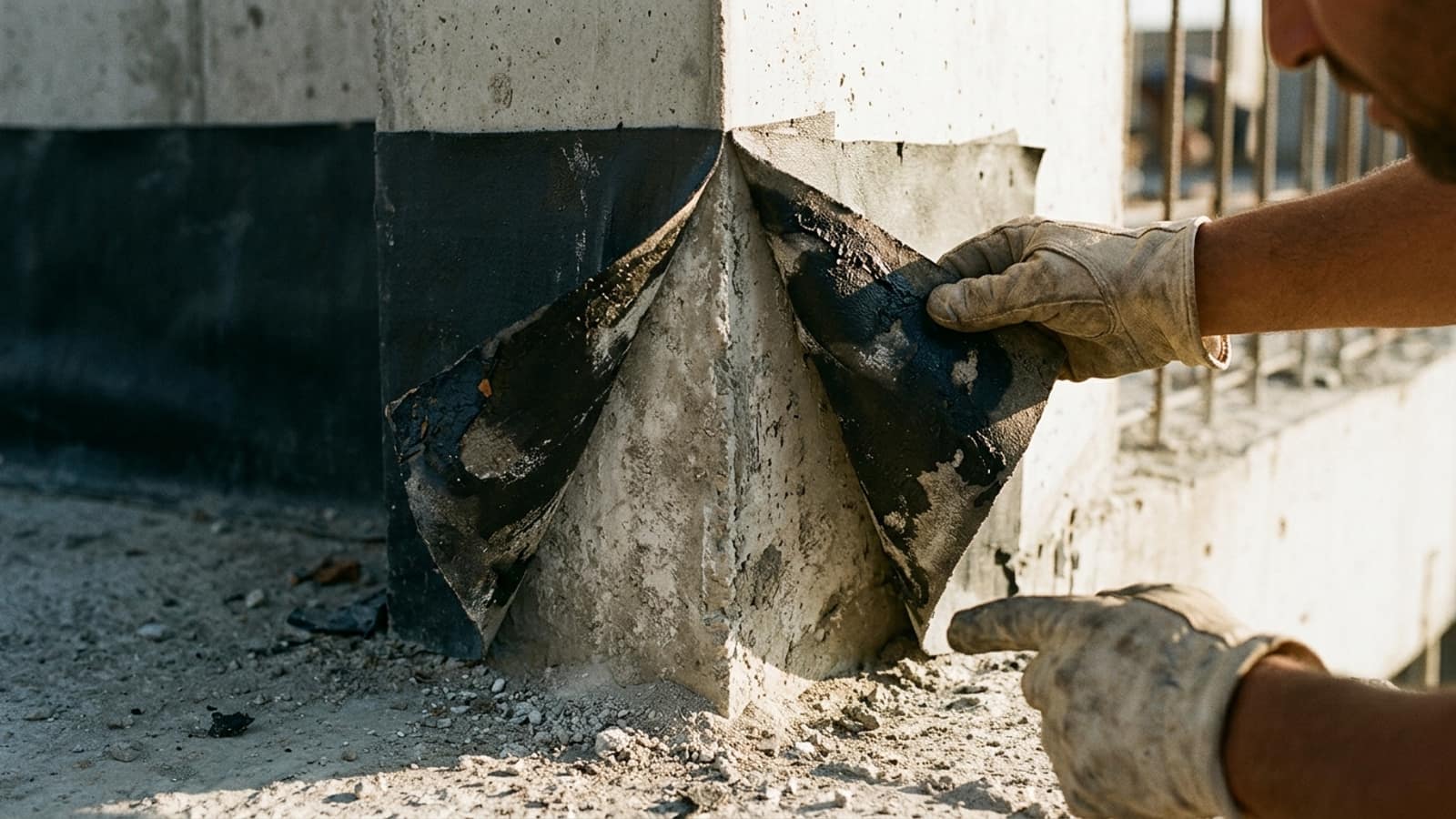
The most expensive option in foundation waterproofing is saving money on a surface that can never be reached again. Once the backfill is in place, that decision is permanent.

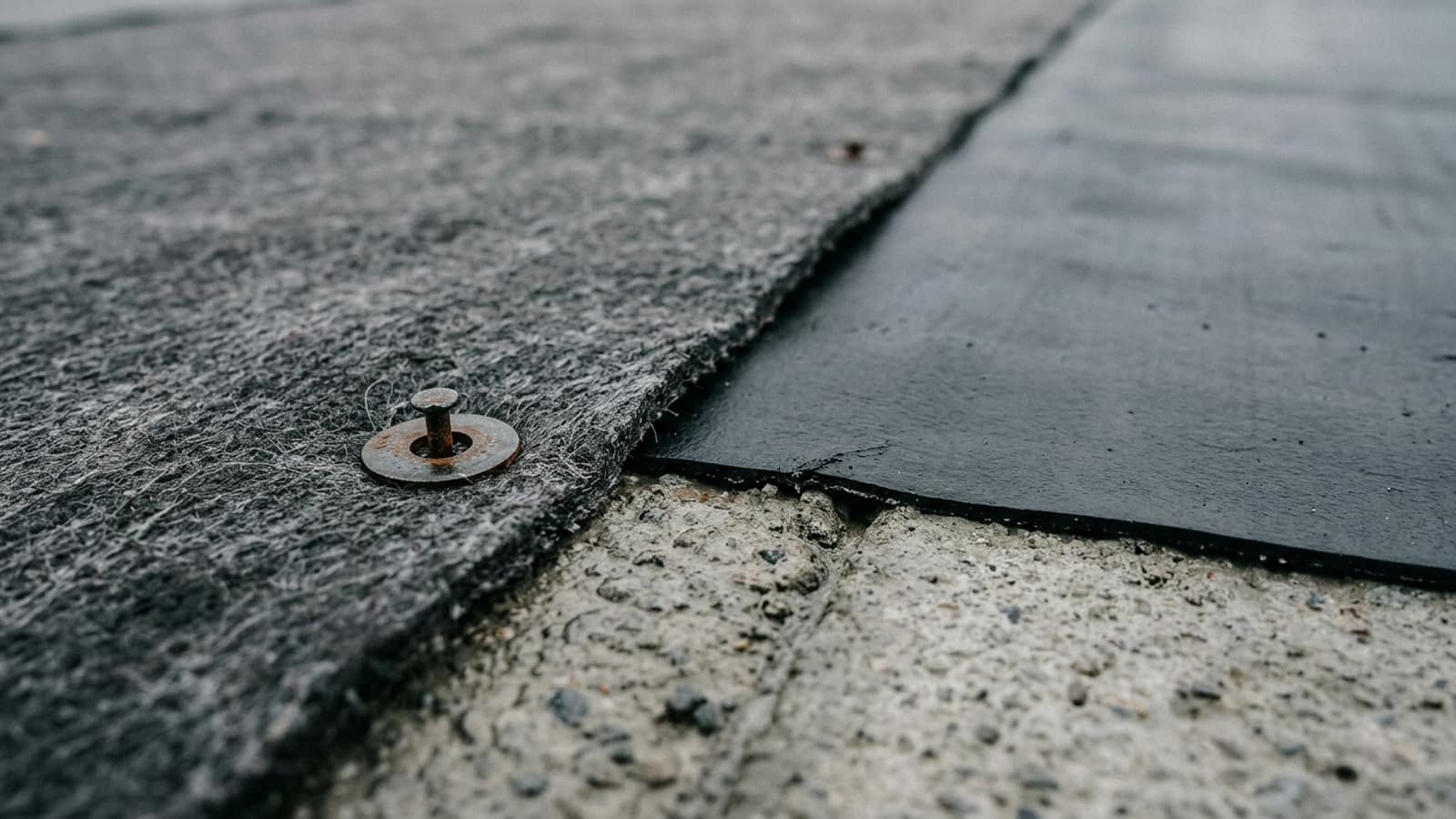
Foundation waterproofing is one of the hardest jobs in a building to reverse. Once the concrete has been poured and the backfill placed, that surface can never be reached again. This is why a decision made in foundation waterproofing carries far heavier consequences than one made on a terrace: when a mistake is made, the remedy is not external repair but internal injection, drainage and, more often than not, permanent problem management.
Two main systems compete on site: the classic bituminous membrane and bentonite-based sheets. Both work perfectly under the right conditions and both disappoint under the wrong ones. In this article we compare them in terms of excavation conditions, water table, application speed and tolerance for error.

The most expensive option in foundation waterproofing is saving money on a surface that can never be reached again. Once the backfill is in place, that decision is permanent.
Ahmet Toka, General Manager
A foundation surface meets three different water effects, and each of them calls for a different solution.
If the soil survey does not state the water table level, or seasonal variation has not been measured, system selection rests on guesswork. That is the riskiest possible start in foundation waterproofing.
This is the most common and best-known solution. It is laid over the blinding concrete and on the outer face of the retaining wall, usually in two layers. The working principle is simple: to form a continuous, impermeable skin against water.
Strengths: Because it is factory-made its thickness is guaranteed. The material behaves predictably, the cost is balanced and it has a track record spanning many years. It can be inspected visually after application; shortcomings are visible.
Difficulties: It requires a dry, clean surface. If there is water in the excavation or rain continues, application stops. Laps are critical; every overlap must be welded correctly. Sharp stones and rubble can tear the membrane during backfilling, so a protection board is mandatory.
For details see our bitumen-based waterproofing applications page.
Bentonite is a natural clay that expands many times over on contact with water. Bentonite confined between geotextile layers forms a dense, impermeable gel layer when it swells within a limited volume. In other words, instead of "keeping water out", the system seals itself when it meets water.
Strengths: It can be applied to a damp or even wet surface; work can continue while there is water in the excavation. It has self-healing properties: small punctures and tears are closed by bentonite swelling on contact with water. Application is fast and requires no welding or flame. It is advantageous with complex geometries and in narrow excavations.
Difficulties: It requires confinement to work; that is, there must be a counter-face against which the bentonite can press as it swells. On an unconfined surface it does not deliver the expected performance. There is a risk of premature hydration: if it is exposed to rain for a long period after application, it can swell before the concrete is poured. In highly saline groundwater its swelling capacity drops; special salt-resistant types are used in that case.
Details: bentonite-based foundation waterproofing.
| Condition | Recommended system |
|---|---|
| Dry excavation, low water table | Bituminous membrane |
| Water in the excavation, hard to dewater | Bentonite |
| High and continuous hydrostatic pressure | Bentonite, or double-layer membrane + drainage |
| Narrow excavation, against bored piles / diaphragm wall | Bentonite |
| Many anchors and pipe penetrations | Bentonite (self-sealing advantage) |
| Limited budget, standard conditions | Bituminous membrane |
| Saline or chemically loaded groundwater | Membrane; or a special bentonite type |
| Fast programme, open flame prohibited | Bentonite |
In critical structures (hospitals, data centres, buildings with deep basements) layered solutions using both systems together are also preferred. Moreover, no system is strong enough to allow the permeability of the concrete itself to be ignored; for this reason crystalline concrete admixture is frequently used to make the concrete impermeable throughout its mass, as a complement to the external waterproofing.
A defect in the foundation waterproofing usually appears months after the building comes into use. Damp patches on the basement wall, odours, blistering paint and, in time, active dripping are seen.
At that point external repair is rarely economical; it requires excavation, scaffolding and the removal of existing landscaping. The solutions applied are generally internal: at points of active water ingress the water is stopped with polyurethane injection , and the surface is then closed with cementitious systems that can work on the negative side. If there is a structural crack, crack repair is also required.
These solutions work; but all of them cost more than external waterproofing done correctly in the first place, and their durability depends on conditions. In foundation waterproofing, getting it right the first time is genuine economy.
Give your structures 100% natural, long-lasting protection with bentonite-based sub-foundation waterproofing. Choose Likit İzolasyon for environmentally friendly solutions that can be laid directly onto the soil surface!
Service details →Bitumen-based waterproofing solutions with Likit İzolasyon! Give your structures a long life by providing superior protection against water and moisture in foundations, retaining walls and wet areas. Contact us now for professional service.
Service details →Crystalline concrete admixture penetrates the mass of the concrete to provide permanent waterproofing. It also works on the negative side in water tanks, basements, lift pits and pools. Applied with Likit İzolasyon expertise.
Service details →Permanently stop water ingress through cracks with injection waterproofing. Trust Likit İzolasyon for effective solutions in basements, car park walls and terrace slabs!
Service details →To a limited extent, yes. In defects such as nail holes or small tears, bentonite swelling on contact with water fills the void and closes the path. However, this property does not compensate for wide tears, missing laps or errors in unconfined areas. It is no substitute for correct application.
It is not advisable even if the soil is very dry and permeable. Moisture initiates corrosion of the reinforcement and creates a permanent damp problem in the basement. Furthermore, groundwater conditions change with the seasons and with surrounding development; ground that is dry today may hold water a few years later.
A damp surface during application is not a problem; that is bentonite's greatest advantage. However, prolonged exposure to rain after application and before the concrete is poured is undesirable; premature swelling occurs without confinement and reduces performance. For this reason the interval between application and concrete pouring is kept short.
Doing it externally requires excavating around the foundation, which is often impossible because of neighbouring buildings and landscaping. In practice an internal solution is applied: active leaks are stopped by injection, the surface is closed with systems that work on the negative side, and perimeter drainage is improved where possible.
After the blinding concrete has been poured and levelled, the waterproofing layer is laid, a protection layer is placed over it and the raft concrete is poured on top. Ensuring continuity at the level where the horizontal waterproofing meets the retaining wall waterproofing is the most critical detail of the application.
No, the two do not replace each other. Drainage lowers the pressure on the waterproofing by taking water away; but it can block, collapse and prove insufficient in heavy rain. Waterproofing provides impermeability directly. The correct solution is to design both together.
With over 25 years of field experience, let us determine the right solution for your building together. Contact us for a survey and quotation.
Over 25 years of field experience in waterproofing, floor coatings and structural strengthening. This article is based on applications encountered on site and the standards currently in force.