Negative-side application is a solution of necessity, not a preference. If intervention from outside is possible, it is always done from outside.

A damp patch appearing at the foot of a basement wall, blistering paint and, in time, a musty smell; all of them raise the same question: "Can we solve this from the inside?" The answer depends on the conditions, and the key to understanding those conditions lies in the most fundamental distinction in waterproofing: positive side and negative side.
In this article we explain what the two sides mean, why the positive side is always preferred, how negative-side solutions should nevertheless be structured correctly in existing buildings, and which one really works in which situation.

Negative-side application is a solution of necessity, not a preference. If intervention from outside is possible, it is always done from outside.
Ahmet Toka, General Manager
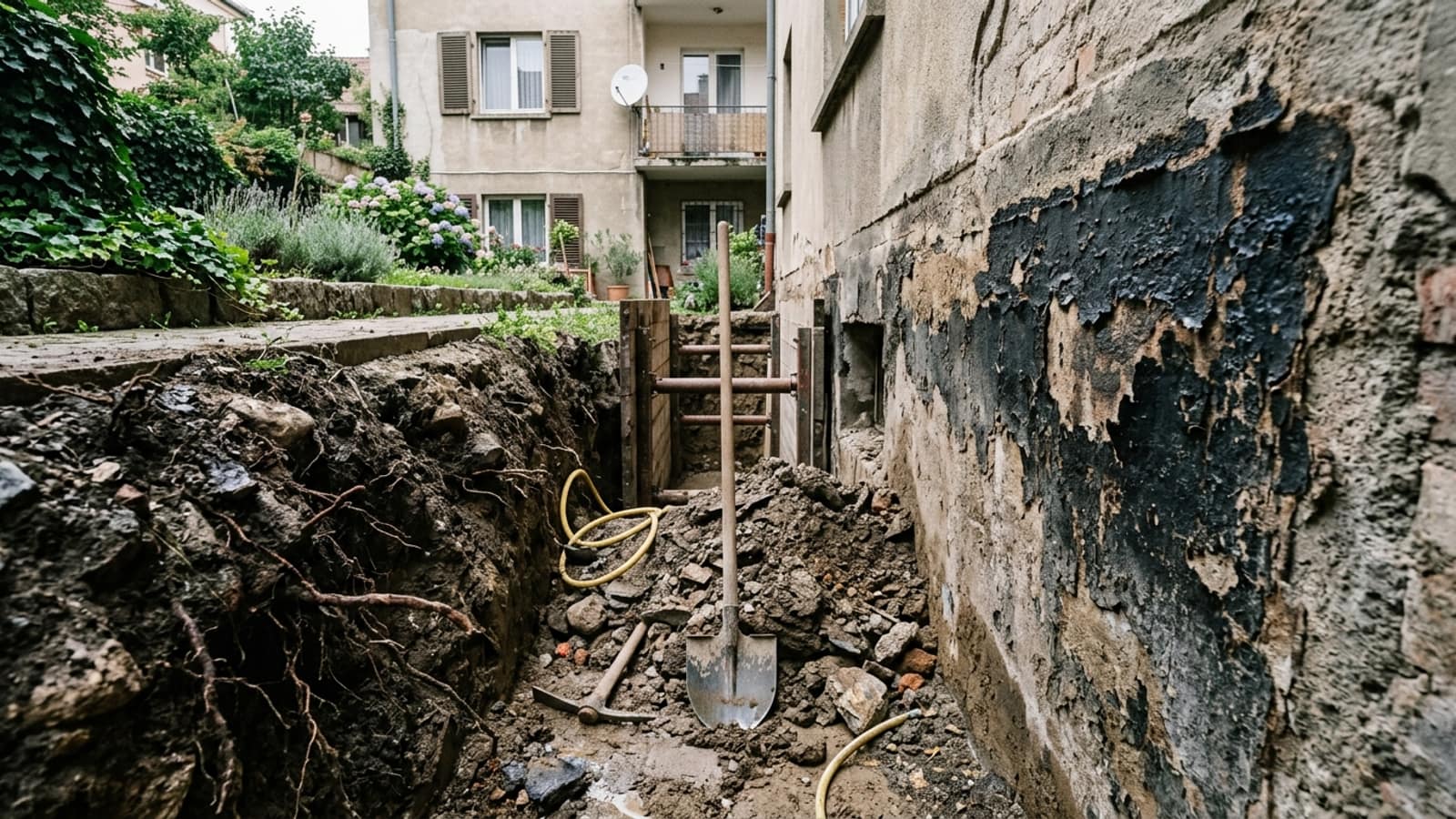
The definition is made according to the side the water comes from. Positive sidemeans applying the waterproofing to the surface the water comes from; in a basement this is the outer face of the retaining wall in contact with the soil. Negative side means applying the waterproofing to the surface the water emerges from, that is, the inner face of the wall.
The difference is not only position; the physics change too. On the positive side, water presses the waterproofing layer against the wall. The layer is held in place and the bond is not strained. On the negative side, water tries to pull the layer off the wall. For this reason the range of materials usable on the negative side is much narrower: only systems that bond chemically to the surface or work into the mass of the concrete will do.
Another critical difference is the concrete itself. On the positive side water never reaches the concrete. On the negative side the concrete section stays permanently wet; the risk of reinforcement corrosion and freeze-thaw damage continues. In other words, negative-side application dries the interior but does not free the concrete entirely from the effects of water.
In new buildings, therefore, there is no debate: the waterproofing is applied from outside. For details see our bitumen-based waterproofing applications and bentonite-based foundation waterproofing pages.
In an existing building, intervention from outside is often impossible: terraced development, neighbouring plots, landscaping, a car park ramp or the risk of deep excavation rule it out. In that case a staged solution is set up from the inside.
If water is actively coming through the wall, no surface coating can be applied over it. The water must be stopped first. Water coming through cracks and cold joints is stopped by injection with polyurethane resins that react with water and expand. This method is applied without breaking out the wall, simply by drilling packer holes.
Once the water has been stopped, the surface is closed with systems that can work on the negative side. Two groups stand out here: cementitious waterproofing mortars and crystalline systems. Neither bonds mechanically to the surface; both form a chemical bond with the capillary structure of the concrete. This is why they do not detach under water pressure.
Where possible, perimeter drainage is improved: rainwater downpipes are directed away, the ground around the building is graded away from the structure and blocked drainage lines are cleared. Removing part of the water before it even reaches the structure noticeably extends the life of a negative-side application.
It is important to place these solutions in a realistic frame. Negative-side application makes the interior usable; however it does not do the following three things:
When these limits are understood, expectations are set correctly and the outcome is usually satisfying. When they are not, the complaint "we did the waterproofing but there is still damp" follows.
Not every damp problem is a waterproofing problem. Damp in a basement can have three separate sources, and their solutions are completely different from one another.
There is a simple method for correct diagnosis: a sheet of clear plastic roughly 40x40 cm is taped tightly to the suspect surface and left for a few days. If moisture collects on the wall-facing side of the plastic, the source is the wall (leakage); room-facing if it collects on that side, the source is the indoor air (condensation). For diagnosis we also carry out on-site inspections as part of our waterproofing service.
Permanently stop water ingress through cracks with injection waterproofing. Trust Likit İzolasyon for effective solutions in basements, car park walls and terrace slabs!
Service details →Prevent the damaging effects of leaks and damp on your concrete, retaining wall and render surfaces with cementitious waterproofing. Achieve long-lasting protection with Likit İzolasyon's two-component flexible solutions!
Service details →Crystalline concrete admixture penetrates the mass of the concrete to provide permanent waterproofing. It also works on the negative side in water tanks, basements, lift pits and pools. Applied with Likit İzolasyon expertise.
Service details →Give your structures complete protection against the harmful effects of water and damp with Likit İzolasyon! With our foundation, roof, wet area and façade waterproofing services we make your buildings durable and long-lasting. Get in touch now for professional service!
Service details →Structured correctly it gives a long-lasting result; however it does not offer the same assurance as waterproofing done from outside. The concrete stays wet, and if there is structural movement the problem can recur. If intervention from outside is possible it should always be preferred.
No. No coating applied while water is actively coming through will bond; hydrostatic pressure lifts a layer that has not yet cured. The water is stopped first by injection and the surface is then closed. This sequence cannot be reversed.
If the damp is caused by condensation, thermal insulation and ventilation will solve it. However, if the damp is coming from the soil, thermal insulation hides the problem and creates the conditions for mould behind it. This is why the source must be diagnosed correctly first.
A cementitious mortar forms a layer on the surface and bonds chemically to it. A crystalline system, by contrast, sends its active ingredients into the concrete section and fills the capillary voids from within; the surface layer is only a carrier. On very damp surfaces under pressure the two are also used together.
Yes, but the curing time of the system used must be complete and the material applied over it must be breathable. If an impermeable finish is applied over the waterproofing layer, moisture in the section cannot escape and blistering may occur.
It depends on the number of active leaks and the area. The injection stage usually takes a few days, while surface application and curing are completed within one to ten days. In occupied buildings the work can also be carried out zone by zone without emptying the space.
With over 25 years of field experience, let us determine the right solution for your building together. Contact us for a survey and quotation.
Over 25 years of field experience in waterproofing, floor coatings and structural strengthening. This article is based on applications encountered on site and the standards currently in force.