Self-levelling screed is a levelling product, not a load-bearing layer. If the floor beneath it is weak, even the flattest surface poured over it will carry that weakness.

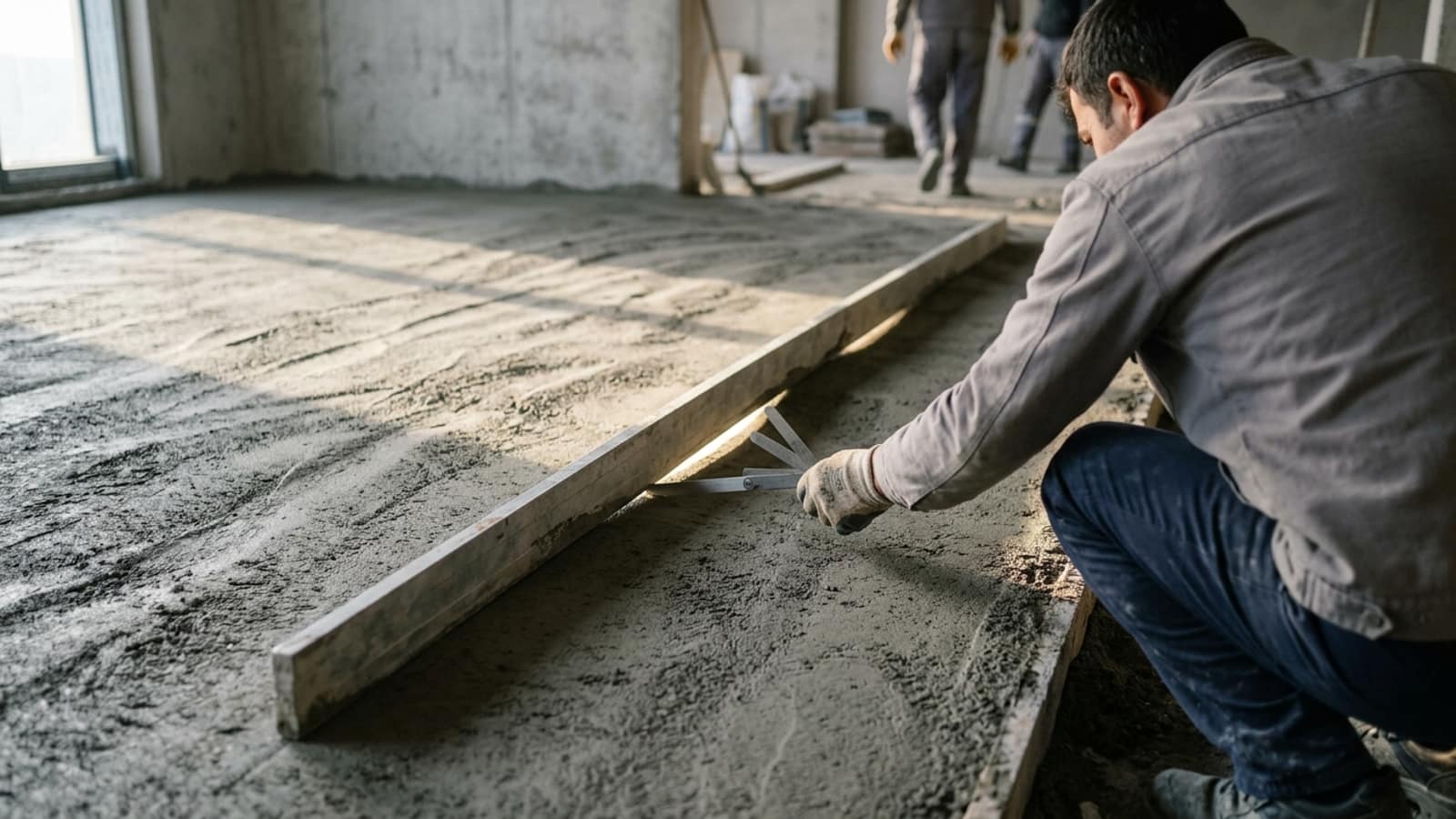
The quality of a floor covering is often limited by the flatness of the layer beneath it. Parquet, vinyl, laminate or resin coating — all of them deliver the performance expected of them only over a flat surface. With traditional screed, achieving that flatness depends on workmanship and luck. Self-levelling screed leaves the job to gravity.
In this article we explain what self-levelling screed is, in what respects it differs from traditional screed, at what thicknesses it is used, how the application proceeds and which mistakes are made most often on site.

Self-levelling screed is a levelling product, not a load-bearing layer. If the floor beneath it is weak, even the flattest surface poured over it will carry that weakness.
Ahmet Toka, General Manager
Self-levelling screed is a cement- or calcium sulphate-based mortar that becomes fluid when mixed with water and, when poured onto a surface, spreads under its own weight to form a level plane. The plasticising additives it contains provide high fluidity at a low water content, so that both flow and strength are achieved together.
In application, the mix is poured by pump or by bucket, air bubbles are released with a spiked roller and the material levels itself. Defects that are unavoidable with traditional screed — trowel marks, waves and differences in level — are largely eliminated.
The product family is wide: there are types applied in millimetres for fine levelling, types designed for underfloor heating systems, and fast-curing, low-shrinkage types. Details: self-levelling screed applications.
| Self-levelling screed | Traditional screed | |
|---|---|---|
| Flatness | Automatically | Depends on workmanship |
| Application speed | Very fast | Slow |
| Typical thickness | 3–30 mm | 40 mm and above |
| Drying time | Short (depending on type) | Long |
| Rise in level | Little | Considerable |
| Surface quality | Ready for covering | An additional levelling layer is usually needed |
| Material cost | High | Low |
| Total cost | Balanced by the saving in labour | Labour-intensive |
The decision usually comes down to this: how much height allowance is there? Traditional screed does not work properly in a 3 cm gap, whereas self-levelling screed is designed for exactly that range. If a thick fill is required, the most economical route is to build up with traditional screed or lightweight fill concrete and apply a thin self-levelling screed over it.
For floor systems as a whole see floor coating applications page.
Self-levelling screed is a more expensive material than traditional screed. However, the material price is not the only item to consider in a total cost comparison.
On the planning side, the item most often overlooked is the drying time. Self-levelling screed dries quickly; but the moisture tolerance of the covering that will go over it is a criterion independent of the product's drying speed. When programming, an allowance should be left that will be confirmed by measurement.
Eliminate irregularities in your floor and achieve a smooth surface with self-levelling screed applications. Discover Likit İzolasyon's self-levelling solutions!
Service details →Protect your structures against external factors with floor coating applications from Likit İzolasyon. Discover our solutions offering hygiene, durability and aesthetics!
Service details →Bring durability and good looks together with epoxy floor coating. Discover the self-levelling, antistatic and decorative epoxy solutions of Likit İzolasyon!
Service details →With micro concrete application we offer durable and attractive floor solutions. Choose Likit İzolasyon for modern, long-lasting floors from industrial facilities to commercial spaces!
Service details →It depends on the product type. Fine levelling products are used in the 1–10 mm range and general-purpose types in the 3–30 mm range. If a thicker fill is required, the level is first built up with traditional screed or lightweight concrete and a thin layer of self-levelling screed is applied over it.
A day may be enough with fast types and a few days with standard types. But what is decisive is not the calendar but measurement: it must be checked whether the moisture content permitted by the covering to be laid has been reached. Parquet and vinyl in particular are sensitive on this point.
Yes. The tiles must be sound and fully bonded, and loose tiles must be replaced. The surface is cleaned, a suitable bonding bridge primer is applied and the pour is then made. This is a practical method that avoids the cost of removal and debris.
It can; there are special types designed for it. These products encase the pipes without voids and conduct heat evenly. The heating system must be brought into operation gradually, in accordance with the commissioning procedure stated by the manufacturer.
With the correct water content, the correct thickness and correct joint planning, cracking is not expected. The main causes of cracks are excess water, excessive thickness, rapid drying and the absence of joints. If there is a moving crack in the substrate, it will be reflected in the self-levelling screed too.
Most self-levelling screeds are an intermediate layer; a covering is expected over them. Some high-strength types can be finished with a surface hardener or clear resin and used as the final surface. This use depends on the abrasion class of the product.
With over 25 years of field experience, let us determine the right solution for your building together. Contact us for a survey and quotation.
Over 25 years of field experience in waterproofing, floor coatings and structural strengthening. This article is based on applications encountered on site and the standards currently in force.