Joint sealing is a finishing method used to improve the appearance of buildings and to ensure the durability of surfaces. It is carried out in particular to fill the gaps between surface finishes such as ceramic tiles, stone and similar materials. This work protects surfaces against water, chemicals and impact.
With the right choice of material and professional application, joint sealants give surfaces a long life and an attractive appearance. They also make buildings easier to clean and provide a hygienic environment.
 Water and Chemical Resistance: By filling the joint gaps, it prevents water and chemicals from damaging the surface. Attractive Appearance: Provides continuity across the surface and gives a decorative appearance. Hygienic Solution: Prevents the accumulation of dust and dirt and creates surfaces that are easy to clean. Long-Lasting Use: Applications made with durable materials provide long-term protection. A Wide Range of Colours: Provides an attractive match with the surface finishes through different colour options. Preparation: Cleaning the joint gaps and preparing the surface for application. Material Selection: A sealant suited to the type of surface is selected. Sealant Application: The joint gaps are filled and the surface is levelled off. Cleaning and Inspection: The surface is cleaned after application and the durability of the joint sealant is checked.
With an expert team and quality materials, Likit İzolasyon offers long-lasting, attractive solutions in joint sealing applications. Make use of our professional services for durable and elegant joint sealing on your buildings.
Construction and shrinkage joints in industrial floors Expansion joints in car park and bridge decks Joints between precast façade panels Waterproof joint sealing in wet areas and pools Hygienic joint solutions in food plants Sealants resistant to low temperatures in cold storesThese offer high elasticity and good adhesion; they are the most widely used system in moving joints. Because their UV resistance is limited, a suitable formulation must be chosen for outdoor use. Paintable options are available.
On industrial floors with heavy forklift traffic, rigid sealants are used to prevent the joint edges from breaking away. These sealants do not accommodate movement; they are suitable only in static shrinkage joints.
These are preferred in wet areas, glazing and façade applications. They offer high UV and water resistance. In food areas, products with anti-mould additives and resistance to cleaning are used.
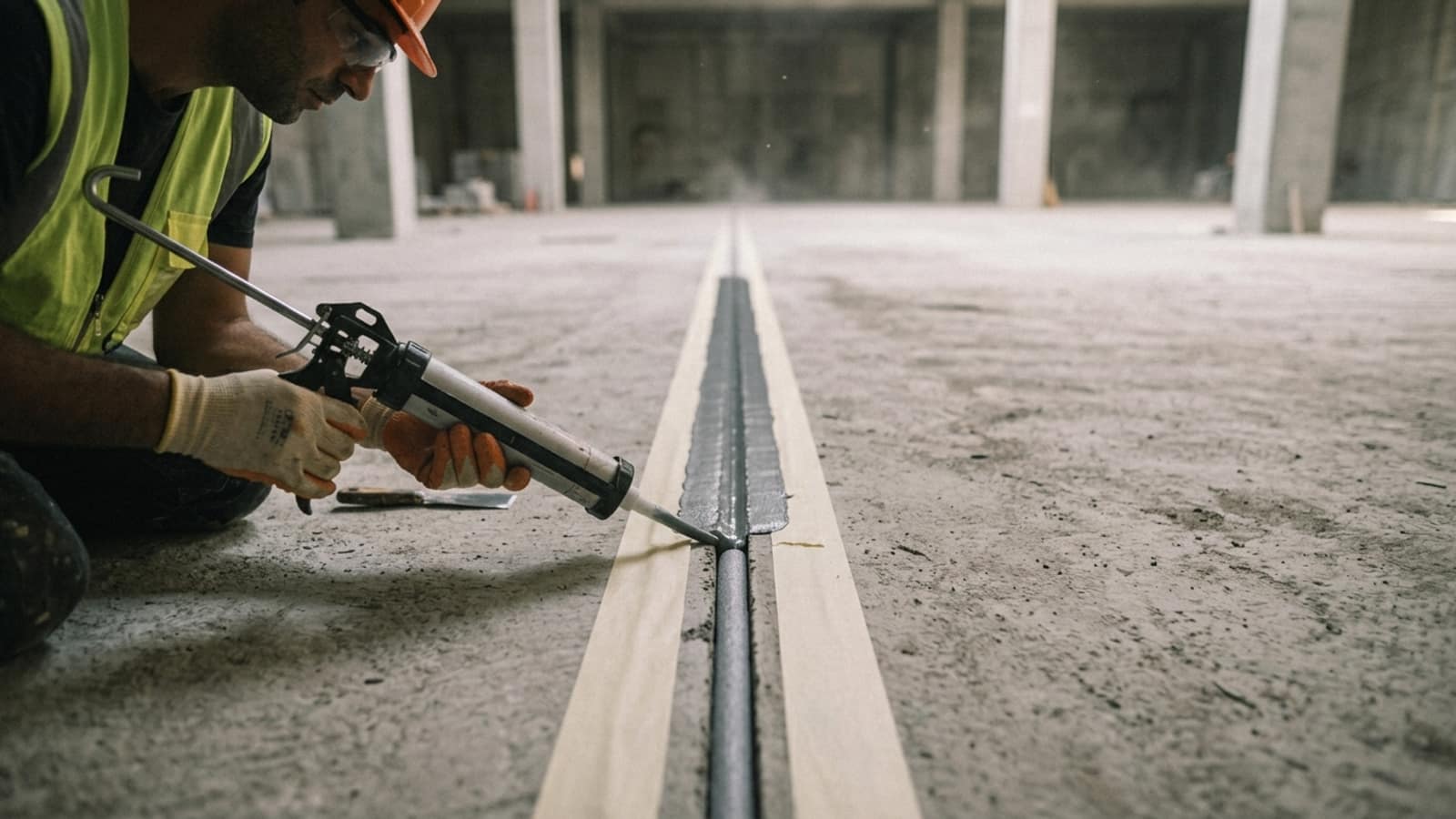
1. Checking the joint geometry: The width and depth of the joint are measured. The ratio of sealant depth to width is critical if the sealant is to accommodate movement correctly. 2. Cleaning: The inside of the joint is cleared completely of old sealant, dust and oil. If necessary the edges are milled to make them true. 3. Placing the backer rod: A foam backer rod is placed to set the depth of the joint and to ensure the sealant adheres to two faces only. Sealant that adheres to three faces tears when movement occurs. 4. Primer: A primer is applied according to the product and the type of surface to ensure adhesion. 5. Sealing and finishing: The sealant is applied with a gun so that no voids remain and is finished with a spatula. The edge tapes are removed at the appropriate time. The width-to-depth ratio of the sealant must comply with the product instructions; sealant applied too deep cannot accommodate movement. Where the work is carried out without a backer rod the sealant adheres to three faces and tears when movement occurs — this is one of the most common mistakes. Expansion joints must never be closed with a rigid sealant; if movement is restrained, the surrounding concrete cracks. In food areas, joints are critical in terms of dirt accumulation; hygienic, cleanable systems should be preferred. On floors with forklift traffic, rigid sealant and edge protection details must be planned so that the joint edges do not break away.The most common causes are inadequate cleaning of the surface, no primer, omitting the backer rod and an incorrect width-to-depth ratio. In addition, choosing a product too rigid to accommodate the movement also leads to early failure.
No. Expansion joints move and require an elastic sealant; shrinkage joints, on the other hand, are static and need a rigid sealant for edge protection under forklift traffic. Mismatching causes early damage in both cases.
Yes. The rod both controls the depth of the sealant and prevents it adhering to the base of the joint. Sealant adhering to two faces only can stretch freely as movement occurs; if it also adheres to the base, stress builds up and it tears.
This depends on use and exposure conditions. Joints exposed to traffic and UV deteriorate faster. In an annual visual inspection, areas showing debonding, cracking or rupture should be renewed; this is the most economical way of protecting the structure beneath.

Likit İzolasyon exceeded our expectations with their waterproofing and floor coating services. Thanks to their meticulous workmanship and on-time delivery, our building is now far safer and more durable.
During our building strengthening works we saw the difference of working with a professional team. With carbon fibre and concrete repair applications they gave our structure a new life. I would definitely recommend them!
We used their epoxy floor coating service and the result is incredible! We gained both an attractive appearance and a long-lasting, durable solution. I appreciate their professional approach.
We received terrace and foundation waterproofing services. With their polyurethane-based solutions in particular, they provided a permanent answer to water leaks. The team's professionalism and on-time delivery are truly commendable.
Concrete cracks and deterioration in our old building were causing serious problems. The Likit İzolasyon team made the structure safe again with concrete repair and protection. They kept us informed in detail at every stage of the process.
They did outstanding work on car park line marking and industrial painting projects. With thermoplastic paint they delivered a solution that is both attractive and long-lasting. The importance they place on occupational safety is a further plus!
We had epoxy and polyurethane floor coating applied in our factory. Our spaces gained both a durable and an attractive appearance. They are also very easy to clean. Thank you to the professional team!
We worked with Likit İzolasyon on building strengthening. Thanks to the carbon fibre application our structure became earthquake resistant. Their transparent and meticulous work from start to finish gave us confidence.
The concrete crack repair service completely solved the problems in our old building. Even the finest details were attended to during the work. We now have a structure we can use safely for many years.