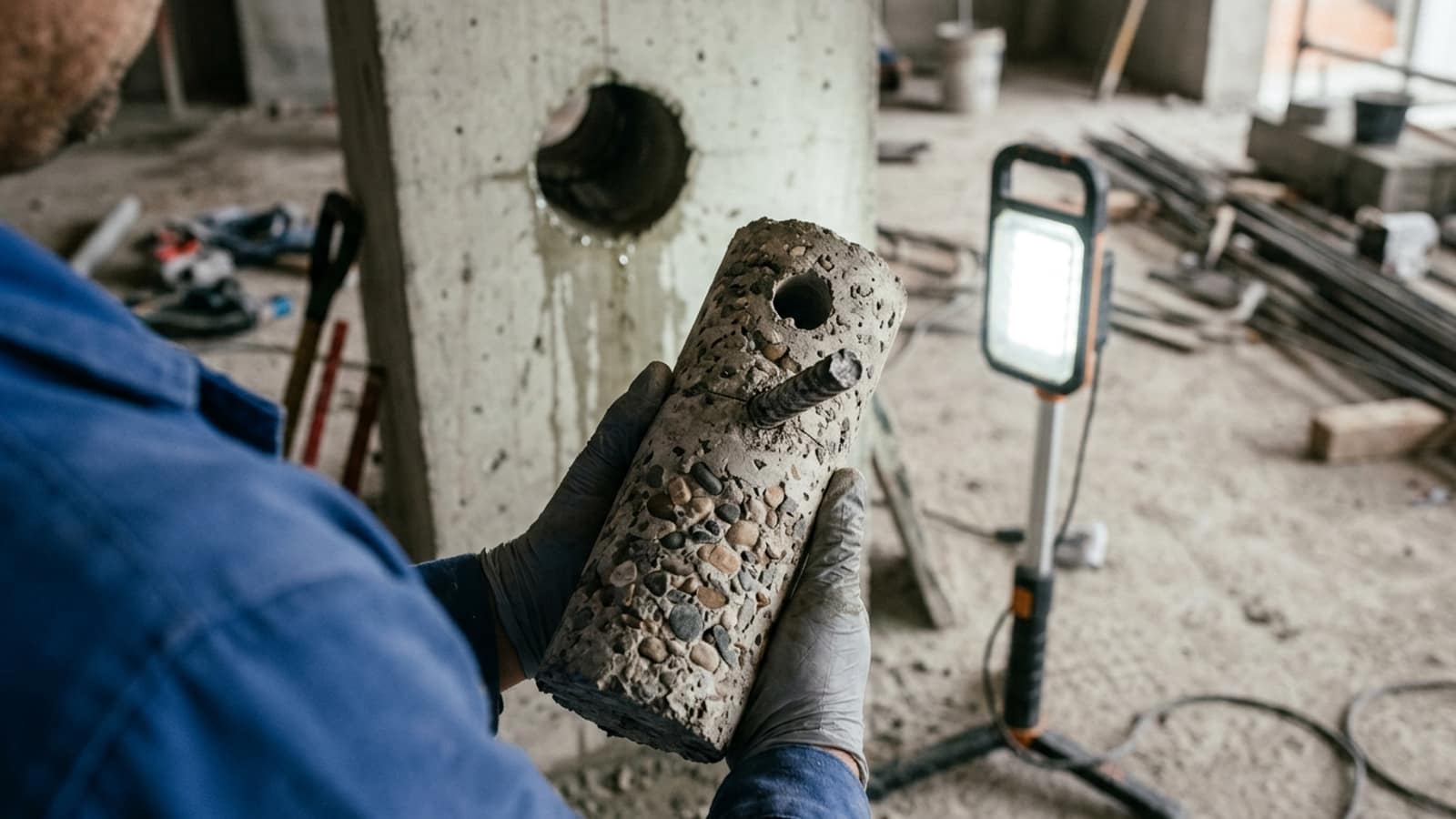
In rebar dowelling, the quality of the work ends in a hole that has not been cleaned. Dust is the single and sufficient reason for the chemical failing to grip the concrete.

Rebar dowelling is the invisible foundation of almost all strengthening and additional construction work. A new shear wall, a jacketed column or an added beam — all of them have to be connected in some way to the existing reinforced concrete. That connection is made with reinforcing bars fixed chemically into a hole drilled in the concrete.
If the connection does not work, none of the construction built on it can transfer load. That is why rebar dowelling is one of those jobs that looks simple but must leave the least room for error. In this article we explain how it works, the steps of correct application, the inspection methods and the mistakes made most often.

In rebar dowelling, the quality of the work ends in a hole that has not been cleaned. Dust is the single and sufficient reason for the chemical failing to grip the concrete.
Ahmet Toka, General Manager
Rebar dowelling is the process of fixing a reinforcing bar by injecting chemical anchoring material (epoxy- or vinyl ester-based resin) into a hole drilled in hardened concrete. The aim is to make the new reinforcement work together with the existing structure — that is, to create a continuous connection capable of transferring force.
The system consists of three interfaces, and the weakest link determines the chain: the bar–resin interface, the resin–concrete interface and the concrete itselfIn an ideal application, failure occurs not at these interfaces but within the concrete; this means the connection is stronger than the concrete.
Its fields of use are wide: jacketing connecting reinforcement, anchoring added shear walls and beams to the existing system, installing machine plinths and balustrades, and connecting added slabs. Details: rebar dowelling.
The anchor embedment is not an arbitrary value; it is determined by calculation. The governing factors are the bar diameter, the concrete strength, the force to be transferred, the edge distance of the anchor and the spacing between neighbouring anchors.
The edge distance is particularly important. An anchor set too close to the edge of the concrete can, under load, break out a cone-shaped piece of concrete; in that case the connection will not carry even if the bar and the resin are flawless. In the same way, anchors placed too close together do not give the expected capacity because their failure cones overlap.
In the choice of chemical, the ambient conditions are decisive. Epoxy-based systems give high strength but their curing time is long and slows down at low temperatures. Vinyl ester and hybrid systems cure faster and are more tolerant in damp holes. Where there are high temperatures, permanent damp or freeze–thaw conditions, the values given for those conditions in the product's approval documents must be checked.
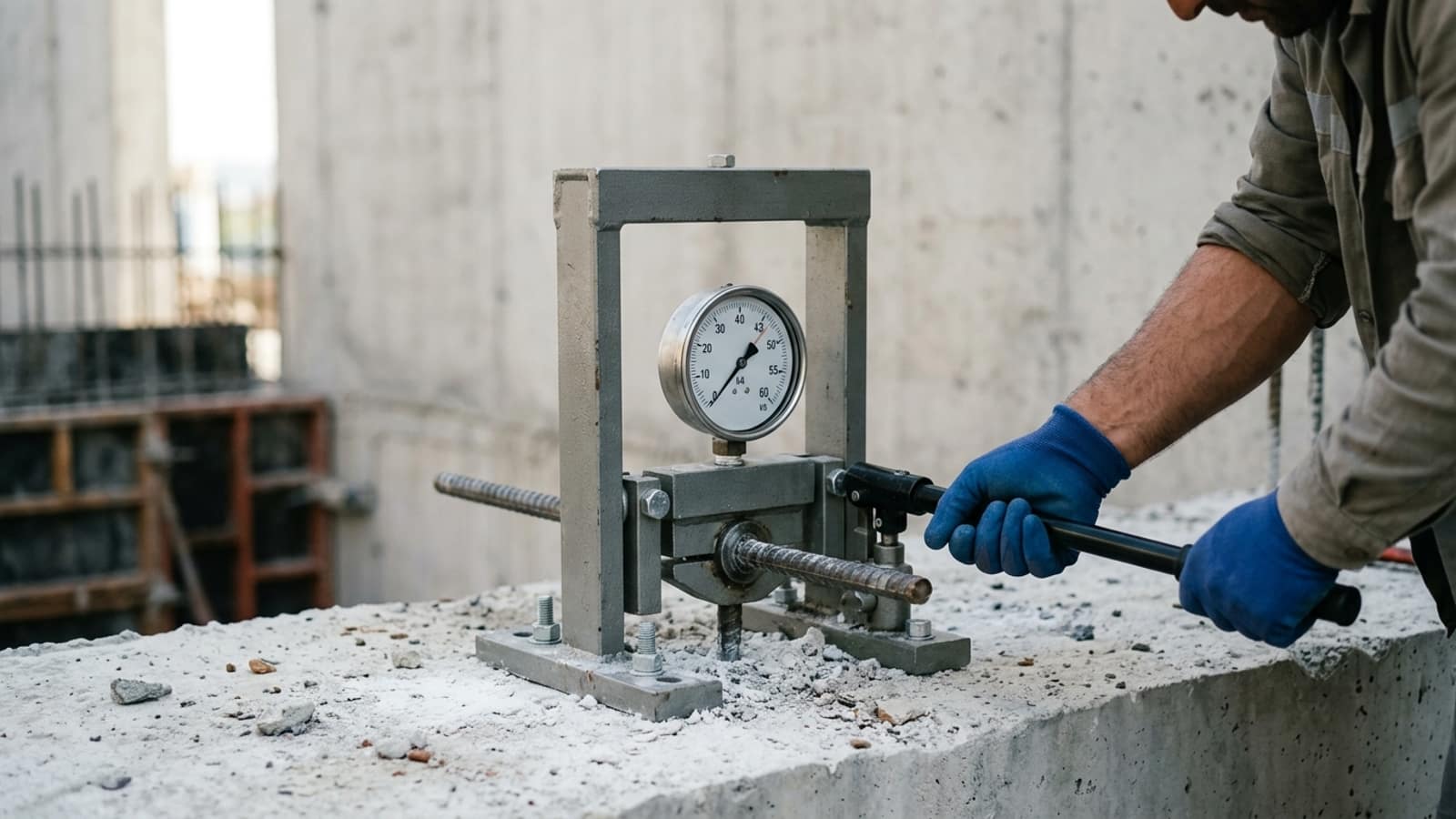
The correctness of rebar dowelling cannot be judged by eye. That is why a pull-out test is carried out on site: a controlled tensile force is applied to selected anchors with a hydraulic rig and it is observed whether any slip occurs under the specified load.
These records are the only objective evidence that the work was done correctly, and the client should always ask for them.
For the strengthening process as a whole see structural strengthening page.
With rebar dowelling we bring dependable and durable strengthening solutions to your structures. Reinforce your structures with the professional dowelling services of Likit İzolasyon!
Service details →With reinforced concrete strengthening we make your structures durable and safe. Reinforce your structures again with the professional analysis and application solutions of Likit İzolasyon!
Service details →We make your structures safe and durable with our structural strengthening services. Choose Likit İzolasyon for detailed analysis and professional application methods!
Service details →With concrete damage repair we bring durability and safety to your structures. Restore damaged structural elements with the professional solutions of Likit İzolasyon!
Service details →It depends on the bar diameter, the anchor embedment, the concrete strength, the edge distance and the chemical used. Correctly applied, the connection can transfer load up to the yield capacity of the bar itself — that is, failure occurs in the bar. The value is determined by calculation in the design.
Yes. The fine dust created during drilling forms a separating film between the resin and the concrete and greatly reduces the bond. This is the most common cause of the failed pull-out tests we see on site. Blowing out and brushing must be repeated several times.
Yes, if products approved for it are used. Not every chemical is suitable for a damp or water-filled hole; the values given for that condition in the product's approval document must be checked. With an unsuitable product the capacity falls markedly.
It depends on the product and the ambient temperature; it can be hours in warm weather and more than a day in cold weather. The manufacturer's table for temperature must be followed. Loading an anchor before curing is complete weakens the connection permanently.
Mechanical anchors are fast and can take load immediately; however, they stress the concrete with an expansion force and their edge distance requirements are higher. Chemical anchors work without expansion and are more suitable in cracked concrete and in applications close to an edge. Chemical anchors are used for dowelling strengthening reinforcement.
The identity and batch number of the product used, the hole diameters and depths, the ambient temperature, the curing period and the pull-out test results must be recorded. These documents are the evidence that the work was carried out in accordance with the design.
With over 25 years of field experience, let us determine the right solution for your building together. Contact us for a survey and quotation.
Over 25 years of field experience in waterproofing, floor coatings and structural strengthening. This article is based on applications encountered on site and the standards currently in force.