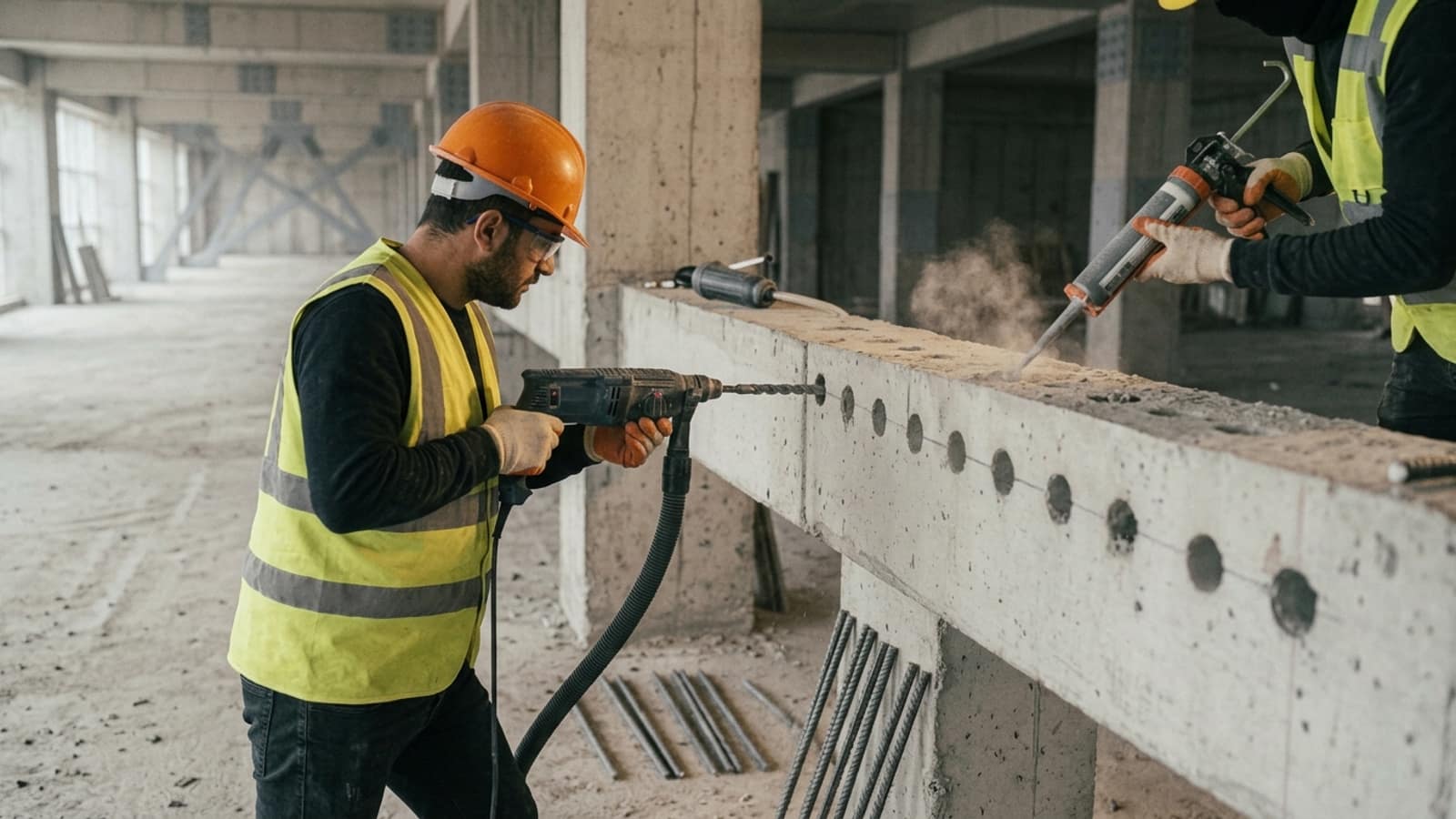
Rebar dowelling is a strengthening method that aims to increase the load-carrying capacity of existing reinforced concrete structures by adding new reinforcement. It is an effective solution used to meet the repair and strengthening needs of structures. It is used particularly at the connections between structural elements such as columns, beams and slabs, and improves structural safety.
Rebar dowelling is carried out using special chemical adhesives. These chemical materials form a high-strength bond between the new reinforcement and the existing concrete. When correctly applied, rebar dowelling gives the structure long-lasting and dependable durability.
 Increased Durability: Increases the load-carrying capacity of the structure and the strength of its connections. Easy Application: Offers a fast and effective solution without major intervention in the existing structure. Wide Range of Use: Can be used on different structural elements such as columns, beams and slabs. Strong Bond: Forms a high-strength bond between the reinforcement and the concrete thanks to the chemical materials. Long-Lasting Solution: Ensures the long-term safety of the structure.
With its expert team and the use of quality materials in rebar dowelling, Likit İzolasyon offers your structures dependable and durable solutions. You can contact us for a professional service on your strengthening projects.
Connecting new reinforcement to the existing concrete in column and wall jacketing Connection reinforcement in additional shear wall and slab construction Foundation widening and reinforcement works Anchoring in added stairs, cantilevers and balconies Anchor bolts for steel structures and machine foundations All joints and connection points where new work is tied into the existing structureThese offer high adhesion and load capacity. They are suitable for vibrating loads and large-diameter reinforcement. The curing time can lengthen depending on temperature; the waiting period increases in cold weather.
These cure faster and are preferred in applications where the load must be taken within a short time. Product options are available whose performance in damp holes can be more tolerant than epoxy.
The great majority of failures in rebar dowelling stem from the cleaning of the hole. Drilling dust prevents the mortar from bonding to the concrete surface. Cleaning several times with compressed air and a brush is standard practice.
1. Locating the reinforcement: The position of the existing reinforcement is determined with a scanner. It is critically important that the reinforcement is not cut during drilling. 2. Drilling: A hole is drilled at the diameter and depth specified in the design. The depth is calculated according to the bar diameter and the type of mortar. 3. Cleaning: The hole is blown out with compressed air, brushed and blown out again. This cycle is generally repeated several times. 4. Mortar injection: Using a cartridge gun, the mortar is injected starting from the bottom of the hole so that no voids remain. The first part of the mix is discarded. 5. Placing the bar and waiting: The bar is inserted with a twisting motion and excess mortar is cleaned off. No load is placed on the bar and it is not moved during the curing period. Structural adhesives and anchoring mortars are assessed under TS EN 1504-4 . The anchorage depth (embedment length) directly determines the load capacity; there must be no compromise on the depth given in the design. The curing time depends on the ambient temperature; at low temperatures it lengthens markedly. The quality of the work must be verified by pull-out tests on site; the number of samples is determined in the design. If the edge distance and the spacing between anchors are inadequate, concrete cone failure occurs; these distances must be checked in the design.This depends on the bar diameter, the embedment depth, the concrete strength, the edge distance and the type of mortar. When correctly applied, the anchorage capacity can reach the yield strength of the bar; that is, the weak link becomes the bar itself rather than the anchorage.
The fine dust created during drilling behaves like a separating layer on the wall of the hole. The mortar bonds to this dust, not to the concrete. In an uncleaned hole the anchorage capacity falls very sharply; this is the most frequently encountered error on site.
Some products are certified for use in damp or water-filled holes, but their load capacities are lower than the values for dry holes. Separate values for these conditions are given in the product data sheet and these must be used in the design.
Yes — particularly in strengthening the load-bearing system, it is standard practice to carry out pull-out tests on a certain proportion of the anchors. The test both verifies the quality of the work and creates a record in the works file.

Likit İzolasyon exceeded our expectations with their waterproofing and floor coating services. Thanks to their meticulous workmanship and on-time delivery, our building is now far safer and more durable.
During our building strengthening works we saw the difference of working with a professional team. With carbon fibre and concrete repair applications they gave our structure a new life. I would definitely recommend them!
We used their epoxy floor coating service and the result is incredible! We gained both an attractive appearance and a long-lasting, durable solution. I appreciate their professional approach.
We received terrace and foundation waterproofing services. With their polyurethane-based solutions in particular, they provided a permanent answer to water leaks. The team's professionalism and on-time delivery are truly commendable.
Concrete cracks and deterioration in our old building were causing serious problems. The Likit İzolasyon team made the structure safe again with concrete repair and protection. They kept us informed in detail at every stage of the process.
They did outstanding work on car park line marking and industrial painting projects. With thermoplastic paint they delivered a solution that is both attractive and long-lasting. The importance they place on occupational safety is a further plus!
We had epoxy and polyurethane floor coating applied in our factory. Our spaces gained both a durable and an attractive appearance. They are also very easy to clean. Thank you to the professional team!
We worked with Likit İzolasyon on building strengthening. Thanks to the carbon fibre application our structure became earthquake resistant. Their transparent and meticulous work from start to finish gave us confidence.
The concrete crack repair service completely solved the problems in our old building. Even the finest details were attended to during the work. We now have a structure we can use safely for many years.