There is no aesthetic choice in heliport marking. The size, colour and position of every symbol are defined; the work follows that definition, it does not interpret it.

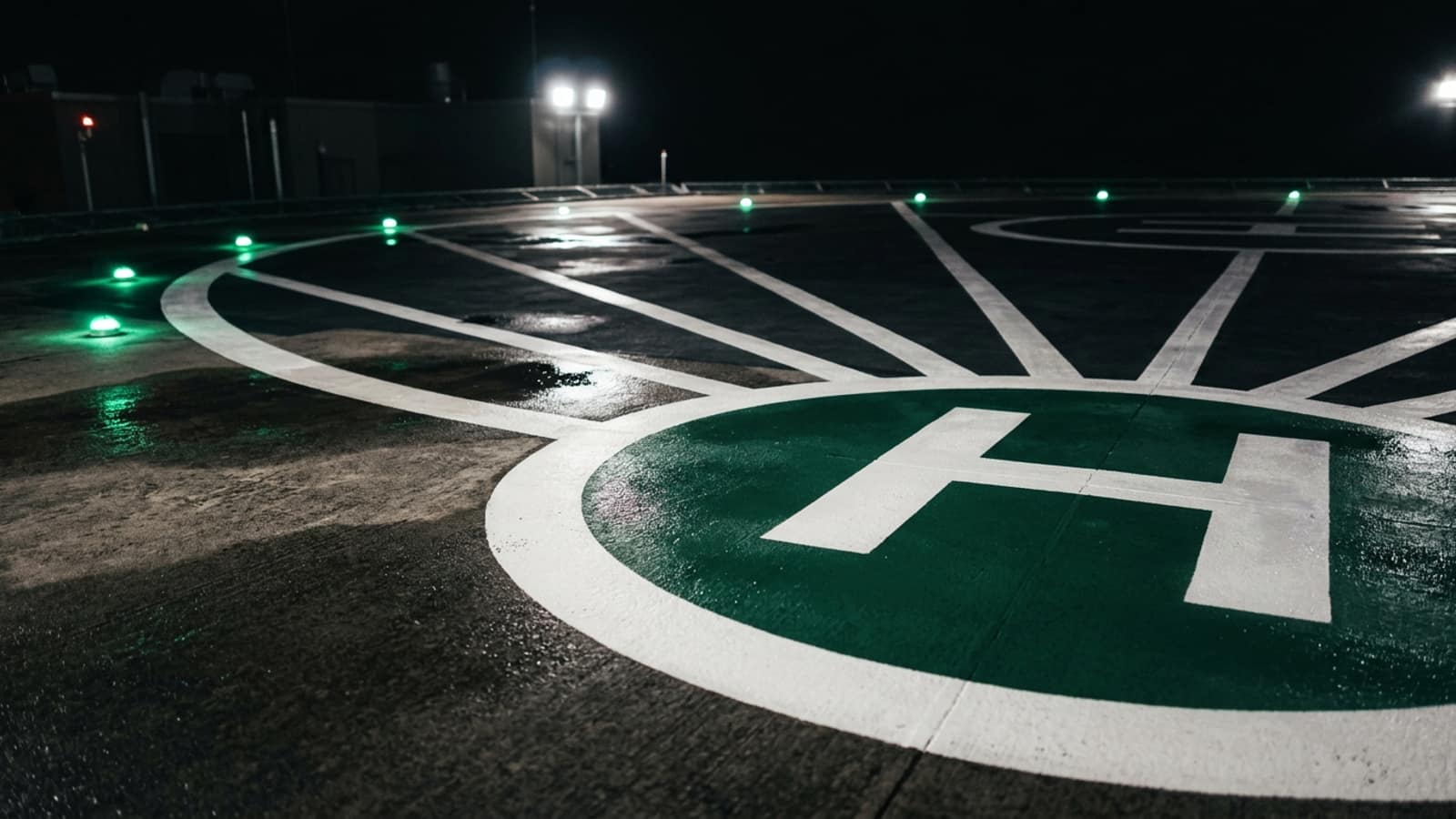
Heliport marking is far more than a floor painting job. On approach, the pilot has to recognise the area within seconds, see its boundaries and read its bearing capacity. All of this information is written on the surface, and its legibility is directly related to flight safety.
In this article we address the components of heliport marking, the colour and contrast requirements, the constraints specific to rooftop heliports, slip resistance and the maintenance regime. Let us state at the outset that what governs every stage of the work is the design approved by the competent authority.

There is no aesthetic choice in heliport marking. The size, colour and position of every symbol are defined; the work follows that definition, it does not interpret it.
Ahmet Toka, General Manager
A heliport surface is set out to give the pilot several separate pieces of information at once.
The dimensions and layout of these components are set out in the heliport design approved by the competent authority. For the scope of the work see heliport lines and paints page.
In heliport marking, colour is not a design preference but a functional requirement. White and yellow are the main marking colours, while red is generally used at hospital heliports and for certain warning markings.
What is decisive is not only the colour itself but the contrast with the surfaceOn a light grey concrete surface a white symbol does not give sufficient contrast; in that case legibility is provided by adding a dark outline around the symbol. In the same way, light-coloured markings read directly on a dark surface.
At heliports operating at night, surface marking alone is not sufficient; perimeter lighting and lit systems are part of the design. The surface paint complements that system, it does not replace it. In some applications the marking paint is given a retroreflective property; this must be assessed together with the lighting.
Heliport surfaces are in the open: rain, snow, dew and moisture carried by rotor downwash are permanently present. For this reason the slip resistance of the marking paint matters not only for the safety of people on foot but also for the behaviour of the surface the helicopter contacts with its skids or wheels.
In application, anti-slip aggregate is added to the paint. The quantity is a balance: too little aggregate leaves a slip risk, while too much makes the surface impossible to clean and accelerates the wear of the paint.
The paint system is chosen to suit the surface type. On reinforced concrete rooftop heliports, epoxy- or polyurethane-based systems are generally used; on asphalt surfaces, products that do not affect the bitumen are preferred. Outdoors, an aliphatic polyurethane topcoat is important for UV resistance; otherwise the white symbol yellows over time and the contrast is lost. For the product family see industrial painting and equipment page.
Heliports on the roof of a building carry different constraints from those at ground level, and these constraints directly affect the painting work.
Maintenance On the maintenance side, a heliport is a surface requiring regular inspection. Rotor downwash constantly scours the surface, UV ages the paint and de-icing chemicals stress the surface in winter. Annual visual inspection and renewal of worn symbols is the most economical way of maintaining the legibility of the marking. A faded bearing capacity figure is a direct flight safety deficiency.
Create safe and orderly landing and take-off areas with heliport markings and paint. Achieve long-lasting results with the solutions of Likit İzolasyon, prepared in accordance with international standards!
Service details →We make your structures durable and attractive with industrial paint and road marking. Achieve long-lasting results with Likit İzolasyon's professional solutions!
Service details →With traffic signs and markings we bring order and safety to your areas. Create safe spaces with the professional traffic marking solutions of Likit İzolasyon!
Service details →Give your structures complete protection against the harmful effects of water and damp with Likit İzolasyon! With our foundation, roof, wet area and façade waterproofing services we make your buildings durable and long-lasting. Get in touch now for professional service!
Service details →The size, colour and position of the symbols are defined in the heliport design approved by the competent civil aviation authority. The work is carried out in accordance with that design; dimensions and colours are not changed by a site decision. Any change must go through the approval process.
Systems compatible with the surface type and with high exterior durability are used. On reinforced concrete surfaces, epoxy- or polyurethane-based systems are generally preferred; an aliphatic polyurethane topcoat is applied to prevent UV yellowing. On asphalt surfaces, products that do not affect the bitumen are chosen.
A visual inspection should be carried out at least once a year, and symbols showing colour fading, loss of contrast or wear should be renewed. On critical markings such as the bearing capacity figure and the H symbol, legibility must not deteriorate under any circumstances.
It can. That is why surface preparation must be carried out by methods that will not injure the waterproofing layer. The best approach is to plan the painting and waterproofing works together; if the waterproofing has reached the end of its life, it should be renewed first.
It depends on the total of surface preparation, application and curing time; it generally takes a few days. Where interruption is critical, as at hospital heliports, the work is divided into phases and fast-curing systems are preferred.
It is provided by adding anti-slip aggregate to the paint. The quantity must be balanced: too little aggregate leaves a risk on a wet surface, while too much makes cleaning difficult and accelerates the wear of the paint. After application, the surface should be assessed in wet conditions.
With over 25 years of field experience, let us determine the right solution for your building together. Contact us for a survey and quotation.
Over 25 years of field experience in waterproofing, floor coatings and structural strengthening. This article is based on applications encountered on site and the standards currently in force.