The real criterion for a road line is not the colour visible by day but the light returned when it is lit by headlights at night. Without glass beads, even the whitest line is invisible at night.

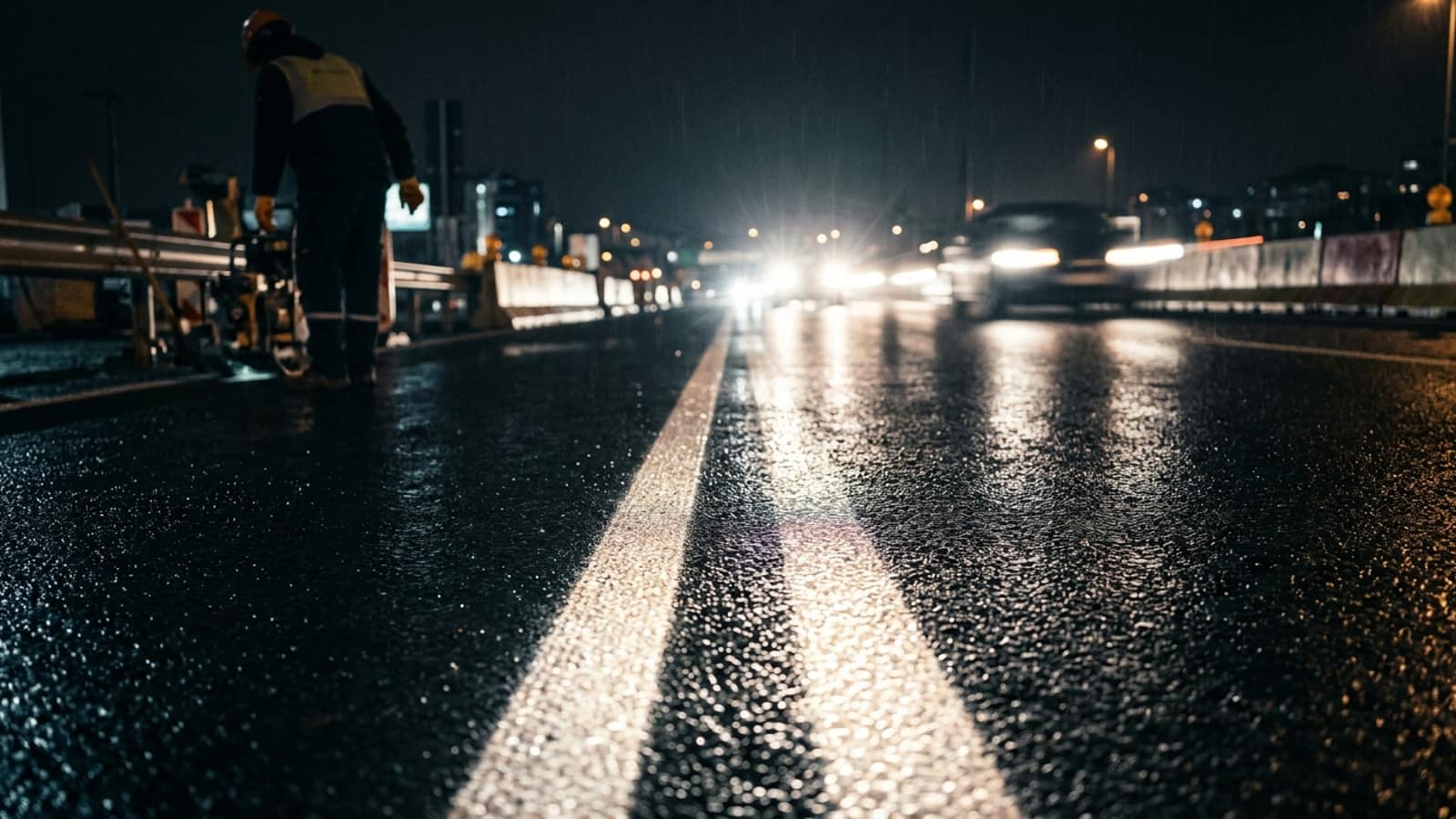
A road line is the most used yet least noticed safety element in traffic. Its job looks simple: to tell the driver where the road is. But it has to do that at night, in the rain, under headlights and despite thousands of vehicles passing over it.
Thermoplastic paint is a system developed for exactly these conditions. In this article we explain how it works, how it differs from cold-applied paints, how night-time visibility is achieved and when it should be preferred.

The real criterion for a road line is not the colour visible by day but the light returned when it is lit by headlights at night. Without glass beads, even the whitest line is invisible at night.
Ahmet Toka, General Manager
Thermoplastic road material is a product that is solid at room temperature, becomes fluid when heated and solidifies again as it cools. It contains binder resin, fillers, pigment and glass beads for retroreflection.
In application, the material is heated in special kettles to around 180–200 °C and laid on the road by machine. Cooling takes place within a few minutes and the line can be opened to traffic quickly. The thickness is far greater than with cold paints, and that thickness is the direct source of its durability.
For details see our thermoplastic paint page.
| Criterion | Thermoplastic | Cold (acrylic) paint |
|---|---|---|
| Applied thickness | High | Low |
| Expected service life | Long | Short |
| Opening to traffic | Minutes | Minutes to hours |
| Retroreflection | High and lasting | Medium |
| Equipment | A heated kettle is required | Simple |
| Unit cost | High | Low |
| Annual cost | Low | High (frequent renewal) |
| Profiled application | Possible | Not possible |
The critical row in the table is the third from the bottom. The cost per metre of thermoplastic is high; but because the renewal frequency is far lower, the annual cost turns in its favour on heavily trafficked roads. On low-traffic roads, cold paint can remain the economical choice.
The night-time visibility of a road line is a matter not of the colour of the paint but of its retroreflection property. This is provided by glass beads embedded in the surface of the line.
Light from the headlamp enters the glass bead, reflects off the back of the bead and returns in the direction it came from — that is, to the driver's eye. The driver therefore receives their own headlight back from the line, and the line appears bright.
Glass beads are used in two ways: some are mixed into the material (as the surface wears, new beads are exposed, so retroreflection lasts for the life of the line) and some are broadcast onto the hot surface during application (providing high retroreflection from the very first moment). Using both together is standard practice.
The embedment depth of the beads is critical: a bead embedded too deeply cannot catch the light, while a bead left too proud is easily knocked off by traffic. Correct application aims for about half of the bead to be embedded.
For traffic marking as a whole see traffic signs and markings page.
Thermoplastic application is sensitive to equipment and conditions. The following points directly determine the result:
A short waiting period is recommended for application over new asphalt; work carried out before the volatile components at the asphalt surface have fully dispersed can suffer adhesion problems.
When the decision between thermoplastic and cold paint is made by comparing the price per metre, cold paint wins almost every time. But that comparison is incomplete, because the renewal frequency of the two systems is very different.
The correct comparison is made on annual cost : the application cost is divided by the expected service life. Two more items should be added to that calculation. The first is the cost of traffic management: every renewal brings the cost of road closure, signing and traffic diversion; on a busy artery this item can be more expensive than the paint itself. The second is the period of lost visibility: the time that passes while a line has faded but has not yet been renewed is a real safety cost, even if it cannot be measured.
The practical approach is this: divide the road network into zones by traffic intensity. Use thermoplastic in areas that are both busy and critical, such as main arteries, pedestrian crossings and stop lines; use cold paint on low-traffic side roads and for temporary arrangements. Applying a single system to the entire network produces either unnecessary cost or early renewal.
Three questions to ask when deciding: how many vehicles pass along this route per day? What does it cost to close the road during renewal? How long does it take us to notice a faded line and act on it?
Create durable, long-lasting road markings with thermoplastic material. Create safe areas with the professional thermoplastic solutions of Likit İzolasyon!
Service details →With traffic signs and markings we bring order and safety to your areas. Create safe spaces with the professional traffic marking solutions of Likit İzolasyon!
Service details →With car park line marking we bring order and safety to your areas. Create functional spaces with the durable and attractive car park solutions of Likit İzolasyon!
Service details →We make your structures durable and attractive with industrial paint and road marking. Achieve long-lasting results with Likit İzolasyon's professional solutions!
Service details →It depends on traffic intensity, vehicle type and climate. On a busy artery it gives several times the life of cold paint. Wear concentrates most at pedestrian crossings, stop lines and lane-change areas; these points are renewed first.
No. On low-traffic roads and for temporary markings, cold paint is economical and sufficient. Thermoplastic offers an advantage on busy routes where the frequency of renewal creates cost. The decision is made by comparing traffic intensity and the cost of renewal.
If the existing line is sound and fully bonded to the surface, it can be applied over it. However, if the old layer is loose, blistered or has built up into a thick mass, it must be removed; otherwise the new layer will lift with it. A build-up of thickness also creates a ridge and a ride comfort problem.
The most common causes are that the glass beads have come away through wear, that the beads were not sufficiently embedded during application, or that they were never broadcast at all. Visibility also falls in the rain; there are specially profiled applications designed for that condition.
The material solidifies as it cools; it can generally be opened to traffic within a few minutes. That speed is a significant advantage on main arteries where the duration of a road closure is costly. The cooling time varies with the ambient and surface temperature.
Yes, but a primer must be used. Concrete is less porous than asphalt and has a different surface chemistry; without a primer, adhesion is inadequate. The concrete surface must also be clean, dry and free of laitance.
With over 25 years of field experience, let us determine the right solution for your building together. Contact us for a survey and quotation.
Over 25 years of field experience in waterproofing, floor coatings and structural strengthening. This article is based on applications encountered on site and the standards currently in force.