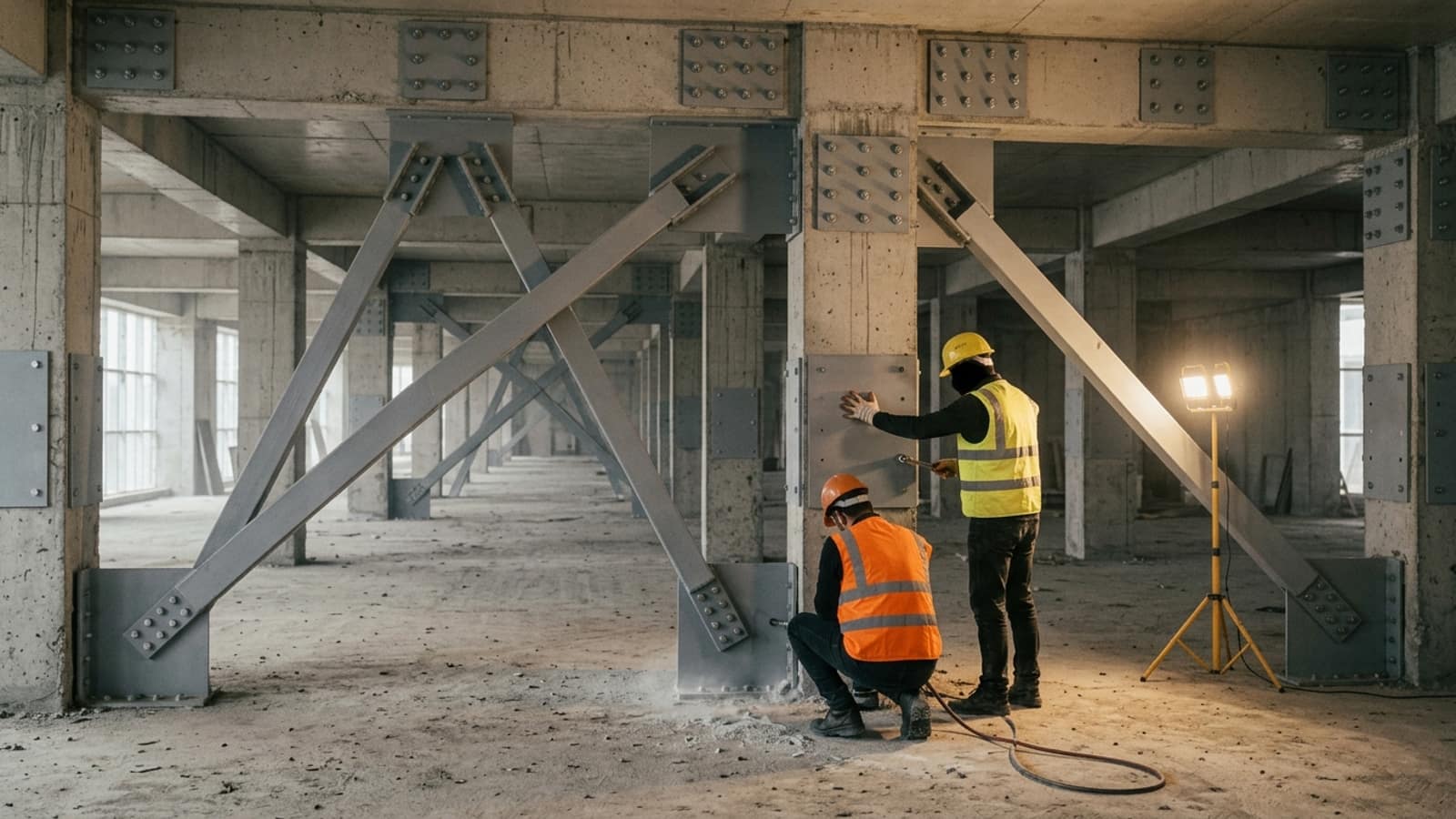
Steel strengthening is a modern method applied in order to increase the load-carrying capacity of structures, to ensure their safety and to reinforce their durability. By adding steel elements to the existing structure, it improves structural integrity and minimises the risk of potential damage. Steel strengthening is an ideal solution for structures that need to be made more resistant to natural disasters such as earthquakes.
The light, high-strength nature of steel elements makes the strengthening process both fast and effective. Preferred particularly in old or damaged buildings, this method makes the structure safely ready for use.
 Durability and Safety: Increases the load-carrying capacity of structures and ensures safety. Fast Application: The installation of steel elements is practical and can be completed in a short time. Earthquake Resistance: Steel elements increase the ductility of the structure and its resistance to earthquakes. Long-Lasting Solution: Extends the service life of structures with its high durability. Compatibility with the Existing Structure: Steel elements can be customised to suit the characteristics of the existing structure.
With its expert team and innovative solutions in the field of steel strengthening, Likit İzolasyon brings durability and safety to your structures. Contact us for professional solutions on your strengthening projects.
Increasing lateral resistance with steel bracing elements Confining columns and beams with steel plates and sections Reinforcement in industrial buildings following an increase in machine loads Reversible solutions with documented intervention in historic buildings Adding steel beams at floor openings Increasing capacity on bridges and industrial platformsThe element is confined with angles placed at the column corners and horizontal straps wrapped around them. The confining effect increases the compressive strength and ductility of the concrete. The increase in section size is far smaller than with reinforced concrete jacketing.
Steel bracing added to the structural frames carries lateral loads directly and increases stiffness and strength. Installation is fast, but closing off the bays affects architectural use.
Steel plates fixed to the underside of a beam with epoxy and anchors increase its flexural capacity. This can be more economical than carbon fibre, but it adds weight and requires corrosion protection.
1. Assessment and design: The existing system is measured, analysis is carried out, and the steel reinforcing elements are sized and designed. 2. Fabrication: The steel elements are cut, drilled and welded in the workshop. Workshop fabrication reduces site labour and time. 3. Surface preparation and anchoring: The concrete surface is made good, anchor holes are drilled and cleaned, and chemical anchors are installed. 4. Installation: The elements are lifted into place, anchored and, where necessary, welded on site. Gaps are filled with epoxy mortar. 5. Corrosion and fire protection: A protective paint system is applied after surface preparation; fire protection coating is provided where required. For the protection of steel surfaces against corrosion, reference is made to TS EN ISO 12944 corrosion categories and paint systems are taken as the basis. Steel loses strength in a fire; in structures requiring a fire scenario, protective coating or boxing-in must be planned. Anchor capacity depends directly on the cleanliness of the hole; a chemical anchor in a dusty hole will not reach its design value. Steel reinforcement is a reversible solution; being removable is a reason for choosing it in historic buildings.Installation is fast, and there is no wet trade work or long curing period. This shortens the time the structure is out of service. In addition, being removable is an advantage in historic buildings and in temporary solutions.
The steel elements remain visible in the space. They can be concealed by boxing-in, plasterboard cladding or painting, but these operations must be planned together with fire protection and access for maintenance. In some projects the steel is deliberately left exposed.
Yes, if suitable surface preparation and a paint system are not applied. Particularly in damp environments and outdoors, corrosion protection determines the life of the system. Periodic inspection and renewal of the paint must be planned.
Not always; there are also systems resolved with bolted and anchored connections. In buildings that remain in use, welding may be avoided because of fire risk and smoke. The type of connection is determined in the design.

Likit İzolasyon exceeded our expectations with their waterproofing and floor coating services. Thanks to their meticulous workmanship and on-time delivery, our building is now far safer and more durable.
During our building strengthening works we saw the difference of working with a professional team. With carbon fibre and concrete repair applications they gave our structure a new life. I would definitely recommend them!
We used their epoxy floor coating service and the result is incredible! We gained both an attractive appearance and a long-lasting, durable solution. I appreciate their professional approach.
We received terrace and foundation waterproofing services. With their polyurethane-based solutions in particular, they provided a permanent answer to water leaks. The team's professionalism and on-time delivery are truly commendable.
Concrete cracks and deterioration in our old building were causing serious problems. The Likit İzolasyon team made the structure safe again with concrete repair and protection. They kept us informed in detail at every stage of the process.
They did outstanding work on car park line marking and industrial painting projects. With thermoplastic paint they delivered a solution that is both attractive and long-lasting. The importance they place on occupational safety is a further plus!
We had epoxy and polyurethane floor coating applied in our factory. Our spaces gained both a durable and an attractive appearance. They are also very easy to clean. Thank you to the professional team!
We worked with Likit İzolasyon on building strengthening. Thanks to the carbon fibre application our structure became earthquake resistant. Their transparent and meticulous work from start to finish gave us confidence.
The concrete crack repair service completely solved the problems in our old building. Even the finest details were attended to during the work. We now have a structure we can use safely for many years.