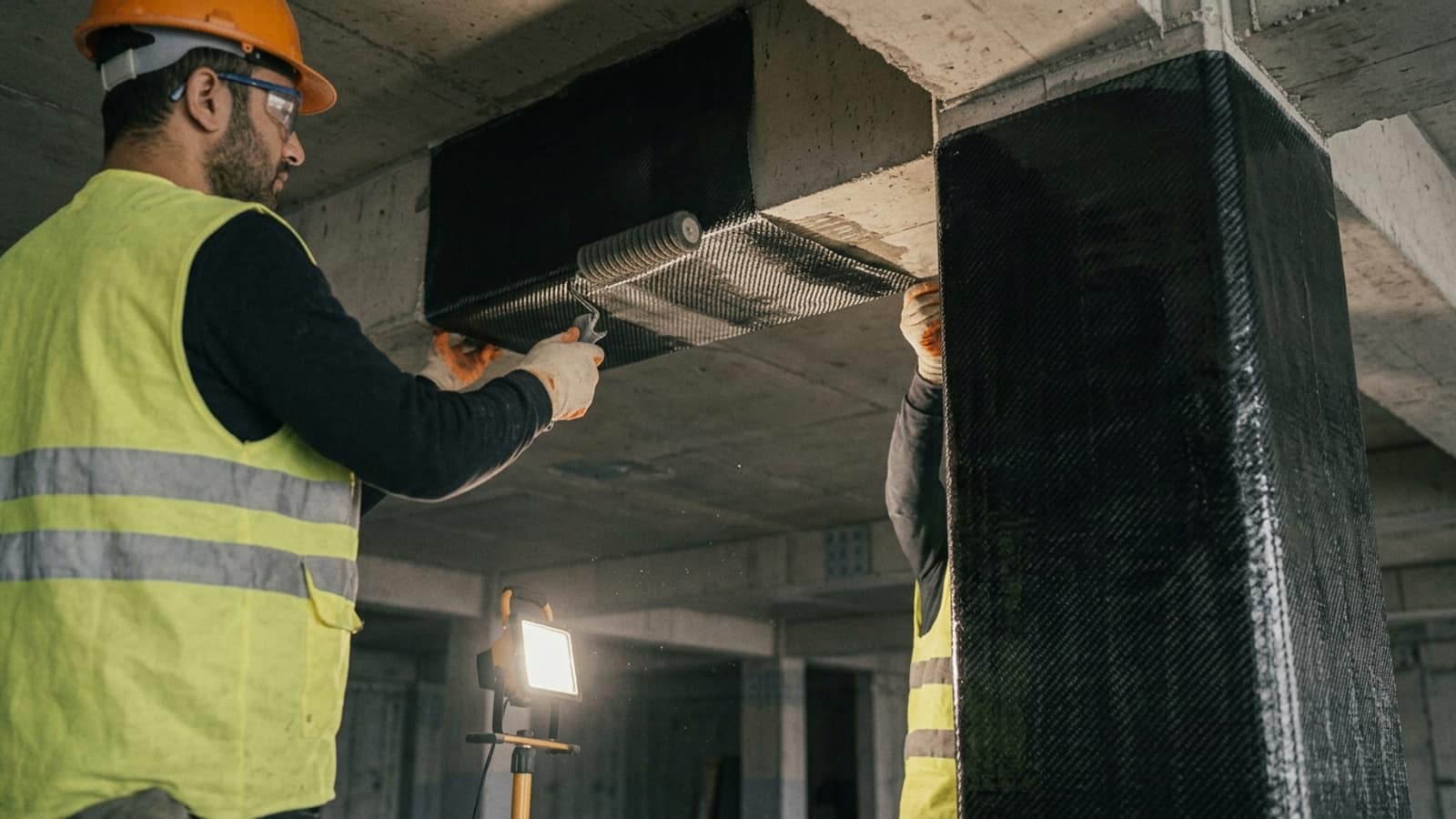
Carbon fibre reinforced polymer (CFRP) is a light but high-strength strengthening method used to increase the durability of structures. This method is chosen to increase the load-carrying capacity of structures, to make them more resistant to natural disasters such as earthquakes, and to preserve structural integrity.
Carbon fibre polymer strengthening is applied particularly in reinforced concrete structures and, thanks to the flexible nature of the material, delivers superior performance in both tension and compression. It offers maximum durability while adding a minimum of extra load to the structure, which makes it an ideal solution for sensitive structures.
 High Strength: Provides superior resistance to tension and compression. Light Construction: Adds a minimum of extra load to the structure and increases its load-carrying capacity. Easy Application: Offers a fast and effective process during installation. Corrosion Resistant: Carbon fibre polymer is unaffected by chemical action and corrosion. Flexible Use: Can be used in reinforced concrete, steel and timber structures. Long-Lasting Solution: Increases the durability of the structure over the long term.
With its expert teams in carbon fibre polymer strengthening, Likit İzolasyon offers your structures a light but effective solution. Make use of our professional services for safe and durable structures.
Increasing flexural and shear capacity in beams Improving ductility and axial capacity in columns by wrapping The need for reinforcement in slabs because of increased spans or new loads Increasing load capacity on bridges and viaducts Reinforcement in historic buildings carried out without disturbing the original fabric Wrapping cylindrical structures such as pipes, silos and tanksThis is a flexible fabric bonded to the surface with epoxy. It conforms to curved surfaces and complex geometry; it is used in column wrapping and shear reinforcement. The fibre direction is determined by the direction of the force to be carried.
These are rigid strips of constant thickness produced in the factory. They are bonded to flat surfaces with epoxy and are particularly efficient in increasing flexural capacity in beams and slabs. Quality control is easier than with fabric.
There is a risk of debonding at the end zones of carbon fibre. The end zones are secured with fibre anchors or mechanical anchor plates. If the anchorage detail is neglected, the system can be put out of action before reaching its design capacity.
1. Surface preparation: Plaster and loose concrete are removed from the surface, and an open, even surface is achieved by grinding. A minimum radius is formed at corners to prevent the fibres from breaking. 2. Repair and levelling: Voids and irregularities are made good with epoxy filler. The evenness of the surface directly affects the quality of the bond. 3. Priming: An epoxy primer is applied and allowed to penetrate the concrete, increasing the bond strength. 4. Fibre application: Epoxy resin is applied, the fabric or laminate is placed, and air bubbles are removed by pressing with a roller. The fibre direction is checked against the design. 5. Anchorage and protection: The end anchorages are installed. If necessary, the work is covered with a fire protection or UV protection coating. Carbon fibre adds almost no weight to the structure and does not change the section sizes; this is a decisive advantage in projects with architectural constraints. It does not significantly increase the stiffness of the structure; if there is a general lack of stiffness, it is not sufficient on its own. Structural bonding adhesives are assessed under TS EN 1504-4 . During application, surface moisture and temperature directly affect the curing of the epoxy; the conditions must be recorded. Carbon fibre loses performance at high temperatures; a protective layer must be planned where a fire scenario is required.Its tensile strength per unit weight is markedly higher than that of steel. However, it is not ductile; it behaves linearly until it ruptures and fails without warning. For this reason safety factors and anchorage details are of great importance in the design.
It is much faster than reinforced concrete methods. Strengthening a limited number of elements can be completed within a few days. Because there is no formwork, concrete or curing period to wait for, the time the structure is out of service is short.
After application it can be covered with plaster and paint; because it is only a few millimetres thick it is not noticeable in the space. This is an important advantage over methods that enlarge the section.
No. The existing concrete must have adequate strength; on very low-strength concrete the bonded surface cannot transfer sufficient force. In addition, if the structure has a general stiffness problem, carbon fibre alone is not a solution.

Likit İzolasyon exceeded our expectations with their waterproofing and floor coating services. Thanks to their meticulous workmanship and on-time delivery, our building is now far safer and more durable.
During our building strengthening works we saw the difference of working with a professional team. With carbon fibre and concrete repair applications they gave our structure a new life. I would definitely recommend them!
We used their epoxy floor coating service and the result is incredible! We gained both an attractive appearance and a long-lasting, durable solution. I appreciate their professional approach.
We received terrace and foundation waterproofing services. With their polyurethane-based solutions in particular, they provided a permanent answer to water leaks. The team's professionalism and on-time delivery are truly commendable.
Concrete cracks and deterioration in our old building were causing serious problems. The Likit İzolasyon team made the structure safe again with concrete repair and protection. They kept us informed in detail at every stage of the process.
They did outstanding work on car park line marking and industrial painting projects. With thermoplastic paint they delivered a solution that is both attractive and long-lasting. The importance they place on occupational safety is a further plus!
We had epoxy and polyurethane floor coating applied in our factory. Our spaces gained both a durable and an attractive appearance. They are also very easy to clean. Thank you to the professional team!
We worked with Likit İzolasyon on building strengthening. Thanks to the carbon fibre application our structure became earthquake resistant. Their transparent and meticulous work from start to finish gave us confidence.
The concrete crack repair service completely solved the problems in our old building. Even the finest details were attended to during the work. We now have a structure we can use safely for many years.