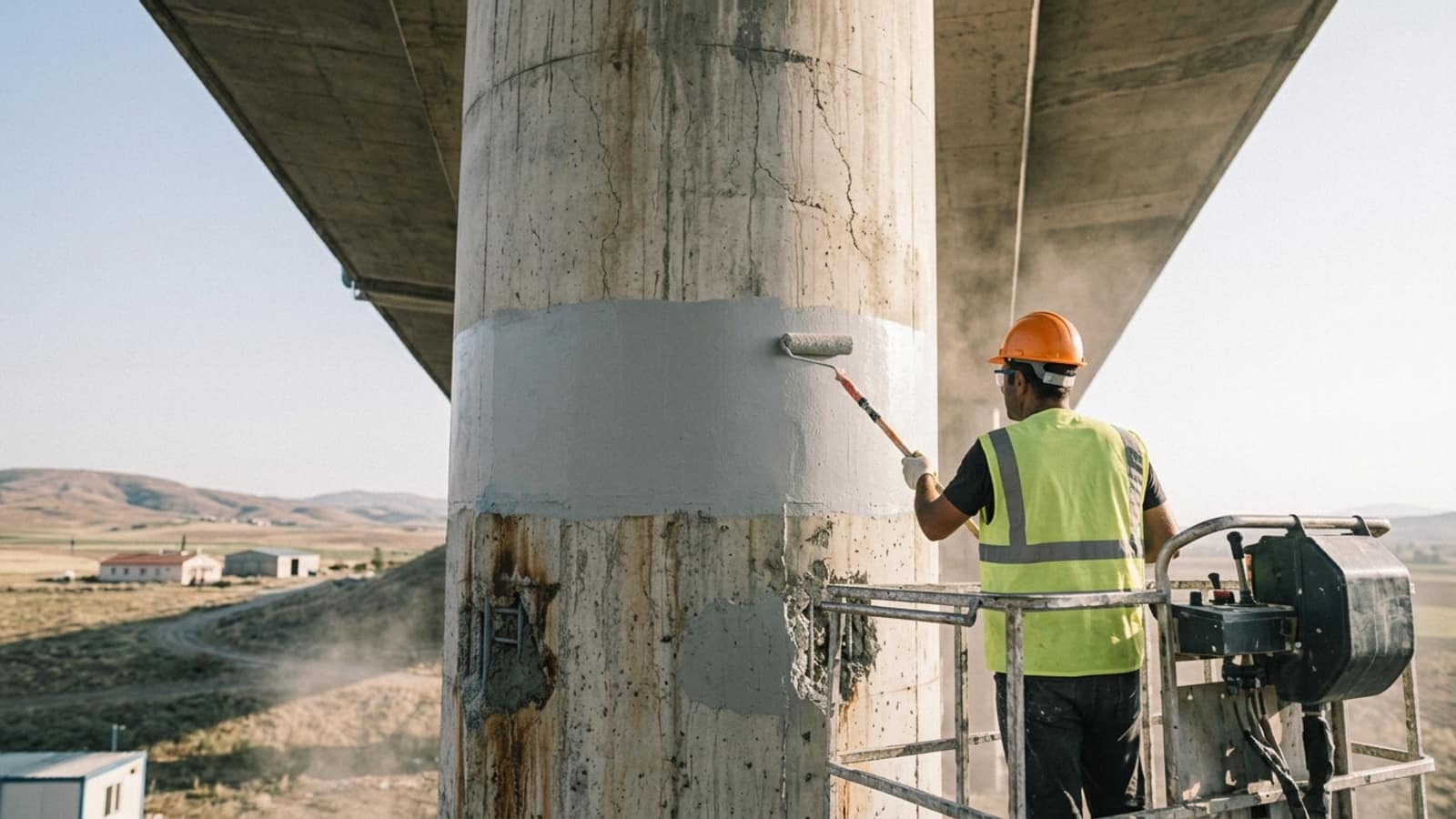
Concrete protection is a service applied to increase the durability of concrete surfaces and to provide protection against environmental and mechanical effects. The protection and maintenance of concrete floors is of vital importance for long-lasting, attractive buildings. We offer concrete protection solutions with quality, economical products accepted worldwide.
With clear and coloured product options, aesthetics and function are offered together on concrete and brick surfaces. Concrete protection makes surfaces resistant to wear, staining, water and chemicals. With solutions applied in both commercial and industrial areas, this service makes your buildings safer and longer-lasting.
 Long-Lasting Protection: Increases the durability of concrete surfaces and extends their life. A Wide Range of Products: Offers attractive solutions with clear and coloured products. Chemical and Water Resistance: Protects surfaces against chemicals, water and staining. Wear Prevention: Minimises wear on floors caused by mechanical action. Environmentally Friendly Solutions: Provides dependable protection with economical and sustainable products. Surface Analysis: The current condition of the concrete and brick surfaces is assessed. Product Selection: Clear or coloured protection products suited to the surface are determined. Application: The protection treatment is applied to the surfaces by professional teams. Inspection and Maintenance: The condition of the surfaces is checked after application and the recommended maintenance procedures are provided.
With its expert team and products accepted worldwide in the field of concrete protection and maintenance, Likit İzolasyon brings durability and good looks to your structures. Make use of our professional solutions to give your concrete surfaces a long life.
Car park decks and ramps — against the effects of salt and water Bridges, viaducts and retaining walls — carbonation protection Marine structures and jetties — chloride barrier Water tanks, treatment plants and channel structures Concrete surfaces with chemical exposure in industrial facilities Attractive and protective coatings on façades and exposed concrete surfacesThis penetrates the capillary voids of the concrete and makes the surface water-repellent. It does not change the appearance, does not prevent the concrete from breathing, and reduces the ingress of chlorides carried with water. It is the fundamental protective layer on structures exposed to salt, such as bridges and car parks.
Acrylic, epoxy or polyurethane-based coatings form a film on the surface and prevent the ingress of carbon dioxide and chlorides. Systems with high carbonation resistance that retain water vapour permeability are preferred; otherwise moisture is trapped within the concrete.
On surfaces that move because of temperature change, flexible protective coatings bridge fine cracks and maintain continuity of protection. Upper car park decks and bridge decks are typical application areas.
1. Condition survey: The depth of carbonation, the chloride content and the existing damage are assessed. The protection strategy is determined on the basis of these findings. 2. Repair: Protection is not applied before existing damage has been made good; deteriorated concrete is repaired and cracks are sealed. 3. Surface preparation: The surface is cleaned with pressurised water, grinding or blasting; loose layers and remnants of old coatings are removed. 4. System application: The impregnation or coating is applied observing the recommended consumption rate and number of coats. Checking consumption directly determines performance. 5. Inspection: Effectiveness can be verified by dry film thickness in coating systems and by a water absorption test in the case of impregnation. Concrete surface protection systems are defined within the scope of TS EN 1504-2 and are divided into performance classes. When selecting a protective coating, products with high resistance to carbon dioxide and adequate water vapour permeability should be preferred. A coating that does not allow vapour through can trap moisture within the concrete and lead to blistering and freeze damage. The effectiveness of hydrophobic impregnations decreases over time; periodic renewal must be planned. Protection must be applied after repair; protection applied over damaged concrete only delays the problem.Although concrete is durable in itself, the carbon dioxide in the air lowers its alkalinity over time (carbonation) and the passive layer protecting the reinforcement breaks down. Salt and water, meanwhile, accelerate corrosion. Protection systems slow these processes and extend the service life.
Hydrophobic impregnation is suitable on exposed concrete surfaces where the appearance is to be preserved and where the effect of salt is the main concern. If carbonation resistance and an expectation of colour or appearance are involved, a coating is preferred. The two can also be used together.
This depends on the exposure conditions. The effect of impregnations decreases over time and renewal is required. Coatings, meanwhile, deteriorate with UV and mechanical wear. Regular inspection and timely renewal prevent major repair costs.
In aggressive environments, yes — indeed this is the best time. Protection applied before damage occurs slows carbonation and chloride ingress from the outset. It is far more economical than intervening later.

Likit İzolasyon exceeded our expectations with their waterproofing and floor coating services. Thanks to their meticulous workmanship and on-time delivery, our building is now far safer and more durable.
During our building strengthening works we saw the difference of working with a professional team. With carbon fibre and concrete repair applications they gave our structure a new life. I would definitely recommend them!
We used their epoxy floor coating service and the result is incredible! We gained both an attractive appearance and a long-lasting, durable solution. I appreciate their professional approach.
We received terrace and foundation waterproofing services. With their polyurethane-based solutions in particular, they provided a permanent answer to water leaks. The team's professionalism and on-time delivery are truly commendable.
Concrete cracks and deterioration in our old building were causing serious problems. The Likit İzolasyon team made the structure safe again with concrete repair and protection. They kept us informed in detail at every stage of the process.
They did outstanding work on car park line marking and industrial painting projects. With thermoplastic paint they delivered a solution that is both attractive and long-lasting. The importance they place on occupational safety is a further plus!
We had epoxy and polyurethane floor coating applied in our factory. Our spaces gained both a durable and an attractive appearance. They are also very easy to clean. Thank you to the professional team!
We worked with Likit İzolasyon on building strengthening. Thanks to the carbon fibre application our structure became earthquake resistant. Their transparent and meticulous work from start to finish gave us confidence.
The concrete crack repair service completely solved the problems in our old building. Even the finest details were attended to during the work. We now have a structure we can use safely for many years.